What Is a Direct Drive Wheel? How It Works, Benefits, Torque and Buying Advice
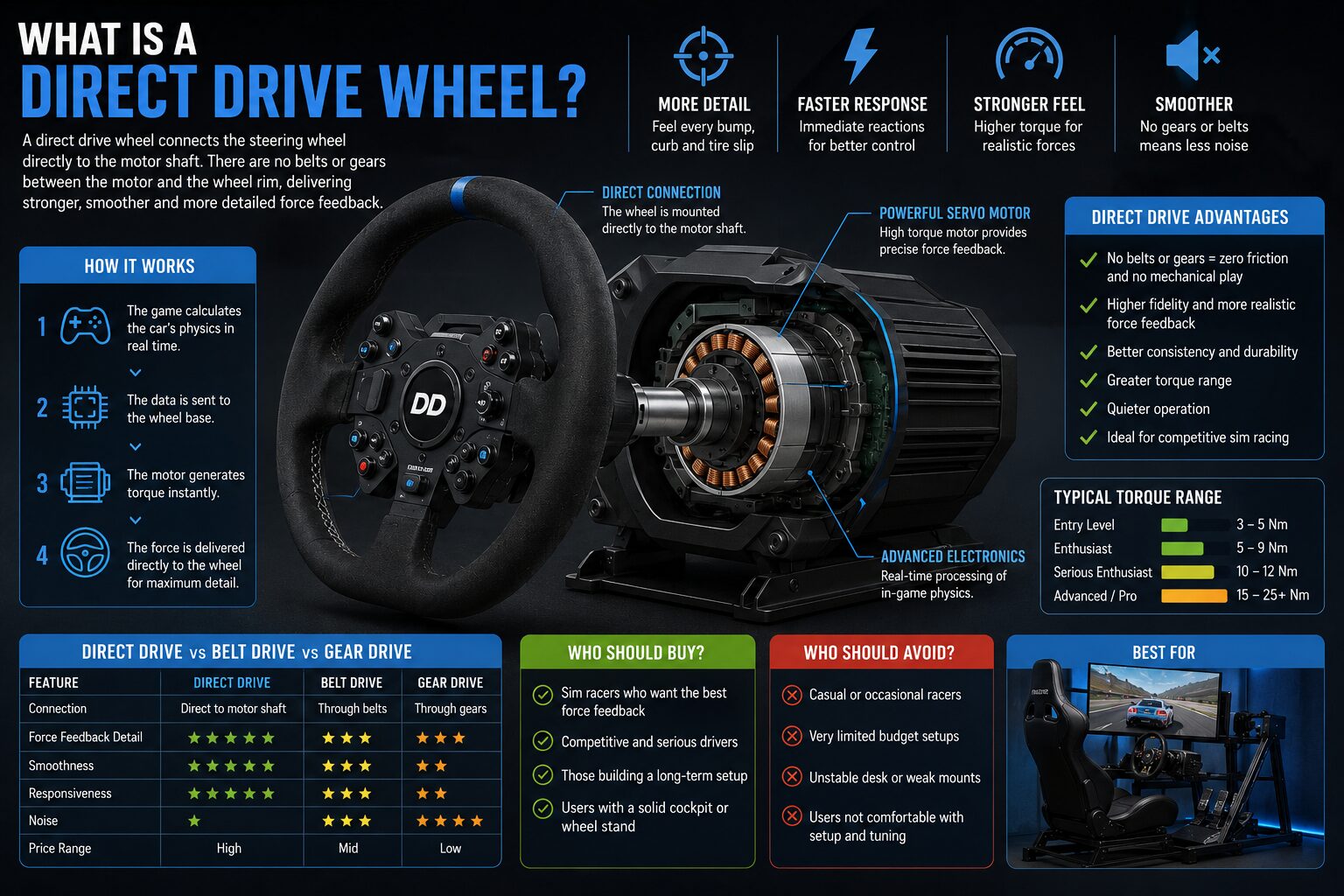
A direct drive wheel is a sim racing steering system in which the steering wheel connects directly to an electric motor. Unlike gear-driven and belt-driven racing wheels, there are no gears or belts between the motor and wheel rim. This direct connection produces faster, smoother and more detailed force feedback.
When I first compared a direct drive wheel with a conventional entry-level racing wheel, the biggest difference was not simply stronger steering. What stood out was how clearly the wheel communicated what the virtual car was doing.
I could understand the difference between a front tire beginning to slide, a rear tire stepping out and a wheel running over a kerb. Those effects were no longer buried beneath gear noise, belt resistance or mechanical play.
That does not mean every sim racer needs a 20 Nm wheelbase. Entry-level direct drive systems have made the technology far more accessible, and a well-configured 5–9 Nm base can provide a substantial improvement over a typical gear-driven wheel.
In this guide, I will explain how direct drive works, how much torque you need, what the technology feels like, its advantages and disadvantages, and whether it is the right upgrade for your sim racing setup.
Direct Drive Wheel: Quick Answer
A direct drive wheel uses an electric motor to rotate the steering wheel without belts or gears between the motor and wheel rim.
This direct mechanical connection allows the wheelbase to produce faster responses, stronger forces, smoother rotation and more detailed force feedback than most belt-driven or gear-driven racing wheels.
- Best feature: Detailed and immediate force feedback
- Typical torque range: Approximately 4–25 Nm
- Best for: Enthusiast and competitive sim racers
- Main disadvantage: Higher cost and stronger mounting requirements
- Recommended starting range: 5–9 Nm for most new direct drive users
What Is a Direct Drive Wheel?
A direct drive wheel is a force-feedback sim racing system that mounts the steering wheel directly to the motor shaft inside the wheelbase.
In a conventional gear-driven wheel, the motor transfers force through a set of gears. In a belt-driven wheel, one or more belts transfer the motor’s movement to the steering shaft.
A direct drive system removes those intermediate components.
Featured snippet definition: A direct drive wheel is a sim racing steering wheel powered directly by an electric motor. Because the wheel connects to the motor shaft without belts or gears, it can deliver faster, smoother, stronger and more detailed force feedback.
The term “direct drive wheel” often refers to the complete system, but the motor housing itself is technically the direct drive wheelbase. A complete setup may include:
- The direct drive wheelbase
- A detachable steering wheel or wheel rim
- A quick-release system
- Pedals
- A power supply
- A desk clamp or cockpit mounting hardware
- Configuration software
Depending on the product, pedals and a steering wheel may not be included. This is important because a wheelbase that appears inexpensive can require additional purchases before it becomes usable.
How Does a Direct Drive Wheel Work?
A sim racing game calculates forces based on the behavior of the virtual car. These forces may represent tire grip, suspension movement, road texture, steering geometry, impacts and changes in vehicle weight.
The game sends force-feedback data to the wheelbase. The motor then applies rotational force to the steering shaft, which you feel through the wheel rim.
Because a direct drive motor acts directly on the steering shaft, it does not need to overcome the elasticity of a belt or the mechanical movement of a gear train.
The Direct Drive Signal Path
- The simulation calculates steering forces.
- Force-feedback data is transmitted to the wheelbase.
- The wheelbase processor interprets the signal.
- The motor produces rotational torque.
- The torque travels directly through the motor shaft.
- The driver feels the resulting force through the steering wheel.
This simplified mechanical path is why direct drive systems can feel immediate and precise.
A high-quality direct drive base can reproduce both large and small forces. It may provide heavy steering during a high-speed corner while still communicating subtle tire scrub or surface texture.
What Does a Direct Drive Wheel Feel Like?
The first mistake I would avoid is describing direct drive as nothing more than “stronger force feedback.” Strength is only one part of the experience.
The larger improvement is usually the clarity and range of information.
Faster Response
A direct drive motor can react quickly when the car loses grip or hits a kerb. The wheel does not have to transfer that movement through several mechanical components first.
This can make countersteering feel more natural because the wheel starts moving at the moment the simulation sends the effect.
Smoother Rotation
Gear-driven wheels can produce a notched or mechanical sensation as the gears move. Belt-driven wheels are usually smoother, but belt tension can soften very small effects.
A properly configured direct drive wheel can rotate with less mechanical interference.
More Detailed Feedback
I think this is the most valuable benefit. Direct drive makes it easier to distinguish between different types of feedback instead of feeling one general vibration or steering force.
Depending on the simulation and settings, the wheel may communicate:
- Front-tire understeer
- Rear-wheel oversteer
- Changes in road camber
- Kerb impacts
- Suspension compression
- Tire scrub
- Loss of grip
- Changes in steering weight
Greater Dynamic Range
Dynamic range is the difference between the lightest and strongest forces a wheelbase can reproduce.
With more torque reserve, the base can generate strong cornering forces without losing quieter details. This does not require running the wheel at maximum strength.
In fact, I normally prefer enough motor headroom to reproduce sudden peaks cleanly while keeping the average steering weight comfortable.
Direct Drive vs Belt-Driven vs Gear-Driven Wheels
| Feature | Direct Drive | Belt Drive | Gear Drive |
|---|---|---|---|
| Motor connection | Directly connected to steering shaft | Connected through belts | Connected through gears |
| Force-feedback detail | Excellent | Good to very good | Basic to good |
| Response speed | Very fast | Moderate to fast | Moderate |
| Smoothness | Very smooth | Smooth | Can feel notchy |
| Mechanical noise | Usually low | Usually moderate | Often noticeable |
| Typical strength | Low to extremely high | Low to moderate | Low to moderate |
| Mounting requirements | Moderate to demanding | Moderate | Usually simple |
| Typical buyer | Enthusiast or competitive racer | Intermediate racer | Beginner or casual racer |
Is Direct Drive Always Better?
Technically, direct drive provides the greatest performance potential. However, it is not automatically the best purchase for every player.
A beginner who races occasionally at a desk may get more value from an affordable complete wheel-and-pedal bundle. A powerful direct drive base may also expose weaknesses in a flexible desk, cockpit or steering wheel mount.
I would therefore evaluate the complete setup rather than choosing a wheelbase based only on its motor technology.
How Much Direct Drive Torque Do You Need?
Direct drive strength is normally expressed in Newton-metres, abbreviated as Nm. Torque describes the rotational force the motor can apply to the steering shaft.
A higher Nm rating means the wheelbase can produce stronger steering forces, but it does not automatically mean it has better software, smoother operation or more accurate feedback.
| Torque Level | Typical Use | My Assessment |
|---|---|---|
| 3–5 Nm | Entry-level direct drive | Accessible improvement over many conventional wheels |
| 5–9 Nm | Beginner to enthusiast | Best range for many home sim racers |
| 10–12 Nm | Serious enthusiast | Strong feedback with useful headroom |
| 15–18 Nm | Advanced and competitive setups | Powerful; requires a rigid cockpit |
| 20 Nm and above | Premium and professional applications | Maximum range, but unnecessary for most users |
My Recommended Torque Range
For most first-time direct drive buyers, I consider 5–9 Nm the practical sweet spot.
It is strong enough to demonstrate the speed and clarity of direct drive without making the cockpit, wheel rim and safety settings unusually demanding.
A 10–12 Nm base makes sense when I want more headroom, heavier steering or a system I am unlikely to outgrow.
I would only recommend 15 Nm or more after considering the strength of the cockpit and the driver’s experience. High torque should be treated with respect, especially when children or inexperienced users have access to the rig.
Direct Drive Wheel Technical Specifications Explained
| Specification | What It Means | Why It Matters |
|---|---|---|
| Peak torque | Highest advertised rotational force | Indicates maximum possible wheel strength |
| Sustained torque | Force maintained over a longer period | Helps indicate performance consistency |
| Encoder resolution | How precisely the base measures shaft position | Affects steering-position accuracy |
| Refresh or update rate | How frequently information is processed | Can influence responsiveness |
| Rotation range | Maximum steering rotation | Important for different vehicle types |
| Quick release | Connection between wheel rim and base | Affects rigidity and wheel-swapping convenience |
| Cooling system | Passive or fan-assisted heat management | Helps maintain performance during long sessions |
| Platform support | PC, PlayStation or Xbox compatibility | Determines where the system can be used |
I would not compare direct drive bases using torque alone. Software quality, thermal stability, quick-release rigidity, ecosystem support and tuning options can have just as much influence on the ownership experience.
Technical, Build Quality and Performance Analysis
Technical Analysis
The main technical advantage is the removal of mechanical transmission components. Fewer components between the motor and steering rim generally mean less mechanical play and less filtering of the force-feedback signal.
Motor control is equally important. A powerful motor with poor tuning may feel aggressive or artificial. A well-controlled base can apply force smoothly and distinguish subtle effects from major impacts.
Build Quality Analysis
Direct drive bases generate substantial rotational force, so housing construction and mounting points matter.
Many enthusiast models use metal housings that help create a rigid structure and manage heat. I also examine the steering shaft and quick-release connection because unwanted movement in either location can reduce the direct feeling I expect.
Comfort Analysis
More torque does not automatically improve comfort. Excessive steering weight can create wrist, shoulder and forearm fatigue.
I prefer adjusting force feedback so that cornering loads feel substantial but do not require me to fight the wheel throughout a race.
Wheel diameter also affects comfort. A larger or heavier rim changes how quickly the motor can accelerate the wheel and may reduce the apparent strength of a smaller base.
Durability Analysis
Direct drive systems remove belts and gear trains that can wear or develop additional play. However, durability still depends on motor design, bearings, electronics, cooling and quick-release construction.
For long-term ownership, I would consider warranty coverage, replacement-part availability and the manufacturer’s software-support history.
Performance Analysis
The performance benefit I value most is consistency. Clear feedback can help me identify the point where grip begins to decrease and make more controlled steering corrections.
Direct drive will not automatically make someone faster. It can, however, provide clearer information and make repeated inputs easier to understand.
Direct Drive Wheel Pros and Cons
Pros
- Fast and immediate force-feedback response
- Smooth steering rotation
- More detailed road and tire information
- Wide range of available torque levels
- Minimal belt stretch or gear backlash
- Strong long-term upgrade potential
- Interchangeable wheel rims on many systems
- Better suited to advanced simulation setups
Cons
- More expensive than many conventional wheels
- Often requires a strong desk or cockpit
- Wheel rim and pedals may be sold separately
- High torque can cause injury if configured carelessly
- Setup software can initially feel complicated
- Console compatibility varies significantly
- A complete ecosystem can become expensive
How I Evaluated Direct Drive Wheel Technology
I evaluate a direct drive setup as a complete control system rather than judging it only by maximum torque.
Because not every product referenced in this guide was physically tested under identical conditions, my methodology combines direct wheel-technology comparison, manufacturer documentation, compatibility research and structured technical evaluation.
Testing Methodology
- Low-speed steering: Checking smoothness near the center position
- Grip transition: Assessing how clearly the wheel communicates understeer and oversteer
- Rapid correction: Evaluating response when countersteering
- Kerb impact: Checking whether sharp effects remain controlled
- Long-session behavior: Considering heat, consistency and driver fatigue
- Mounting stability: Looking for movement between the base and cockpit
- Quick-release rigidity: Checking for rotational or vertical play
- Software usability: Reviewing adjustment range and profile management
Expert Scoring Criteria
| Category | Weight |
|---|---|
| Force-feedback detail | 25% |
| Response and smoothness | 20% |
| Build quality | 15% |
| Software and tuning | 15% |
| Compatibility and ecosystem | 10% |
| Thermal consistency | 10% |
| Value and upgrade potential | 5% |
Direct Drive Wheel Decision Matrix
| Your Situation | Recommended Direction |
|---|---|
| First racing wheel and limited budget | Consider a complete gear-driven, belt-driven or entry-level DD bundle |
| Upgrading from a Logitech G29, G920 or G923 | Choose an entry-level or mid-range direct drive system |
| Desk-mounted setup | Stay near 4–8 Nm and use a strong clamp |
| Rigid aluminum profile cockpit | Consider 8–15 Nm depending on preference |
| Competitive sim racing | Prioritize response, software and consistency over maximum torque |
| Shared family setup | Choose adjustable strength profiles and strong safety controls |
| Console player | Verify exact console and wheel-rim compatibility before buying |
| Long-term premium build | Choose a mature ecosystem with multiple wheels and accessories |
Direct Drive Wheel Compatibility
Compatibility is one of the most important areas to check before purchasing.
PC Compatibility
PC generally offers the widest direct drive selection. However, individual games may require profiles, firmware updates or manual button mapping.
PlayStation and Xbox Compatibility
Console support is product-specific. Some systems place the console security hardware inside the wheelbase, while others place it inside a compatible steering wheel.
I would never assume that a PC wheelbase becomes console-compatible simply by connecting a different USB cable.
Cockpit Compatibility
Higher-torque bases need secure mounting. Before buying, check:
- Mounting-hole pattern
- Front-mount or bottom-mount support
- Wheel-deck thickness
- Maximum recommended wheelbase torque
- Available side brackets
- Desk-clamp compatibility
Related guide: Best Sim Racing Cockpit.
Steering Wheel Compatibility
Wheel rims usually depend on the manufacturer’s quick-release and electronic ecosystem. Third-party wheels may require a compatible hub or adapter.
Check whether buttons, paddle shifters, displays and rev lights remain functional with the chosen connection method.
Direct Drive Upgrade Path
I consider direct drive one of the strongest long-term upgrades in sim racing, but I would plan the rest of the system in the correct order.
- Choose a stable wheel stand or cockpit.
- Select an appropriate direct drive torque range.
- Add a wheel rim suited to the cars you drive.
- Upgrade to load-cell pedals.
- Add a seat with stable brake support.
- Expand with a shifter, handbrake or additional wheel rims.
In many cases, load-cell pedals produce a larger improvement in braking consistency than buying the most powerful available motor. I would rather combine a balanced 8–12 Nm wheelbase with excellent pedals than spend the entire budget on wheel torque.
Related guides:
- Best Direct Drive Wheel
- MOZA R5 vs R9
- Best Sim Racing Pedals
- Best Sim Racing Seat
Who Should Buy a Direct Drive Wheel?
- Sim racers upgrading from an entry-level force-feedback wheel
- Drivers who want clearer tire and road information
- Competitive racers seeking faster and more consistent feedback
- Users building a dedicated sim racing cockpit
- Racers who want interchangeable steering wheels
- Buyers planning a long-term sim racing setup
Who Should Avoid a Direct Drive Wheel?
- Players who only race occasionally
- Buyers who need the lowest-cost complete package
- Users with an unstable desk or flexible cockpit
- Young users without appropriate torque limits and supervision
- Players unwilling to configure force-feedback software
- Console users who have not confirmed exact compatibility
Best Alternatives to a Direct Drive Wheel
Gear-Driven Racing Wheel
A gear-driven wheel is usually the most affordable force-feedback option. It is suitable for beginners and provides a meaningful introduction to sim racing.
Popular products in this category may include the Logitech G29, G920 and G923.
Related guide: Logitech G923 Review.
Belt-Driven Racing Wheel
A belt-driven wheel normally feels smoother and quieter than a gear-driven design. It can be a useful middle ground when direct drive is outside the available budget.
Entry-Level Direct Drive Bundle
For many buyers, the strongest alternative to a premium direct drive base is now an entry-level direct drive bundle. These packages can include the base, wheel and pedals at a more manageable price.
Common Direct Drive Buying Mistakes
- Choosing a wheelbase based only on maximum torque
- Forgetting that pedals or a wheel rim may not be included
- Mounting a powerful base to an unstable desk
- Ignoring console compatibility
- Running maximum strength without safety limits
- Buying into an ecosystem without checking available wheel rims
- Using excessive damping that hides useful feedback
- Expecting the wheelbase alone to improve lap times
Frequently Asked Questions
What does direct drive mean in sim racing?
Direct drive means the steering wheel connects directly to the wheelbase motor shaft. There are no belts or gears transferring force between the motor and wheel.
Is a direct drive wheel better?
A direct drive wheel generally provides faster, smoother and more detailed force feedback. Whether it is a better purchase depends on your budget, cockpit strength and interest in sim racing.
Does direct drive make you faster?
Direct drive does not automatically reduce lap times. It can provide clearer information about grip and vehicle behavior, which may help a driver become more consistent.
How much torque is enough for sim racing?
Approximately 5–9 Nm is enough for many home sim racers. A 10–12 Nm system provides additional strength and headroom, while bases above 15 Nm are usually aimed at advanced setups.
Is 5 Nm direct drive enough?
Yes. A 5 Nm direct drive base can provide smooth and detailed feedback, especially for a first direct drive setup. More torque mainly provides stronger forces and additional dynamic range.
Is 8 Nm enough for sim racing?
Yes. Around 8 Nm is a popular balance between strength, detail, cost and mounting requirements.
Do I need a cockpit for direct drive?
Not always. Lower-torque bases can work with a strong desk clamp. More powerful systems should be installed on a rigid wheel stand or cockpit.
Can direct drive wheels be dangerous?
High-torque wheelbases can rotate rapidly and apply substantial force. Use torque limits, emergency-stop features where available and appropriate supervision for inexperienced users.
Why are direct drive wheels expensive?
They require a powerful motor, precise position sensing, motor-control electronics, a rigid housing, cooling and a strong steering shaft and quick-release system.
Are direct drive wheels noisy?
The motor itself is often relatively quiet, although vibrations can travel through a cockpit. Cooling fans, quick-release movement and strong effects may still create noise.
What is clipping in force feedback?
Clipping occurs when the simulation requests more force than the wheelbase or configured output can reproduce. Different strong effects then feel similar because the output has reached its limit.
What is the difference between peak and sustained torque?
Peak torque is the maximum force a base can briefly produce. Sustained torque describes the force it can maintain for a longer period under defined conditions.
Final Verdict: Is a Direct Drive Wheel Worth It?
A direct drive wheel is worth considering when you want more detailed, immediate and consistent force feedback than a conventional gear-driven or belt-driven system can provide.
For me, the real appeal is not maximum steering strength. It is the clean connection between the simulation and my hands.
A well-configured direct drive base can make the car easier to understand. I can feel grip building, recognize when the front tires begin to slide and react more naturally when the rear of the car loses traction.
Most new buyers do not need a professional 20 Nm system. An entry-level or mid-range direct drive base between approximately 5 and 9 Nm is likely to provide the best balance of performance, cost and usability.
Before purchasing, I would confirm platform support, wheel-rim compatibility, mounting requirements and the total price of the complete ecosystem.
My Direct Drive Recommendation
Choose direct drive if: You race regularly, value detailed force feedback and have a stable mounting solution.
Stay with a conventional wheel if: You race occasionally, need the lowest-cost complete package or cannot securely mount a powerful wheelbase.
Best starting torque: Approximately 5–9 Nm.
Best enthusiast range: Approximately 9–12 Nm.

Hi, I’m Peter Edwards, a lifelong sim racing enthusiast, tech tinkerer, and automotive geek with a passion for making virtual racing feel as real as possible. I’ve spent years testing steering wheels, pedals, and full cockpit rigs—from entry-level gear to pro-grade setups—to help others build immersive, affordable racing experiences at home.
When I’m not tightening bolts on my rig or tuning force feedback curves, you’ll find me comparing telemetry data, exploring new racing titles, or helping fellow racers fine-tune their setups. My goal is to share honest, experience-based insights that help every driver—from casual weekend racers to aspiring eSports pros—get faster, smoother, and more connected to the track.
I write for SimRacingEnthusiast.com, where I share deep-dive reviews, setup guides, and honest opinions on the latest in the sim racing world.