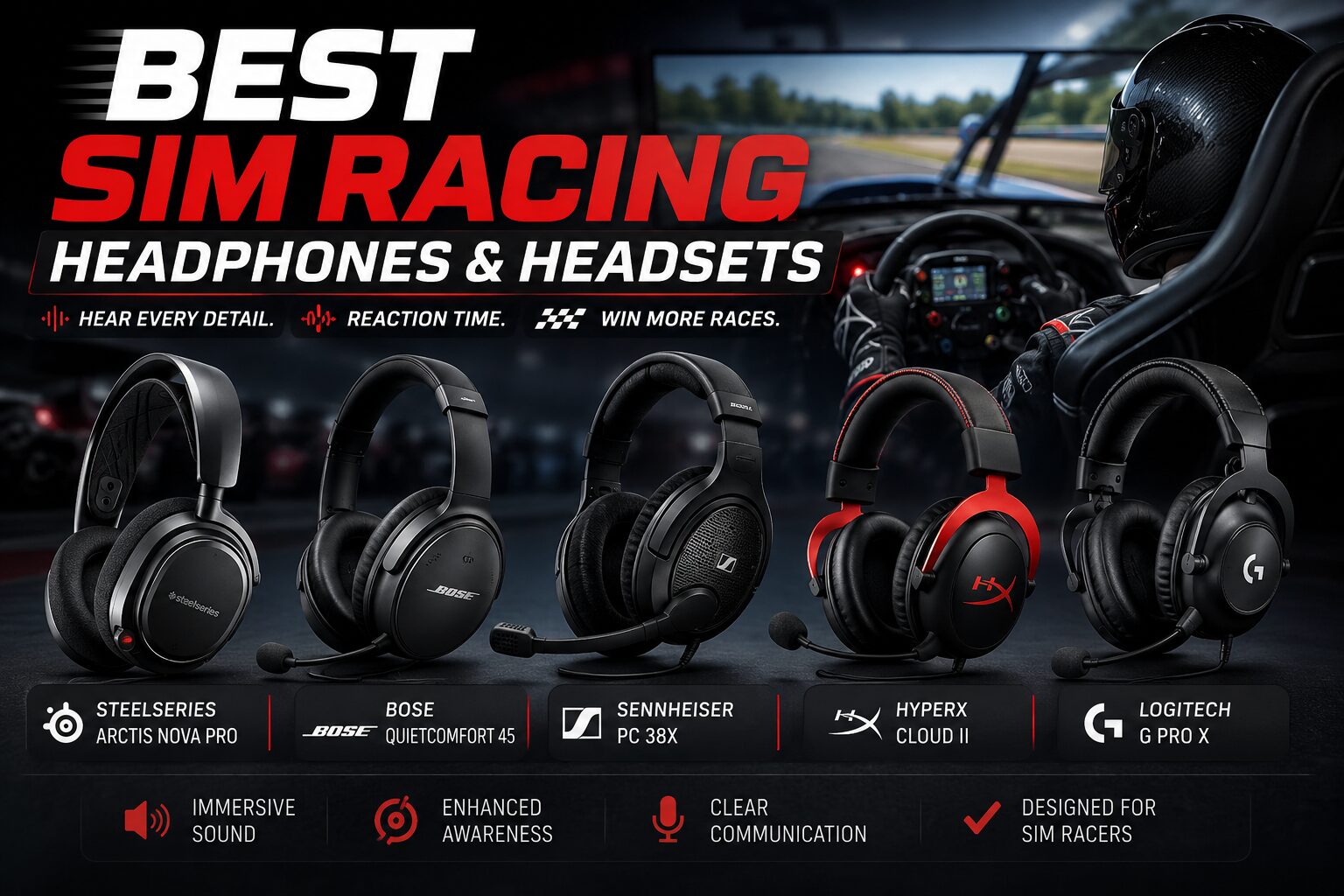
Best Sim Racing Headphones and Headsets: 8 Immersive Options for Racing Games
The best sim racing headphones should reproduce more than loud engines and dramatic crashes. They should reveal tire scrub, brake lockups, transmission whine, suspension impacts, wind noise, nearby cars, spotter calls, and subtle changes in engine load without becoming painful during a long endurance race.
Audio plays a larger role in sim racing than many equipment guides acknowledge. A steering wheel communicates grip through force feedback, but sound often provides the earliest warning that the car is approaching its limit. The pitch of tire scrub changes before a complete slide. The engine note indicates whether I selected the correct gear. A change in road noise can reveal that two wheels have moved onto grass or gravel. A nearby opponent can sometimes be located through audio before I see the car in a mirror.
A basic gaming headset can reproduce these signals, but a well-designed headphone presents them more clearly. Strong imaging helps place opponents to the left, right, front, or rear. Controlled bass preserves the impact of an engine without burying tire and transmission detail. A spacious soundstage makes the cockpit feel less like sound is being played directly inside my head.
Comfort is equally important. Sim racers may wear headphones through practice, qualifying, and a two-hour race. Excessive clamp pressure, heat, weight, or poorly shaped ear pads can become more distracting than mediocre audio quality.
After comparing soundstage, imaging, tonal balance, engine reproduction, bass control, comfort, microphone quality, isolation, wireless latency, battery life, compatibility, durability, and value, my best overall recommendation is the Audeze Maxwell Wireless.
The Maxwell uses large planar-magnetic drivers and provides more than 80 hours of wireless playback under Audeze’s stated test conditions. It supports low-latency wireless operation, Bluetooth, USB audio, a detachable hypercardioid boom microphone, and physical plus AI-assisted microphone noise reduction.
Its major strength is sound quality. Engine layers remain distinct rather than collapsing into a wall of bass. Tire scrub, kerb strikes, wind, road texture, and nearby vehicles remain audible even when the simulated car is loud.
The SteelSeries Arctis Nova Pro Wireless is my best feature-rich alternative. It offers active noise cancellation, a wireless base station, hot-swappable batteries, multi-system convenience, and simultaneous connection options. SteelSeries describes the system as providing effectively unlimited operation through its dual-battery arrangement.
For open-back positional audio, I prefer the beyerdynamic MMX 330 PRO. Its open construction creates a broad and natural presentation that helps separate cars and environmental sounds. Beyerdynamic specifically positions the model as spacious and balanced, with acoustic events that can be located quickly.
The Logitech G PRO X 2 LIGHTSPEED is a strong all-round wireless choice with 50 mm graphene drivers, LIGHTSPEED wireless, Bluetooth, analog connectivity, replaceable ear pads, and a lighter design than the planar-magnetic Audeze.
For maximum battery life at a more accessible price, the HyperX Cloud III S Wireless offers up to 120 hours over 2.4 GHz and up to 200 hours in Bluetooth mode under HyperX’s stated conditions. It also includes angled 53 mm drivers, memory-foam cushioning, and a detachable 10 mm boom microphone.
This guide covers both headphones and gaming headsets. A headset includes a microphone, while a conventional headphone may require a separate USB or XLR microphone. For league racing, team communication, streaming, and endurance events, microphone quality and convenience can be almost as important as playback quality.
Quick Answer: What Are the Best Sim Racing Headphones?
The Audeze Maxwell Wireless is my best overall sim racing headset. It combines planar-magnetic sound quality, excellent separation, strong bass control, low-latency wireless operation, long battery life, and a detachable communication microphone.
Disclosure: This post contains affiliate links. If you click through and make a purchase, we may earn a small commission at no extra cost to you.

SteelSeries Arctis Nova Pro Wireless Multi-System Gaming Headset
Neodymium Magnetic Drivers — Active Noise Cancellation — 2 Battery System — ClearCast Gen 2 Mic — PC, PS5, PS4, Switch, Mobile
Check Price on Amazon.com
beyerdynamic MMX 330 Pro Wired Open-Back Gaming Headset
Hear enemies first, open-back spatial audio on PC, PlayStation and Switch, broadcast-grade mic, Handmade in Germany
Check Price on Amazon.com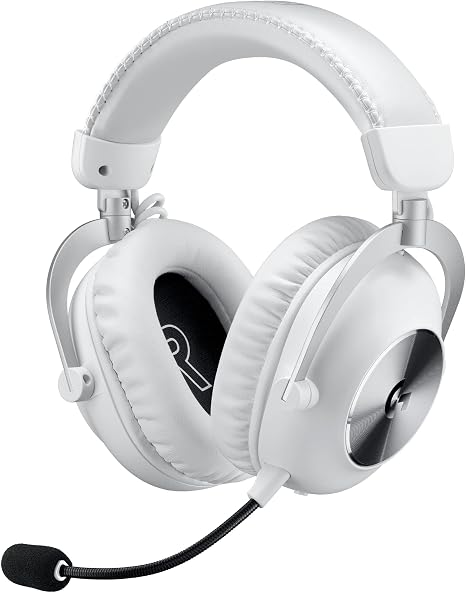
Logitech G PRO X 2 Lightspeed Wireless Gaming Headset
Bluetooth/USB/3.5mm Aux for PC, Detachable Boom Mic.
Check Price on Amazon.com
HyperX Cloud III S – Wireless Gaming Headset for Multi-Platform
2.4GHz, Bluetooth, Battery Life up to 120 Hours 2.4GHz / 200 Hours Bluetooth, 53mm Angled Drivers
Check Price on Amazon.com
Razer BlackShark V3 Pro Wireless ANC Gaming Headset for PC
Full Band Mic, 50mm Drivers, 2.4 GHz, Bluetooth, USB, 3.5mm, Works with Mac, PS5
Check Price on Amazon.com
beyerdynamic MMX 300 Pro Wired Closed-Back Gaming Headset
closed-back audio for PC, PlayStation and Switch, broadcast-grade mic
Check Price on Amazon.com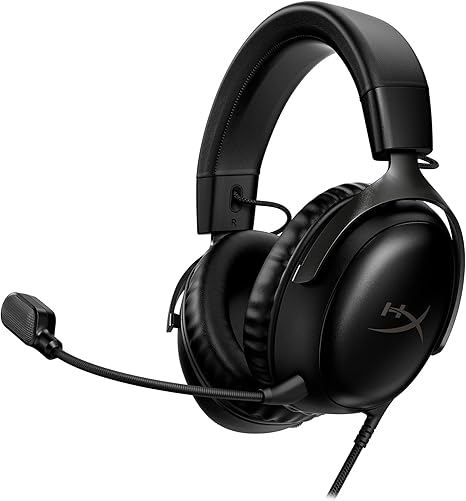
HyperX Cloud III – Wired Gaming Headset, PC, PS5
Angled 53mm Drivers, Spatial Audio, Memory Foam, Durable Frame, Ultra-Clear 10mm Mic, USB-C, USB-A, 3.5mm
Check Price on Amazon.com
Audeze Maxwell Wireless Gaming Headset for PlayStation, Mac, PC, and Switch
FOR PLAYSTATION, MAC, PC, AND SWITCH - 80AND
Check Price on Amazon.com- Best overall: Audeze Maxwell Wireless
- Best feature-rich wireless headset: SteelSeries Arctis Nova Pro Wireless
- Best open-back headset: beyerdynamic MMX 330 PRO
- Best balanced wireless alternative: Logitech G PRO X 2 LIGHTSPEED
- Best battery life: HyperX Cloud III S Wireless
- Best competitive wireless headset: Razer BlackShark V3 Pro
- Best wired closed-back headset: beyerdynamic MMX 300 PRO
- Best value option: HyperX Cloud III wired or a discounted Cloud III Wireless
- Best for noisy rooms: SteelSeries Arctis Nova Pro Wireless or Razer BlackShark V3 Pro
- Best for natural spatial audio: beyerdynamic MMX 330 PRO
Best Sim Racing Headphones Comparison Table
| Headset | Design | Connection | Main Strength | Best For | My Score |
|---|---|---|---|---|---|
| Audeze Maxwell Wireless | Closed-back planar magnetic | Low-latency wireless, Bluetooth, USB | Exceptional sound quality and separation | Best overall | 4.9/5 |
| SteelSeries Arctis Nova Pro Wireless | Closed-back with ANC | Wireless base station and Bluetooth | Features and multi-device convenience | Complex PC and console rigs | 4.8/5 |
| beyerdynamic MMX 330 PRO | Open-back | Wired analog | Natural soundstage and precise imaging | Quiet rooms and positional audio | 4.8/5 |
| Logitech G PRO X 2 LIGHTSPEED | Closed-back | LIGHTSPEED, Bluetooth, and 3.5 mm | Balanced wireless performance | General PC and console use | 4.7/5 |
| HyperX Cloud III S Wireless | Closed-back | 2.4 GHz, Bluetooth, Instant Pair | Battery life and comfort | Long endurance sessions | 4.6/5 |
| Razer BlackShark V3 Pro | Closed-back with ANC | Low-latency wireless, Bluetooth, USB | Fast wireless and clear communications | Competitive racing and noisy rooms | 4.6/5 |
| beyerdynamic MMX 300 PRO | Closed-back | Wired analog | Detailed wired audio and isolation | Drivers avoiding batteries and software | 4.7/5 |
| HyperX Cloud III | Closed-back | Wired USB or analog by version | Comfort and straightforward value | Budget and beginner setups | 4.4/5 |
Why Audio Matters in Sim Racing
Featured snippet answer: Good sim racing headphones help the driver hear tire slip, engine load, gear changes, brake lockups, kerb impacts, track-surface changes, nearby opponents, spotter messages, and mechanical warnings. Accurate imaging and controlled frequency response can improve awareness and consistency.
Tire Noise Communicates Grip
Tires often begin producing audible scrub before the car enters a severe slide.
A headset with clear upper-midrange and treble reproduction makes this transition easier to hear. If bass is excessively elevated, tire information may be hidden beneath the engine and exhaust.
The objective is not to remove bass. A racing simulation should still sound powerful. The objective is to prevent low-frequency energy from masking useful details.
Engine Pitch Supports Gear Selection
Engine sound provides a continuous indication of RPM and load.
Many drivers learn to shift by sound rather than watching the rev counter. This keeps the eyes focused on the track and surrounding cars.
Transmission and Drivetrain Feedback
Gear whine, differential noise, turbo sound, hybrid deployment, wastegate operation, and transmission impacts can reveal what the drivetrain is doing.
High-quality headphones separate these layers instead of presenting them as one compressed sound.
Opponent Awareness
Accurate imaging helps determine whether another car is beside the left or right rear quarter.
Audio should never replace mirrors, spotters, or radar overlays. It adds another source of information.
Track-Surface Changes
Road noise changes when the tires move across asphalt, painted kerbs, concrete, gravel, grass, or wet surfaces.
A detailed headset makes these changes easier to recognize immediately.
Spotter and Team Communication
Clear speech reproduction matters during league racing and endurance events.
A good headset keeps voices intelligible even when the engine and tire sounds are loud. A good microphone also prevents teammates from hearing excessive keyboard, fan, wheelbase, or room noise.
Immersion
Sound creates scale and physical presence.
A powerful engine should feel substantial, but the sound should also contain texture. I want to hear induction, exhaust, gearbox, wind, suspension, and surface noise as separate elements.
How I Evaluated the Best Sim Racing Headphones
Sim racing creates different audio priorities from a conventional competitive shooter.
Footstep emphasis is less important. Long-session comfort, engine balance, positional consistency, and clear team communication matter more.
Evaluation Criteria
- Imaging: Ability to position nearby vehicles and environmental sounds.
- Soundstage: Perceived width, depth, and openness.
- Engine reproduction: Weight and texture without excessive masking.
- Tire-detail clarity: Ability to hear scrub and lockup cues.
- Bass control: Impact without boom or congestion.
- Midrange clarity: Reproduction of engine harmonics and speech.
- Treble detail: Kerbs, road texture, turbo, wind, and mechanical sounds.
- Comfort: Weight, clamping force, ear-pad shape, and heat.
- Microphone quality: Speech clarity and rejection of background noise.
- Latency: Synchronization between visual action and sound.
- Battery life: Suitability for endurance racing and frequent use.
- Compatibility: PC, PlayStation, Xbox, mobile, and multiple-source operation.
- Durability: Hinges, headband, pads, cable, battery, and replaceable parts.
- Value: Performance delivered for the installed cost.
Scoring Method
| Category | Weight |
|---|---|
| Sound quality and separation | 25% |
| Imaging and spatial awareness | 20% |
| Long-session comfort | 20% |
| Connection and latency | 10% |
| Microphone quality | 10% |
| Build quality | 10% |
| Value | 5% |
1. Audeze Maxwell Wireless – Best Sim Racing Headset Overall
Audeze Maxwell Wireless Gaming Headset for PlayStation, Mac, PC, and Switch
FOR PLAYSTATION, MAC, PC, AND SWITCH - 80AND
Check Price on Amazon.comMy Rating: 4.9/5
Best for: Maximum sound quality, detailed simulations, and premium wireless rigs
Driver type: Planar magnetic
Battery: More than 80 hours under Audeze’s stated conditions
Microphone: Detachable hypercardioid boom microphone
The Audeze Maxwell Wireless is my best overall choice because it approaches sim racing audio more like a high-quality headphone than a conventional gaming accessory.
Audeze uses large planar-magnetic transducers, a technology known for controlling the diaphragm across a broad surface. In practice, this can produce low distortion, fast transient response, strong bass extension, and excellent separation between sound layers.
The Maxwell supports low-latency wireless playback, Bluetooth, USB audio, a detachable hypercardioid microphone, internal beamforming microphones, and physical plus AI-assisted microphone noise reduction. Audeze rates battery life at more than 80 hours of wireless playback at its specified level.
Sound Quality
The Maxwell’s largest advantage is its ability to preserve detail when many sounds occur at once.
During a race, the headset may need to reproduce the player’s engine, nearby cars, tire scrub, kerb impacts, wind noise, transmission whine, radio messages, and environmental effects simultaneously.
Less capable headsets can become congested. Bass energy expands over the midrange, and quieter details disappear. The Maxwell keeps these elements more distinct.
Engine Reproduction
Planar bass can reach deeply without sounding loose.
This gives large engines convincing weight while retaining the mechanical texture of the exhaust and drivetrain. A V8 does not merely sound louder than a four-cylinder engine; it sounds structurally different.
Tire and Surface Detail
The Maxwell’s resolution helps expose tire noise and changes in surface texture.
This is useful in simulations where sound design accurately represents slip angle, lockup, wheelspin, and road transitions.
Imaging
Although the Maxwell is closed-back, it provides strong positional precision.
It does not create the same open spatial presentation as the MMX 330 PRO, but opponents remain easy to place, particularly when the game’s stereo or spatial mix is well designed.
Weight
The main drawback is physical weight.
The original Maxwell is listed at 490 grams, illustrating the substantial construction associated with its planar drivers and battery hardware.
The Maxwell remains a substantial headset. Weight distribution and head shape therefore matter. Drivers sensitive to heavy headphones should consider the Logitech, HyperX, or an open-back wired alternative.
Battery and Charging
More than 80 hours of stated playback means most drivers can complete many sessions between charges. Audeze also provides USB-C fast charging.
Long battery life reduces the chance that the headset will fail during an endurance event, but I still charge before important races.
Microphone
The detachable hypercardioid boom mic is designed to focus on the voice while reducing surrounding noise.
The additional internal microphones allow the headset to be used without the boom for casual calls, although the boom remains preferable for team racing.
Platform Versions
Buyers should choose the correct platform edition. Audeze provides platform-specific feature differences, including Dolby Atmos support on Xbox-oriented versions and compatibility tailored to PlayStation editions.
Pros
- Exceptional sound quality
- Excellent separation between engines, tires, and environmental audio
- Deep but controlled bass
- Strong positional imaging
- Low-latency wireless operation
- Bluetooth and USB audio support
- More than 80 hours of stated battery life
- Detachable hypercardioid microphone
- Suitable for music and films as well as racing
Cons
- Heavy compared with many gaming headsets
- Premium price
- Closed-back design retains more heat
- Platform edition must be selected carefully
- May be excessive for entry-level rigs
- Does not provide the widest open-back soundstage
Who Should Buy It?
I recommend the Maxwell to racers who prioritize sound quality and want one premium wireless headset for simulation, music, films, and general gaming.
Who Should Avoid It?
I would choose a lighter headset if neck fatigue, heat, or low weight matters more than maximum audio resolution.
My Best Overall Sim Racing Headset
The Audeze Maxwell offers the most convincing combination of engine weight, tire detail, positional precision, and wireless convenience.
2. SteelSeries Arctis Nova Pro Wireless – Best Feature-Rich Wireless Headset
SteelSeries Arctis Nova Pro Wireless Multi-System Gaming Headset
Neodymium Magnetic Drivers — Active Noise Cancellation — 2 Battery System — ClearCast Gen 2 Mic — PC, PS5, PS4, Switch, Mobile
Check Price on Amazon.comMy Rating: 4.8/5
Best for: Multi-platform rigs, noisy rooms, and uninterrupted wireless use
Design: Closed-back with active noise cancellation
Power system: Hot-swappable dual batteries
The SteelSeries Arctis Nova Pro Wireless is the headset I would choose for maximum convenience.
SteelSeries combines active noise cancellation, premium high-fidelity dynamic drivers, a wireless control base, simultaneous wireless functionality, and a dual-battery system designed to keep the headset operating while the spare battery charges.
Hot-Swappable Batteries
The battery system is one of the strongest designs for endurance racing.
Instead of connecting a charging cable to the headset, I can remove the depleted battery and replace it with the charged spare. The base station charges the second battery while the first is in use.
This avoids long-term dependence on a single sealed battery and makes continuous operation practical.
Active Noise Cancellation
ANC helps reduce computer fans, air conditioners, wheelbase fans, motion-platform noise, and other continuous room sounds.
It does not eliminate every mechanical impact, but it can lower the background level enough that racing audio remains clear at a safer listening volume.
Multi-Device Use
The base station and Bluetooth support make the Nova Pro Wireless suitable for complicated setups.
A driver may need race audio from a PC while receiving a phone call or using a secondary communication source. The headset’s connection flexibility is one of its defining strengths.
Sound Quality
The Nova Pro provides detailed, adjustable gaming audio.
It does not match the planar separation and bass control of the Maxwell, but its software features and EQ options make it easy to tailor for racing.
I reduce excessive low bass slightly and preserve upper-midrange detail so tire and transmission sounds remain clear.
Comfort
The suspension-style headband distributes weight effectively.
ANC hardware and wireless electronics still make it more complex than a simple wired open-back headset, but it remains suitable for long sessions when the ear-pad shape fits correctly.
Microphone
The retractable microphone is convenient because it can disappear into the ear cup when not needed.
For serious streaming, a separate microphone may still sound fuller, but the integrated mic is adequate for league and team communication.
Pros
- Excellent wireless feature set
- Hot-swappable battery system
- Active noise cancellation
- Wireless base station
- Bluetooth support
- Strong multi-device flexibility
- Retractable microphone
- Useful software and EQ control
- Ideal for long endurance events
Cons
- Expensive
- Sound quality trails the Maxwell
- Complex setup compared with wired headsets
- ANC can create slight pressure sensation for some users
- Closed ear cups can become warm
- Software is needed for the complete feature set
Who Should Buy It?
I recommend it to racers using multiple systems, competing in endurance events, or driving in rooms with persistent background noise.
Who Should Avoid It?
I would choose the Maxwell for maximum sound quality or the MMX 330 PRO for a simpler open-back experience.
Check Arctis Nova Pro Wireless Price
3. beyerdynamic MMX 330 PRO – Best Open-Back Sim Racing Headset
beyerdynamic MMX 330 Pro Wired Open-Back Gaming Headset
Hear enemies first, open-back spatial audio on PC, PlayStation and Switch
Check Price on Amazon.comMy Rating: 4.8/5
Best for: Quiet rooms, natural spatial audio, and wired PC setups
Design: Open-back
Connection: Wired
The beyerdynamic MMX 330 PRO is my preferred open-back gaming headset for sim racing.
Beyerdynamic describes the open design as natural, spacious, and balanced, allowing in-game acoustic events to be pinpointed quickly.
Open Soundstage
An open-back headset allows air and sound to pass through the ear cups.
This reduces the enclosed pressure and creates a presentation that feels broader and more natural. Nearby cars can appear to exist outside the head rather than being compressed directly between the ears.
Imaging
A wide soundstage is useful only when individual sounds can still be placed accurately.
The MMX 330 PRO combines openness with strong directional precision. It works particularly well in simulations with high-quality binaural or stereo mixing.
Engine Balance
The bass is more neutral than that of many closed gaming headsets.
This may initially seem less dramatic, but it prevents engine rumble from covering tire, suspension, and radio detail.
Comfort and Ventilation
Open ear cups allow more airflow.
Velour-style pads also tend to feel cooler than sealed synthetic-leather pads. This makes the MMX 330 PRO one of the best choices for long races in a quiet room.
Noise Leakage
The open design provides almost no isolation.
Other people can hear the game, and the driver can hear fans, conversations, televisions, and traffic in the room.
The microphone may also capture some leaked audio if playback volume is excessive.
Wired Operation
Wired analog operation avoids battery management, wireless pairing, and software dependence.
The cable should be routed so it cannot catch on a shifter, handbrake, seat rail, or rotating steering wheel.
Pros
- Excellent open soundstage
- Precise positional imaging
- Natural tonal balance
- Clear tire and environmental detail
- Cooler than many closed-back headsets
- No battery or wireless latency concerns
- Strong voice communication
- Replaceable ear pads available
Cons
- Almost no noise isolation
- Leaks sound into the room
- Wired cable requires careful routing
- Less dramatic bass than some gaming headsets
- Not suitable for shared or noisy spaces
- May need a suitable audio output for best performance
Who Should Buy It?
I recommend the MMX 330 PRO to PC racers in quiet rooms who prioritize natural spatial audio and long-session ventilation.
Who Should Avoid It?
I would choose a closed-back model if the cockpit is near other people, loud fans, a television, or a noisy motion system.
Check MMX 330 PRO Price
4. Logitech G PRO X 2 LIGHTSPEED – Best Balanced Wireless Alternative
Logitech G PRO X 2 Lightspeed Wireless Gaming Headset
Bluetooth/USB/3.5mm Aux for PC, Detachable Boom Mic.
Check Price on Amazon.comMy Rating: 4.7/5
Best for: Racers wanting a lighter premium wireless headset
Drivers: 50 mm graphene
Connections: LIGHTSPEED, Bluetooth, and 3.5 mm
Wireless range: Up to 30 meters under Logitech’s stated conditions
The Logitech G PRO X 2 LIGHTSPEED offers an effective balance of sound, comfort, connection flexibility, and weight.
Logitech equips it with 50 mm graphene drivers and supports LIGHTSPEED wireless, Bluetooth, and 3.5 mm analog connectivity. The company states a wireless range of up to 30 meters.
Graphene Drivers
Graphene is used to create a light and rigid driver diaphragm.
The practical objective is controlled movement, lower distortion, and fast response. The PRO X 2 sounds clean and energetic without becoming as heavy or expensive as the Maxwell.
Imaging
Positional performance is strong enough for locating nearby cars and environmental cues.
The soundstage remains more enclosed than the open MMX 330 PRO, but the headset creates a coherent stereo image.
Comfort
Logitech includes soft ear-pad options and a design intended for extended competitive use.
The headset is easier to tolerate for some users than the much heavier Audeze. Clamp pressure and ear-pad preference remain personal.
Connection Flexibility
LIGHTSPEED is the primary low-latency gaming connection. Bluetooth is useful for mobile devices, while 3.5 mm analog provides a fallback for controllers and other sources.
Microphone
The detachable microphone is suitable for voice chat and league racing.
Logitech’s software can provide additional microphone processing on supported PC setups, although a dedicated broadcast microphone remains better for professional streaming.
Pros
- 50 mm graphene drivers
- Strong wireless performance
- Bluetooth and analog options
- Up to 30-meter stated range
- Lighter than the Maxwell
- Comfortable replaceable ear-pad options
- Good positional imaging
- Suitable for general gaming and racing
Cons
- Less detailed than the Maxwell
- Less feature-rich than the Nova Pro Wireless
- Software provides the best PC experience
- Microphone is adequate rather than exceptional
- Closed-back cups can retain heat
Check Logitech G PRO X 2 Price
5. HyperX Cloud III S Wireless – Best Battery Life
HyperX Cloud III S – Wireless Gaming Headset for Multi-Platform
2.4GHz, Bluetooth, Battery Life up to 120 Hours 2.4GHz
Check Price on Amazon.comMy Rating: 4.6/5
Best for: Long endurance sessions and infrequent charging
Drivers: Angled 53 mm
Battery: Up to 120 hours at 2.4 GHz or 200 hours over Bluetooth
Microphone: Detachable 10 mm boom microphone
The HyperX Cloud III S Wireless is my preferred choice for drivers who want long battery life and familiar HyperX comfort.
HyperX states up to 120 hours of operation over 2.4 GHz and up to 200 hours in Bluetooth mode. It supports 2.4 GHz wireless, Bluetooth, and Instant Pair with selected OMEN laptops. The headset uses angled 53 mm drivers and memory-foam cushioning.
Battery Life
The battery capacity is the headline advantage.
A racer can complete many weekly sessions without charging, reducing the risk of beginning an important event with a nearly empty battery.
Battery figures depend on volume, connection mode, features, temperature, and battery age. I still charge before major endurance races.
Comfort
HyperX’s memory-foam design has long emphasized comfort.
The Cloud III S uses padded ear cups and headband surfaces intended for extended play. Closed synthetic-leather pads provide isolation but can become warm.
Sound
The angled 53 mm drivers are tuned to provide an engaging gaming presentation.
The headset delivers useful impact and clear communication, although it lacks the planar resolution of the Maxwell and the open space of the MMX 330 PRO.
Microphone
The detachable 10 mm microphone includes an LED mute indicator and an integrated filter.
It is practical for league racing because the visual indicator reduces uncertainty about whether the microphone is muted.
Pros
- Exceptional stated battery life
- 2.4 GHz and Bluetooth connectivity
- Angled 53 mm drivers
- Comfortable memory foam
- Detachable microphone
- LED mute indicator
- Simple everyday operation
- Good value relative to premium models
Cons
- Sound separation trails premium planar headsets
- Closed pads can become warm
- No hot-swappable battery system
- Less sophisticated multi-device control than SteelSeries
- Bluetooth battery figures do not represent low-latency racing use
Check HyperX Cloud III S Wireless Price
6. Razer BlackShark V3 Pro – Best Competitive Wireless Headset
Razer BlackShark V3 Pro Wireless ANC Gaming Headset for PC
2.4 GHz, Bluetooth, USB, 3.5mm, Works with Mac, PS5
Check Price on Amazon.comMy Rating: 4.6/5
Best for: Low-latency wireless, clear team communications, and noisy rooms
Latency: As low as 10 ms under Razer’s stated conditions
Features: Hybrid ANC and full-band microphone
The Razer BlackShark V3 Pro targets competitive players with low-latency wireless operation, hybrid active noise cancellation, and a high-bandwidth microphone.
Razer states wireless audio latency as low as 10 milliseconds and describes the headset as using a full-band microphone for clear communication.
Low Latency
Audio latency matters when the driver reacts to tire lockup, wheelspin, contact, or engine RPM.
A well-designed 2.4 GHz gaming link keeps sound synchronized closely with the on-screen action. Bluetooth alone is generally less appropriate for competitive racing because latency can be higher and microphone mode may reduce audio quality.
Active Noise Cancellation
Hybrid ANC helps reduce continuous room noise.
This is valuable when the rig includes cooling fans, a loud PC, motion actuators, or household activity.
Microphone
Clear communication is especially important in endurance racing.
Driver changes, fuel targets, tire strategy, incidents, and traffic information need to be understood immediately. Razer’s full-band microphone is a meaningful advantage for teams that do not use a separate mic.
Platform Editions
Razer offers PC, PlayStation, and Xbox-oriented BlackShark V3 Pro versions. Buyers should select the edition intended for the required platform rather than assuming one model supports every console feature.
Pros
- Very low stated wireless latency
- Hybrid active noise cancellation
- High-bandwidth microphone
- Strong competitive positioning
- Multiple connectivity modes
- Platform-specific editions
- Good isolation for noisy rooms
Cons
- Premium price
- Platform edition requires careful selection
- ANC and software add complexity
- Closed design can become warm
- Sound quality is less natural than strong open-back options
Check Razer BlackShark V3 Pro Price
7. beyerdynamic MMX 300 PRO – Best Wired Closed-Back Headset
beyerdynamic MMX 300 Pro Wired Closed-Back Gaming Headset
PC, PlayStation and Switch, broadcast-grade mic
Check Price on Amazon.comMy Rating: 4.7/5
Best for: Detailed wired sound, isolation, and simple multi-platform use
Design: Closed-back
Driver: Low-impedance STELLAR.45
Compatibility: PC, PlayStation, Xbox, and Nintendo Switch
The beyerdynamic MMX 300 PRO is my preferred wired closed-back option.
Beyerdynamic uses a low-impedance STELLAR.45 driver and states compatibility with PC, PlayStation, Xbox, and Nintendo Switch. A supplied adapter supports relevant connection configurations.
Closed-Back Detail
The MMX 300 PRO provides stronger isolation and bass impact than the open MMX 330 PRO.
It is better for noisy environments while retaining a detailed, studio-influenced presentation.
Wired Reliability
There is no battery to charge, no wireless interference, and no pairing process.
The headset begins working when connected to a suitable analog output.
The cable remains the primary inconvenience. It should be routed behind the seat or along the cockpit frame with enough slack for head movement.
Device Compatibility
The low-impedance driver is intended to work from common gaming devices without requiring a large desktop amplifier.
A high-quality motherboard, controller, USB interface, or DAC can still affect available volume and microphone quality.
Sound Isolation
The closed ear cups reduce outside noise and prevent more sound leakage than an open-back headset.
This makes the MMX 300 PRO better for shared rooms, streaming, and nighttime racing.
Pros
- Detailed wired audio
- Strong closed-back isolation
- No battery or wireless management
- Low-impedance driver
- Broad device compatibility
- Clear microphone
- Durable professional design
- Good engine impact without excessive software processing
Cons
- Wired cable can interfere with the cockpit
- Less spacious than the MMX 330 PRO
- No Bluetooth or wireless convenience
- Closed cups retain heat
- Premium price for a wired headset
Check MMX 300 PRO Price
8. HyperX Cloud III – Best Budget Sim Racing Headset
HyperX Cloud III – Wired Gaming Headset, PC, PS5
Angled 53mm Drivers, Spatial Audio, Memory Foam, Durable Frame, Ultra-Clear 10mm Mic
Check Price on Amazon.comThe wired HyperX Cloud III, or a discounted standard Cloud III Wireless, is my preferred budget direction.
The design emphasizes comfort, durable construction, straightforward controls, and a tuning that works across many games.
Why It Works for Sim Racing
- Comfortable memory-foam design
- Closed-back isolation
- Simple microphone setup
- Available in wired and wireless variations
- Broad retailer availability
- More affordable than flagship headsets
The Cloud III does not provide the soundstage of an open beyerdynamic or the resolution of an Audeze planar headset. However, it reproduces the essential racing cues clearly enough for most drivers.
Wired vs Wireless Budget Choice
I choose the wired version when price and reliability matter most. I choose wireless when cockpit cable management is difficult.
Wireless pricing changes frequently, so a discounted previous-generation model may offer better value than the newest version.
Pros
- Comfortable
- Reasonable price
- Simple controls
- Clear basic microphone
- Good isolation
- Easy to find
- Suitable for beginners
Cons
- Limited soundstage
- Less detailed than premium options
- Closed pads can become warm
- Not the strongest choice for music listening
Check HyperX Cloud III Price
Open-Back vs Closed-Back Headphones for Sim Racing
Open-Back Advantages
- Wider and more natural soundstage
- Better airflow
- Less enclosed pressure
- Natural environmental presentation
- Excellent for quiet dedicated rooms
Open-Back Disadvantages
- Minimal isolation
- Substantial sound leakage
- Room noise remains audible
- Microphone can capture leaked game audio at high volume
Closed-Back Advantages
- Better isolation
- Stronger perceived bass
- Less sound leakage
- Better for shared spaces
- Useful around motion rigs and cooling fans
Closed-Back Disadvantages
- Warmer ear cups
- Smaller perceived soundstage
- Greater risk of boomy bass
- Can feel pressurized during long sessions
I prefer open-back headphones in a quiet dedicated racing room. I prefer closed-back headphones when isolation, bass impact, household noise, or microphone leakage matters.
Wired vs Wireless Headsets for Sim Racing
Advantages of Wireless
- No cable around the seat, wheel, or shifter
- Easier entry and exit
- Useful with motion systems
- Convenient for VR
- Allows movement away from the rig
Disadvantages of Wireless
- Battery management
- Potential wireless interference
- Additional weight
- Greater software dependence
- Higher cost
Advantages of Wired
- No battery
- Consistent low latency
- Simple operation
- Lower weight in many models
- Long service life when cables are replaceable
Disadvantages of Wired
- Cable can catch on cockpit hardware
- Less convenient with VR
- Cable movement may transmit noise
- Limited movement away from the simulator
A modern low-latency 2.4 GHz wireless headset is fast enough for sim racing. I avoid ordinary Bluetooth as the primary game-audio connection when latency matters.
Best Sim Racing Headsets for PC, PlayStation, and Xbox
Best for PC
PC provides the broadest compatibility.
My top choices are:
- Audeze Maxwell Wireless
- SteelSeries Arctis Nova Pro Wireless
- beyerdynamic MMX 330 PRO
- Logitech G PRO X 2 LIGHTSPEED
- Razer BlackShark V3 Pro
Best for PlayStation
Choose a version explicitly supporting PlayStation.
Strong options include:
- Audeze Maxwell PlayStation edition
- Razer BlackShark V3 Pro for PlayStation
- Compatible SteelSeries Nova Pro Wireless edition
- Wired MMX 300 PRO through the supported controller connection
Best for Xbox
Xbox wireless compatibility is more restrictive.
Choose an Xbox-specific model such as:
- Audeze Maxwell Xbox edition
- Razer BlackShark V3 Pro for Xbox
- Compatible SteelSeries Xbox edition
- Wired MMX 300 PRO through the controller
USB connectivity does not automatically mean full console compatibility. The exact platform edition should be verified before purchase.
Best Headphones for Sim Racing in VR
VR introduces additional fit and comfort constraints.
Important VR Features
- Low weight
- Flexible headband
- Ear cups that clear the VR straps
- Wireless operation
- Low heat
- Easy physical controls
The Logitech G PRO X 2 and HyperX Cloud III S Wireless are easier to combine with many headsets than a heavy Maxwell.
The correct choice depends on the VR strap design. Some headsets already include acceptable integrated audio, eliminating the need for a separate full-size headset.
I test whether the headphone headband pushes the VR headset downward or breaks the facial seal. Comfort problems become more severe when two head-mounted devices apply pressure simultaneously.
Best Sim Racing Headsets for Streaming and Team Racing
Integrated Headset Microphone
An integrated microphone is convenient and maintains a constant distance from the mouth.
The Razer BlackShark V3 Pro, Audeze Maxwell, and beyerdynamic MMX models are strong choices for clear team communication.
Separate Microphone
A dedicated USB or XLR microphone can sound fuller and more natural.
However, the microphone should be positioned so it does not block the wheel display, interfere with VR, or capture excessive wheelbase and shifter noise.
Noise Sources to Control
- Direct-drive wheel vibration
- Sequential shifter impacts
- Mechanical keyboard noise
- PC and room fans
- Motion-system actuators
- Pedal vibration motors
- Button-box clicks
A directional boom microphone near the mouth usually rejects these sounds more effectively than a distant desk microphone.
Soundstage and Imaging Explained
What Is Soundstage?
Soundstage describes the perceived size and space of the audio presentation.
A wide soundstage can make cars and track environments feel farther from the head. Open-back headphones generally create a broader presentation.
What Is Imaging?
Imaging describes how precisely a headphone places individual sounds within that space.
A headphone can sound wide but vague. Another can sound narrower but position cars very precisely.
Which Matters More?
Imaging matters more for awareness.
Soundstage improves realism, but accurate placement helps determine whether another vehicle is directly beside the car or slightly behind it.
Virtual Surround Sound
Virtual surround can expand or alter the sound field through processing.
It may improve immersion in some games but blur imaging or change tonal balance in others.
I begin with normal stereo because many simulators already produce positional audio designed for headphones. I then test spatial processing rather than assuming it is automatically better.
Recommended EQ for Sim Racing
There is no universal EQ because every headset and simulation is different.
My general approach is:
- Reduce excessive sub-bass or mid-bass when engines sound boomy.
- Preserve the midrange where engine harmonics and speech remain clear.
- Add a small upper-midrange adjustment only when tire scrub is difficult to hear.
- Avoid excessive treble that makes kerbs and transmission noise painful.
- Test at realistic listening levels.
Do Not Tune Only for Excitement
A dramatic V-shaped EQ may produce powerful bass and bright effects, but it can hide important information.
For competitive racing, clarity and separation are usually more useful than maximum impact.
Protect Your Hearing
Long sessions at high volume can damage hearing.
ANC and closed-back isolation can help by reducing the need to overpower room noise. I use the lowest volume that keeps essential cues clear.
How to Choose the Best Sim Racing Headphones
1. Prioritize Comfort
A technically excellent headset is a poor choice if it becomes painful after 30 minutes.
Consider weight, clamp force, ear-pad depth, glasses, head shape, and room temperature.
2. Choose Open or Closed
Select open-back for quiet rooms and natural sound. Select closed-back for isolation and reduced leakage.
3. Choose Wired or Wireless
Wireless improves cockpit freedom. Wired avoids battery and software concerns.
4. Check Platform Compatibility
PlayStation and Xbox editions are not always interchangeable.
5. Consider Microphone Requirements
League and endurance racers need clear speech. Solo racers may prefer conventional headphones without a microphone.
6. Avoid Excessive Bass
Strong bass is enjoyable, but uncontrolled bass masks tires, speech, and mechanical details.
7. Check Ear-Pad Materials
Synthetic leather isolates well but becomes warm. Fabric and velour breathe better but leak more sound.
8. Consider Replaceable Parts
Replaceable pads, cables, microphones, and batteries extend product life.
9. Consider Weight
Heavy planar headsets can sound excellent but cause fatigue for some drivers.
10. Budget for a DAC Only When Needed
Many gaming headsets work well from their included USB hardware or common device outputs.
A separate DAC or amplifier is useful when the source is noisy, lacks volume, or cannot drive the selected headphone correctly. It is not automatically required.
Sim Racing Headset Decision Matrix
| Your Priority | Best Choice | Reason |
|---|---|---|
| Best overall sound | Audeze Maxwell | Planar detail, separation, and controlled bass |
| Best wireless features | SteelSeries Arctis Nova Pro Wireless | ANC, base station, Bluetooth, and dual batteries |
| Best open-back spatial audio | beyerdynamic MMX 330 PRO | Wide natural presentation and precise imaging |
| Best balanced wireless option | Logitech G PRO X 2 | Graphene drivers and three connection types |
| Best battery life | HyperX Cloud III S Wireless | Up to 120 hours over 2.4 GHz |
| Best competitive wireless | Razer BlackShark V3 Pro | Low latency, ANC, and full-band mic |
| Best wired closed-back | beyerdynamic MMX 300 PRO | Detailed sound and broad analog compatibility |
| Best budget option | HyperX Cloud III | Comfort, simplicity, and reasonable pricing |
| Best for a quiet room | MMX 330 PRO | Open-back comfort and soundstage |
| Best for a noisy room | Nova Pro Wireless or BlackShark V3 Pro | Active noise cancellation |
| Best for endurance racing | Nova Pro Wireless | Hot-swappable batteries |
| Best for music and sim racing | Audeze Maxwell | High-resolution planar sound |
Common Sim Racing Headphone Buying Mistakes
Buying Only for Bass
Excessive bass can bury tire, radio, and drivetrain detail.
Ignoring Weight
A heavy headset may become uncomfortable during long races even when it sounds excellent.
Using Bluetooth for Competitive Racing
Bluetooth can introduce noticeable latency depending on the hardware and codec.
Buying an Open-Back Headset for a Noisy Room
Open headphones cannot block fans, conversations, or household noise.
Buying a Closed Headset for a Hot Room
Sealed synthetic-leather pads can become uncomfortable without ventilation.
Assuming Every USB Headset Works on Every Console
Console compatibility depends on licensing, platform editions, and connection methods.
Turning the Volume Too High
High volume causes fatigue and risks permanent hearing damage.
Routing a Cable Across the Wheel
The cable can catch on the steering shaft, shifter, or handbrake.
Using Excessive Virtual Surround
Processing can make the sound larger but less accurate.
Ignoring Microphone Noise
A microphone may capture wheelbase vibration, shifter impacts, fans, and keyboard sounds.
Buying a DAC Before Testing the Existing Source
A separate audio interface is unnecessary when the headset already reaches clean, comfortable volume.
Ignoring Replacement Parts
Ear pads and batteries wear. Replaceable components improve long-term value.
Frequently Asked Questions About Sim Racing Headphones
What are the best headphones for sim racing?
The Audeze Maxwell Wireless is my best overall choice because it combines planar-magnetic detail, controlled bass, strong imaging, low-latency wireless operation, and long battery life.
What is the best wireless sim racing headset?
The Maxwell is best for sound quality. The SteelSeries Arctis Nova Pro Wireless is best for features and continuous battery operation.
What is the best open-back headset for sim racing?
The beyerdynamic MMX 330 PRO is my preferred open-back gaming headset because it provides natural spacious sound and accurate positioning.
Are headphones necessary for sim racing?
No. Speakers work well in a suitable room. Headphones provide isolation, positional detail, and clear team communication without disturbing others.
Are gaming headsets better than normal headphones?
Gaming headsets are more convenient because they include microphones and gaming connections. Conventional headphones may provide better sound quality when paired with a separate microphone.
Is surround sound useful for sim racing?
It can improve immersion, but well-produced stereo often provides more accurate imaging. Test both.
Is Dolby Atmos good for racing games?
It can enhance spatial presentation in supported configurations, but results depend on the game, headset, and personal preference.
Are open-back headphones good for sim racing?
Yes in a quiet room. They provide broad soundstage, airflow, and a natural presentation.
Are closed-back headphones good for sim racing?
Yes. They provide isolation, stronger perceived bass, and less sound leakage.
Are wireless headphones too slow for sim racing?
Modern 2.4 GHz gaming headsets provide sufficiently low latency. Ordinary Bluetooth may be less suitable.
Can Bluetooth headphones be used for sim racing?
Yes for casual use, but latency and reduced audio quality during microphone operation can be problems.
What is the best headset for endurance racing?
The SteelSeries Arctis Nova Pro Wireless is excellent because batteries can be swapped while the spare charges.
What is the best headset for iRacing?
The Maxwell is excellent for detailed sound, while the MMX 330 PRO is ideal for open positional audio in a quiet room.
What is the best headset for Assetto Corsa Competizione?
A headset with controlled bass and clear tire detail works best. The Maxwell, MMX 330 PRO, and Logitech PRO X 2 are strong choices.
What is the best headset for Gran Turismo 7?
Choose a PlayStation-compatible version such as the appropriate Audeze Maxwell, Razer BlackShark V3 Pro for PlayStation, or compatible SteelSeries model.
What is the best Xbox sim racing headset?
Choose the Audeze Maxwell Xbox edition, BlackShark V3 Pro for Xbox, or an Xbox-compatible SteelSeries model.
What headset is best for VR sim racing?
A lightweight wireless headset that fits around the VR strap is best. Logitech PRO X 2 and HyperX Cloud III S are practical options.
Do I need active noise cancellation?
No. ANC is helpful for fans, air conditioning, motion systems, and household noise.
Can ANC reduce wheelbase noise?
It can reduce continuous motor and fan noise, but sharp mechanical impacts remain audible.
Does strong bass improve immersion?
Controlled bass improves engine weight. Excessive bass hides useful details and causes fatigue.
Which frequencies reveal tire slip?
Tire noise often occupies midrange and upper-midrange regions, but the exact frequency depends on the game and car.
Should I use an equalizer?
EQ is useful when bass is excessive, voices are unclear, or tire details are difficult to hear.
Should I use stereo or virtual surround?
Begin with stereo, then compare the game’s spatial mode or headset processing.
Do I need a DAC or headphone amplifier?
Not necessarily. Add one only when the current source is noisy, too quiet, or unsuitable for the headphone’s power requirements.
Can I use studio headphones for sim racing?
Yes. Studio headphones can provide excellent detail and balance but may require a separate microphone.
Can I use earbuds for sim racing?
Yes. Earbuds are light and VR-friendly, but fit, isolation, cable noise, and long-session comfort vary.
Are planar-magnetic headphones better?
They often provide excellent bass control and low distortion, but they can be heavier and more expensive.
Why are Audeze headsets heavy?
Large planar drivers, magnets, battery hardware, and robust construction add weight.
How long should headset batteries last?
Modern wireless models range from several dozen hours to more than 100 hours depending on connection mode and features.
Can I race while charging a wireless headset?
Many models support wired charging during use, but the cable reduces wireless convenience. Check the specific model.
What microphone is best for league racing?
A directional boom microphone positioned close to the mouth usually provides the clearest communication and rejects cockpit noise effectively.
Why can teammates hear my game audio?
Possible causes include open-back leakage, high volume, microphone sensitivity, incorrect routing, or audio echo settings.
Why can teammates hear my wheel and shifter?
The microphone may be too far from the mouth or noise suppression may be disabled. Lower gain and move the microphone closer.
Are leather ear pads or fabric pads better?
Leather-style pads isolate better and provide stronger bass. Fabric or velour pads breathe better and often create a more open sound.
How often should ear pads be replaced?
Replace them when they flatten, crack, become permanently dirty, or no longer seal consistently.
How should headset cables be routed?
Route the cable behind the shoulder or along the cockpit frame, away from the steering shaft, shifter, handbrake, pedals, and seat rails.
Can high volume damage hearing?
Yes. Long exposure to loud audio can cause permanent hearing loss. Use moderate volume and take breaks.
What is the best budget sim racing headset?
The HyperX Cloud III is my preferred straightforward budget option because it emphasizes comfort, isolation, and usability.
What is the most comfortable sim racing headset?
Comfort depends on head shape. HyperX Cloud models, the Logitech PRO X 2, and open-back beyerdynamic models are strong starting points.
What headset has the best battery life?
HyperX states up to 120 hours over 2.4 GHz and 200 hours over Bluetooth for the Cloud III S Wireless.
What headset works without software?
Wired analog models such as the beyerdynamic MMX 300 PRO and MMX 330 PRO can operate without a proprietary software suite.
Final Verdict: Which Sim Racing Headphones Should You Buy?
The Audeze Maxwell Wireless is my best overall sim racing headset.
It delivers the strongest combination of detailed engine reproduction, controlled bass, clear tire information, positional accuracy, wireless convenience, and long battery life.
The planar-magnetic drivers are particularly effective when a simulation contains several overlapping audio layers. The player’s engine can remain powerful while nearby vehicles, tire scrub, wind, kerbs, and radio communication stay distinct.
The Maxwell is not the perfect choice for every driver. It is expensive and physically substantial. Drivers who experience neck fatigue or dislike heavy headsets may prefer the Logitech G PRO X 2, HyperX Cloud III S, or a wired open-back model.
The SteelSeries Arctis Nova Pro Wireless is my recommendation for the most feature-rich cockpit. Its active noise cancellation, wireless base station, simultaneous connection options, and hot-swappable battery system are ideal for endurance racing and multi-platform use.
The beyerdynamic MMX 330 PRO is the best choice for a quiet dedicated room. Its open-back design creates a natural and spacious presentation, helping opponents and environmental sounds feel less compressed around the head.
The Logitech G PRO X 2 LIGHTSPEED is the strongest balanced alternative for drivers who want a premium wireless headset without the weight of a planar-magnetic design. Its graphene drivers, LIGHTSPEED connection, Bluetooth, and analog support make it versatile.
The HyperX Cloud III S Wireless is the endurance battery champion. Its stated battery life is exceptional, and the memory-foam construction remains practical for extended sessions.
The Razer BlackShark V3 Pro is the better choice for competitive drivers who prioritize low-latency wireless audio, active noise cancellation, and clear integrated team communication.
The beyerdynamic MMX 300 PRO is my preferred wired closed-back model. It avoids batteries and wireless software while providing detailed audio, strong isolation, and broad analog compatibility.
The standard HyperX Cloud III remains the practical budget choice. It does not provide flagship resolution or spatial scale, but it covers the essential requirements of comfort, isolation, communication, and reliable game audio.
My final advice is to choose the headset according to the racing environment rather than buying only from a specification sheet.
An open-back headset can sound exceptional but perform poorly in a noisy room. A heavy planar headset can deliver outstanding detail but become uncomfortable during a three-hour event. A feature-rich wireless model can solve cable and battery problems but create additional software complexity.
The best sim racing headphones should allow me to forget that I am wearing them. The engine should feel powerful, tires should communicate grip, nearby cars should remain easy to place, and team communication should stay intelligible without excessive volume.
My Final Recommendations
Best overall: Audeze Maxwell Wireless
Best wireless features: SteelSeries Arctis Nova Pro Wireless
Best open-back headset: beyerdynamic MMX 330 PRO
Best balanced wireless headset: Logitech G PRO X 2 LIGHTSPEED
Best battery life: HyperX Cloud III S Wireless
Best competitive wireless headset: Razer BlackShark V3 Pro
Best wired closed-back headset: beyerdynamic MMX 300 PRO
Best budget headset: HyperX Cloud III
Best for noisy rooms: SteelSeries Nova Pro Wireless or Razer BlackShark V3 Pro
Best for quiet rooms: beyerdynamic MMX 330 PRO
Best for endurance racing: SteelSeries Arctis Nova Pro Wireless
Best for sound quality and music: Audeze Maxwell Wireless
Choose the Audeze Maxwell Wireless
I would choose the Maxwell for the best overall combination of engine realism, tire detail, sound separation, wireless performance, and premium audio quality.
Choose the SteelSeries Arctis Nova Pro Wireless
I would choose the Nova Pro Wireless for active noise cancellation, multi-system convenience, and uninterrupted racing through its hot-swappable batteries.

Hi, I’m Peter Edwards, a lifelong sim racing enthusiast, tech tinkerer, and automotive geek with a passion for making virtual racing feel as real as possible. I’ve spent years testing steering wheels, pedals, and full cockpit rigs—from entry-level gear to pro-grade setups—to help others build immersive, affordable racing experiences at home.
When I’m not tightening bolts on my rig or tuning force feedback curves, you’ll find me comparing telemetry data, exploring new racing titles, or helping fellow racers fine-tune their setups. My goal is to share honest, experience-based insights that help every driver—from casual weekend racers to aspiring eSports pros—get faster, smoother, and more connected to the track.
I write for SimRacingEnthusiast.com, where I share deep-dive reviews, setup guides, and honest opinions on the latest in the sim racing world.