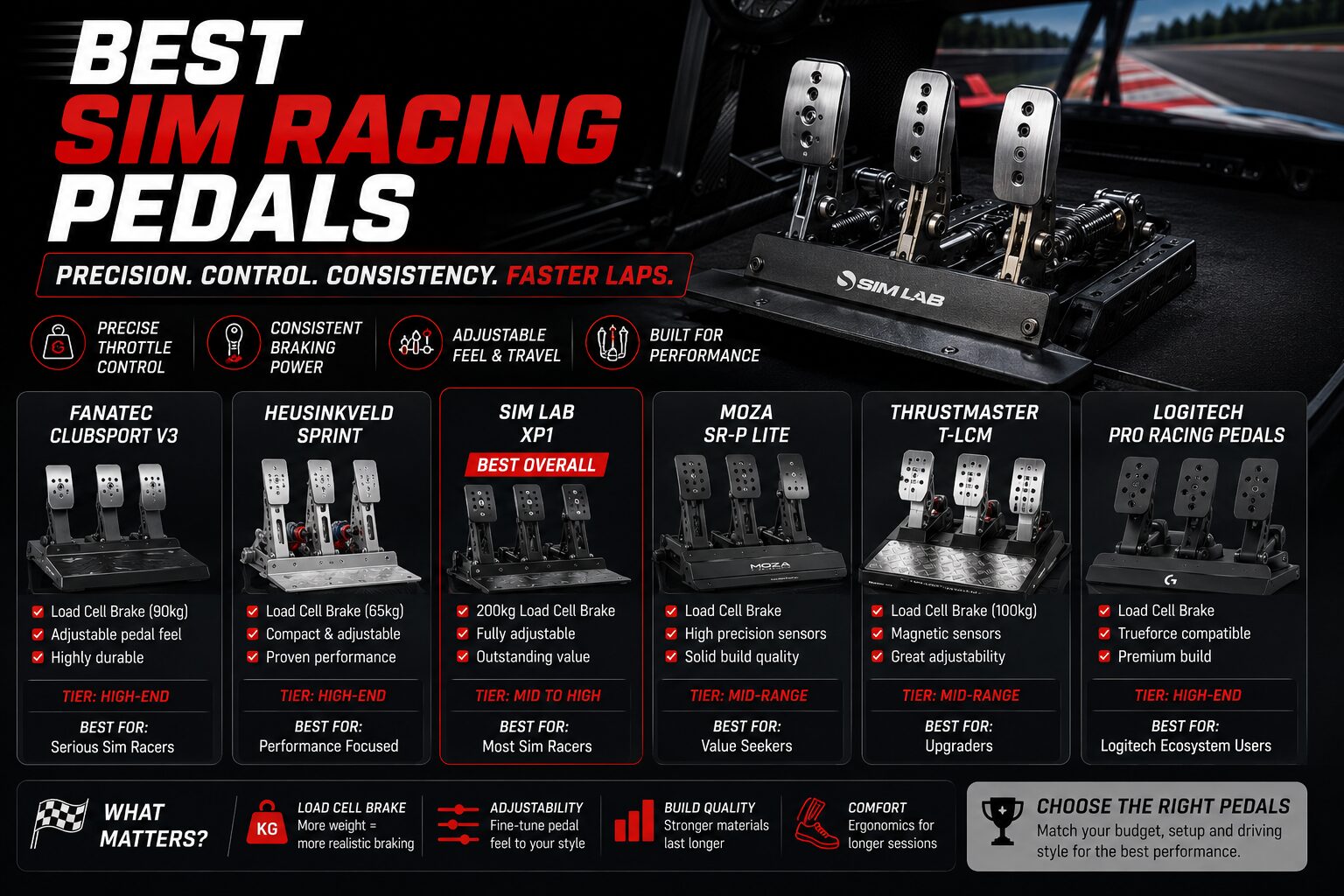
Best Sim Racing Pedals: 7 Pedal Sets I’d Choose for Better Braking and Faster Lap Times
The best sim racing pedals can improve consistency more than almost any other hardware upgrade. A stronger wheelbase may make a simulator feel more exciting, but a predictable brake pedal helps me repeat braking pressure, control weight transfer, avoid lockups, and carry the correct speed into every corner.
After comparing load-cell systems, hydraulic pedals, active pedals, entry-level upgrades, pedal construction, adjustability, software, mounting requirements, and long-term value, my top overall recommendation is the Heusinkveld Sim Pedals Sprint.
The Sprint pedals are not the most powerful, expensive, or technologically advanced option in this guide. I rank them first because they provide the balance I want from a serious home sim racing setup: strong steel construction, a pressure-sensitive brake, extensive physical adjustment, useful calibration software, and enough braking force for most drivers without requiring an extreme cockpit.
For a more modular system, I prefer the SIMAGIC P1000. Its optional hydraulic components, haptic reactors, inverted mounting, and flexible pedal configurations make it one of the most adaptable pedal platforms.
The MOZA CRP2 is my choice for buyers who want a premium 200 kg load-cell system with extensive brake-feel adjustment. At the highest end, the Simucube ActivePedal Pro changes the entire concept of a sim racing pedal by using an electronically controlled motor to recreate different pedal forces, travel profiles, and feedback effects.
In this guide, I compare the best sim racing pedals based on braking consistency, sensor technology, construction, comfort, adjustability, durability, mounting, compatibility, software, upgrade potential, and overall value.
Quick Answer: What Are the Best Sim Racing Pedals?
Disclosure: This post contains affiliate links. If you click through and make a purchase, we may earn a small commission at no extra cost to you.

MOZA CRP2 Load Cell Pedals (Throttle+Brake) Driving Sim Racing Pedal
Features 200kg load cell sensor and high-precision angle sensor, Carbon Fiber Heel Plate...
Check Price on Amazon.com
Fanatec Sim Racing CSL Elite Pedals V2 – PC, PS5, PS4
3-Pedal Set (Clutch, Brake, Throttle), Dual-Stage Load Cell Brake System, Hall-Effect Sensors
Check Price on Amazon.com
MOZA SR-P Pedals – Sim Racing Pedals Set with Load Cell 100 kg
Hybrid Brake, Organ Type Accelerator and 15 Bit Magnetic Encoders for PC
Check Price on Amazon.comThe Heusinkveld Sim Pedals Sprint are my best overall sim racing pedals. They combine a strong load-cell brake, compact steel construction, useful adjustability, excellent calibration software, and a realistic price for a serious home simulator.
- Best overall: Heusinkveld Sim Pedals Sprint
- Best modular pedals: SIMAGIC P1000
- Best premium value: MOZA CRP2
- Best for Fanatec users: Fanatec ClubSport Pedals V2
- Best entry-level load-cell upgrade: MOZA SR-P
- Best high-force passive pedals: Heusinkveld Ultimate+
- Best active pedal: Simucube ActivePedal Pro
Best Sim Racing Pedals Comparison Table
| Pedal Set | Brake Technology | Maximum Rated Force | Best For | My Score |
|---|---|---|---|---|
| Heusinkveld Sprint | Load cell with elastomers | Up to 65 kg actual pedal force | Best overall | 4.8/5 |
| SIMAGIC P1000 | 100 kg load cell with modular hydraulic options | 100 kg load-cell rating | Modularity and customization | 4.7/5 |
| MOZA CRP2 | 200 kg load cell plus angle sensor | 200 kg sensor range | Premium adjustment and value | 4.7/5 |
| Fanatec ClubSport V3 | Load cell | 90 kg load-cell rating | Fanatec and console ecosystems | 4.5/5 |
| MOZA SR-P | Load cell plus angle sensor | 100 kg sensor capacity | Entry-level load-cell upgrade | 4.4/5 |
| Heusinkveld Ultimate+ | Load cell with hydraulic damping | Up to 140 kg actual pedal force | High-force professional-style use | 4.8/5 |
| Simucube ActivePedal Pro | Motorized active pedal with load sensing | Up to 110 kg pedal force | Ultimate electronic customization | 4.9/5 |
How I Evaluated the Best Sim Racing Pedals
I do not rank pedals only by the maximum weight printed on a load-cell specification sheet.
A 200 kg sensor does not mean I should brake with 200 kg of physical force. The sensor rating describes its measurement range or capacity. The actual force experienced at the pedal plate depends on leverage, pedal geometry, calibration, elastomers, springs, hydraulic resistance, and the strength of the cockpit.
My evaluation focuses on whether a pedal allows me to produce the same useful input repeatedly.
Testing Methodology
- Initial brake application: How easily I can reach a predictable braking force.
- Threshold braking: How well the pedal supports braking near the tire’s grip limit.
- Trail braking: How precisely I can reduce pressure while entering a corner.
- Repeatability: Whether the same muscle effort produces the same in-game value.
- Throttle modulation: How smoothly I can apply power without breaking traction.
- Clutch engagement: Whether the clutch provides a useful bite-point sensation.
- Long-session comfort: Foot position, pedal-face shape, effort, and fatigue.
- Adjustment: Pedal spacing, height, angle, travel, spring resistance, and brake stiffness.
- Mounting rigidity: How securely the pedals connect to the simulator.
- Software: Calibration, curves, dead zones, profiles, and live adjustment.
Expert Scoring Criteria
| Scoring Category | Weight |
|---|---|
| Braking consistency | 25% |
| Pedal feel and modulation | 20% |
| Build quality and durability | 15% |
| Physical adjustability | 15% |
| Software and calibration | 10% |
| Compatibility and mounting | 10% |
| Value and upgrade potential | 5% |
Because not every product in this guide was physically tested under identical laboratory conditions, the rankings combine direct pedal-technology experience, official product documentation, engineering analysis, mounting requirements, software capability, and expected long-term use.
What Is a Load-Cell Brake Pedal?
A load-cell brake pedal measures pressure rather than relying only on pedal travel.
Basic pedals usually use a potentiometer or magnetic angle sensor. The farther the pedal moves, the more braking the game receives.
A load cell measures force. Once calibrated, a specific amount of pressure corresponds to a specific brake input.
Featured snippet answer: A load-cell sim racing pedal measures how hard the driver presses the brake rather than only how far the pedal moves. This makes it easier to develop muscle memory and repeat the same braking force from lap to lap.
Why Pressure Is Useful
My leg is generally better at repeating pressure than remembering a precise pedal position.
With a travel-based brake, I may need to move the pedal to exactly the same point every lap. With a load cell, I can learn how much pressure corresponds to 50%, 70%, or 90% braking.
This becomes especially useful during threshold braking and trail braking.
Does a Load Cell Make You Faster?
It does not create speed automatically.
The benefit is consistency. A predictable brake allows me to practice the same braking point and pressure instead of compensating for an inconsistent pedal.
Over time, that can reduce lockups, missed apexes, and large variations between laps.
Load Cell vs Hydraulic Pedals
A hydraulic pedal uses fluid, cylinders, or dampers to recreate resistance and motion. Many hydraulic sim pedals still use a load cell or pressure sensor to measure the final input.
Hydraulics primarily affect pedal feel. They can add damping, progression, and a more mechanical sensation.
A well-designed elastomer load-cell brake can still be extremely accurate. Hydraulic hardware is not automatically faster.
Active Pedals
An active pedal uses a motor or actuator to create configurable resistance and feedback.
Instead of changing springs and elastomers manually, I can use software to alter travel, force curves, damping, bite points, and feedback effects.
This is the most advanced category, but it is also the most expensive and demanding to mount.
1. Heusinkveld Sim Pedals Sprint – Best Sim Racing Pedals Overall
My Rating: 4.8/5
Best for: Serious PC sim racers and aluminum-profile cockpits
Brake type: Load cell with adjustable elastomer stack
Maximum actual brake force: Up to 65 kg
The Heusinkveld Sim Pedals Sprint are my best overall recommendation because they provide the performance most serious home racers need without pushing into professional-level force, complexity, or cost.
The Sprint pedals use laser-cut steel construction and separate pedal units. I can position the throttle, brake, and optional clutch independently rather than accepting a fixed spacing.
This matters because hip width, foot angle, seat position, and driving style differ between users.
Technical Specifications
| Construction | Laser-cut steel |
|---|---|
| Brake Technology | Load cell with elastomer resistance |
| Maximum Actual Brake Force | 65 kg |
| Configuration | Two-pedal or three-pedal set |
| Software | Heusinkveld SmartControl |
| Platform | PC |
| Mounting | Hard mounting strongly recommended |
Brake Performance
The Sprint brake is strong enough to create a firm, pressure-focused braking action while remaining usable on a normal rigid cockpit.
I do not need to use the full 65 kg setting. SmartControl allows me to calibrate the maximum in-game brake value to a pressure that suits my body and seat.
The elastomer stack controls stiffness and travel. A softer configuration creates more movement. A firmer configuration feels closer to a stiff race-car pedal.
I prefer enough movement to understand initial brake application but not so much that the pedal behaves like a road-car brake with excessive travel.
Throttle Analysis
The throttle is smooth and predictable. It does not need to be extremely heavy because throttle control is primarily about progressive movement.
Software curves allow me to soften the first part of the travel for powerful rear-wheel-drive cars or create a more direct response for vehicles that need quick throttle application.
Build Quality and Durability
The steel construction is functional rather than decorative.
Individual pedal arms, pivot points, springs, elastomers, and mounting holes are exposed and accessible. This makes adjustment and maintenance easier than on a closed consumer pedal set.
The design also avoids unnecessary plastic components in the main load paths.
Comfort
The pedal faces are relatively upright and motorsport-oriented. Correct mounting angle is important.
If the pedal plate is too flat or the seat is too high, I may press downward rather than forward, causing ankle fatigue.
Once the cockpit geometry is correct, the Sprint pedals support long sessions well because I can adjust pedal angle, spacing, and force to suit my position.
Software
SmartControl is one of the main reasons I rate the Sprint pedals highly.
I can adjust:
- Dead zones
- Maximum brake force
- Input curves
- Pedal output behavior
- Profiles for different cars
This allows one physical setup to behave differently for Formula, GT, road-car, and rally simulations.
Pros
- Excellent brake consistency
- Strong steel construction
- Independent pedal positioning
- Useful physical adjustment
- Excellent SmartControl software
- Compact enough for many cockpits
- Strong long-term reliability potential
- Available as two- or three-pedal sets
Cons
- PC only
- Hard mounting is effectively required
- No hydraulic system
- May feel too firm for casual users
- Baseplate may need to be purchased separately
Who Should Buy the Sprint?
I recommend the Sprint pedals to PC racers with a rigid wheel stand or cockpit who want a serious load-cell upgrade without moving into extreme high-force hardware.
Who Should Avoid Them?
I would avoid them for a loose desk-and-chair setup, console-only simulator, or cockpit with a flexible pedal plate.
My Best Overall Sim Racing Pedals
The Heusinkveld Sprint provides the balance of precision, adjustment, software, and durability I would choose for most serious PC rigs.
Check Heusinkveld Sprint Price
2. SIMAGIC P1000 – Best Modular Sim Racing Pedals
My Rating: 4.7/5
Best for: Racers who want hydraulic, haptic, or inverted upgrades
Brake type: 100 kg load cell with optional hydraulic system
The SIMAGIC P1000 is one of the most flexible pedal platforms available.
I can begin with a conventional load-cell configuration and later add hydraulic components, haptic pedal reactors, an inverted mounting system, different elastomer stacks, or a clutch.
This makes the P1000 less like one fixed pedal set and more like a configurable ecosystem.
Technical Specifications
| Construction | CNC aluminum alloy |
|---|---|
| Brake Sensor | 100 kg load cell |
| Resolution | 12-bit output |
| Hydraulic Upgrade | Optional or included with selected versions |
| Haptic Feedback | Optional Haptic Pedal Reactors |
| Inverted Layout | Optional P1000i configuration |
| Software | SIMPro Manager |
Brake Analysis
The standard load-cell brake can be adjusted using combinations of elastomers and springs.
The 100 kg load-cell capacity provides enough measurement range for a firm brake, although most drivers will calibrate the usable maximum much lower.
The optional hydraulic upgrade changes the movement and damping rather than simply increasing the sensor rating.
Haptic Pedal Reactors
The optional haptic reactors are one of the P1000’s most distinctive features.
They can provide physical feedback for effects such as:
- ABS activation
- Traction-control intervention
- Wheel lock
- Engine vibration
- Gear shifts
Game and software support varies, but brake-pedal ABS feedback can be genuinely useful. Instead of relying only on sound or the steering wheel, I can feel when the braking system is intervening.
Throttle and Clutch
The throttle resistance can be adjusted to suit different driving styles. A lighter throttle works well for quick Formula inputs, while a stronger setting can provide better control in high-powered road or GT cars.
The optional clutch provides a more progressive sensation than a basic spring pedal, although it does not completely reproduce the complex engagement of every real clutch system.
Build Quality
The CNC aluminum construction gives the P1000 a premium appearance and rigid pedal structure.
Its modularity introduces more parts and possible configurations, so installation and adjustment can take longer than with a simpler fixed set.
Pros
- Extremely modular design
- 100 kg load-cell brake
- Optional hydraulic upgrades
- Optional haptic feedback
- Available in standard and inverted layouts
- Strong CNC aluminum construction
- Good adjustment range
- Two- and three-pedal options
Cons
- Optional upgrades increase total cost
- Setup can become complicated
- Requires a strong pedal plate
- Hydraulics add maintenance considerations
- Haptic features depend on software support
Best Modular Pedal Platform
I would choose the P1000 when I want to add hydraulic resistance, pedal vibration, or an inverted layout over time.
Check SIMAGIC P1000 Price
3. MOZA CRP2 – Best Premium Pedals for Adjustment and Value
My Rating: 4.7/5
Best for: MOZA users and racers wanting extensive brake adjustment
Brake type: 200 kg load cell plus 15-bit angle sensor
The MOZA CRP2 represents a substantial improvement over MOZA’s basic and mid-range pedal sets.
It combines a high-capacity load cell, an additional angle sensor, aerospace-grade aluminum pedal bodies, a carbon-fiber heel plate, and a large selection of spring and elastomer configurations.
Technical Specifications
| Pedal Body | Aerospace-grade aluminum alloy |
|---|---|
| Heel Plate | 3K twill carbon fiber |
| Base | High-strength steel |
| Brake Load Cell | 0–200 kg range |
| Additional Brake Sensor | 15-bit angle sensor |
| Standard Brake Configurations | More than 100 available combinations |
| Clutch | Optional |
| Inverted Mounting | Supported with compatible hardware |
Brake Performance
The dual-sensor approach allows the system to consider both pressure and movement.
The 200 kg load-cell rating provides a large measurement range, but I would not interpret it as a recommendation to apply 200 kg at the pedal face.
MOZA provides multiple springs, elastomers, and adjustment combinations to change travel and progression.
This lets me create anything from a relatively soft road-car-style pedal to a short and firm race-car-style brake.
Tool-Free Adjustment
One of the CRP2’s practical advantages is the emphasis on quick mechanical changes.
Pedals that require substantial disassembly discourage experimentation. Easier access makes it more realistic to create separate setups for different vehicle categories.
Throttle and Clutch
The throttle supports different springs and continuous adjustment. The optional clutch uses a multi-stage mechanism intended to create a more noticeable engagement transition.
Upgrade Potential
The CRP2 is also part of MOZA’s broader pedal ecosystem, including compatibility paths involving its active-pedal technology.
That gives the platform an unusual future upgrade direction compared with a completely passive set.
Pros
- 200 kg load-cell sensor
- Additional 15-bit angle sensor
- Large brake-feel adjustment range
- Premium aluminum construction
- Carbon-fiber heel plate
- Tool-friendly adjustment system
- Optional clutch
- Inverted mounting support
Cons
- Requires hard mounting
- Can be excessive for beginners
- Clutch may cost extra
- Large adjustment range can feel overwhelming
- Full MOZA ecosystem configuration may increase cost
Check MOZA CRP2 Price
4. Fanatec ClubSport Pedals V2 – Best for Fanatec and Console Ecosystems
My Rating: 4.5/5
Best for: Fanatec users and compatible console setups
Brake type: 90 kg load cell
The Fanatec ClubSport Pedals V2 remain an important option because they combine load-cell braking, integrated throttle and brake vibration motors, metal construction, and compatibility with the Fanatec ecosystem.
They are older than several products in this comparison, but their feature set remains useful for drivers who need console compatibility through a compatible Fanatec wheelbase.
Technical Specifications
| Construction | CNC-machined aluminum components |
|---|---|
| Brake Sensor | 90 kg load cell |
| Button Quantity | 16 |
| Throttle and Clutch Sensors | Contactless magnetic sensors |
| Vibration | Integrated motors on brake and throttle |
| Configuration | Three-pedal set |
| Connection | USB on PC or compatible Fanatec wheelbase |
Brake Performance
The load-cell brake measures pressure and can be adjusted for different stiffness levels.
An optional Brake Performance Kit is often considered an important addition because it allows more substantial changes to the elastomer response.
Vibration Feedback
The brake and throttle vibration motors can represent effects such as ABS, wheel lock, or traction loss when supported by the game, wheelbase, or software configuration.
The effect is less powerful than dedicated haptic reactors, but it adds information that many conventional pedals do not provide.
Build Quality
The main structure is metal and feels substantial. However, the integrated base limits independent pedal spacing compared with separate pedal units.
This is the main ergonomic disadvantage for drivers who want a custom two-pedal arrangement.
Compatibility Advantage
On PC, the pedals can operate as a separate USB device.
For compatible console setups, connecting through a supported Fanatec wheelbase can make them more practical than PC-only pedal systems.
Pros
- 90 kg load-cell brake
- Three pedals included
- Integrated vibration motors
- Metal construction
- Fanatec ecosystem integration
- Potential console compatibility through a compatible wheelbase
- Contactless throttle and clutch sensors
Cons
- Older design
- Fixed pedal spacing
- Brake Performance Kit may be needed for the best feel
- Adjustment can require disassembly
- Less modular than newer competitors
5. MOZA SR-P – Best Entry-Level Load-Cell Pedals
My Rating: 4.4/5
Best for: Budget-conscious PC racers moving beyond basic pedals
Brake type: Load cell plus angle sensor
The MOZA SR-P pedals are the option I would consider when I want pressure-sensitive braking without moving immediately into premium hardware.
They are different from the SR-P Lite pedals supplied with many R3 and R5 bundles. The standard SR-P brake includes a load cell.
Technical Specifications
| Construction | High-strength steel |
|---|---|
| Brake Sensor | Load cell plus angle sensor |
| Maximum Sensor Capacity | 100 kg |
| Angle Resolution | 15-bit |
| Configuration | Two-pedal set with optional clutch |
| Connection | USB |
| Pedal Spacing | Adjustable |
Brake Feel
The brake is less sophisticated than the Sprint, P1000, or CRP2, but it provides the key functional upgrade: pressure-based braking.
An optional accessory kit can add resistance and progression.
Mounting
The pedals include anti-slip material, but a load-cell brake works best when the pedal set and seat cannot move apart.
For desk users, I would place the pedals against a wall and prevent the chair from rolling. A basic wheel stand is a better solution.
Value
The SR-P set makes sense when the budget is limited and I would rather spend the remaining money on a cockpit or stronger wheelbase.
Pros
- Affordable load-cell upgrade
- 100 kg sensor capacity
- Load cell plus angle sensing
- Steel construction
- Optional clutch
- USB connection
- Adjustable pedal spacing
Cons
- Less refined brake feel than premium sets
- Basic throttle
- Requires secure mounting for best results
- Accessory kit may be needed for firmer braking
- Primarily PC-focused when used by USB
Check MOZA SR-P Price
6. Heusinkveld Ultimate+ – Best High-Force Passive Sim Racing Pedals
My Rating: 4.8/5
Best for: Advanced racers, professional simulators, and very rigid rigs
Maximum actual brake force: Up to 140 kg
The Heusinkveld Ultimate+ is designed for drivers who want much higher pedal forces and hydraulic damping without moving to an electronically active system.
The brake supports up to 140 kg of actual force at the pedal. That is far beyond what most home users need.
Technical Specifications
| Construction | Powder-coated and glass-bead-blasted stainless steel |
|---|---|
| Maximum Actual Brake Force | 140 kg |
| Brake Damping | Adjustable two-way hydraulic damping |
| Clutch Damping | Adjustable two-way hydraulic damping |
| Throttle Damping | Adjustable one-way hydraulic damping |
| Software | SmartControl and SmartControl Live |
| Platform | PC |
| Recommended Mounting | Full-frame rigid simulator |
Brake Performance
The Ultimate+ is not simply a stronger Sprint.
Hydraulic dampers influence how quickly the pedal moves and returns. This allows the pedal to recreate more complex resistance than an elastomer-only system.
I would still calibrate the maximum force to a realistic and comfortable level. Using a 140 kg setting simply because it is available can cause fatigue and place unnecessary stress on the body and cockpit.
Clutch and Throttle
The hydraulic damping also affects the clutch and throttle, giving the complete set a more mechanical and controlled character.
This can be particularly valuable in professional training simulators or premium rigs intended to mimic specific vehicles.
Mounting Demands
The Ultimate+ requires a rigid cockpit and strong pedal plate.
A flexible frame will absorb pedal force, reduce consistency, and potentially damage mounting components.
Pros
- Up to 140 kg actual brake force
- Adjustable hydraulic damping
- Extremely strong construction
- Excellent software
- Independent pedal mounting
- Suitable for professional applications
- Wide adjustment range
Cons
- Expensive
- Requires a very rigid cockpit
- Excessive for most home racers
- PC only
- High-force settings may cause fatigue
Check Heusinkveld Ultimate+ Price
7. Simucube ActivePedal Pro – Best Active Sim Racing Pedal
My Rating: 4.9/5
Best for: Ultimate PC simulators and software-defined pedal feel
Pedal type: Motorized active pedal
Maximum pedal force: Up to 110 kg
The Simucube ActivePedal Pro is fundamentally different from every passive pedal in this guide.
Instead of using a fixed spring, elastomer, or hydraulic arrangement to define the pedal, it uses an electronically controlled motor system.
Software can alter the pedal’s force, travel, response, damping, and feedback characteristics.
Technical Specifications
| Maximum Pedal Force | Up to 110 kg |
|---|---|
| Maximum Travel | Up to 74 mm |
| Angle Adjustment | 18 degrees |
| Dimensions | Approximately 100 × 255 × 418 mm |
| Weight | Approximately 5.8–6 kg |
| Feedback | Software-defined active effects |
| Connection | Simucube Link ecosystem |
Software-Defined Pedal Feel
The ActivePedal can imitate different pedal styles without physically rebuilding the mechanism.
I can change:
- Maximum force
- Pedal travel
- Initial resistance
- Progressive force curves
- Damping
- Return behavior
- ABS vibration
- Traction-control effects
- Clutch bite-point behavior
This is especially valuable for a simulator used with many vehicle types.
A Formula brake, GT brake, road-car throttle, and clutch pedal can require very different resistance and movement. An active pedal can switch between profiles without replacing springs or elastomers.
Performance
The main advantage is repeatability.
A software profile can be loaded exactly rather than approximated through physical adjustments.
Telemetry-based effects can also provide information directly through the pedal, allowing me to feel ABS or other systems where they occur physically.
Build Quality and Mounting
Each pedal is large, heavy, and powerful. It requires secure mounting with multiple fasteners and a rigid simulator.
This is not hardware I would attach to a lightweight folding wheel stand.
Cost
The price is the main limitation.
A complete active-pedal system may cost more than an entire mid-range simulator. Passive throttle or clutch extensions can reduce the cost compared with using three active units, but it remains an ultra-premium product.
Pros
- Software-defined pedal feel
- Up to 110 kg pedal force
- Adjustable travel and response
- Telemetry-based feedback
- Exact profile repeatability
- Can simulate multiple pedal types
- Exceptional long-term flexibility
Cons
- Extremely expensive
- Large and heavy
- Requires a rigid cockpit
- PC-focused
- More complex power and connection requirements
- Unnecessary for most racers
The Ultimate Active Pedal
I would consider the ActivePedal Pro only after the cockpit, wheelbase, display, and seat were already at a similarly high level.
Check ActivePedal Pro Price
Sim Racing Pedal Decision Matrix
| Your Priority | My Recommendation | Why |
|---|---|---|
| Best overall | Heusinkveld Sprint | Excellent balance of precision, construction, software, and price |
| First load-cell pedal | MOZA SR-P | Affordable pressure-sensitive brake |
| Hydraulic upgrade potential | SIMAGIC P1000 | Modular hydraulic options |
| Haptic brake feedback | SIMAGIC P1000 | Optional pedal reactors |
| Maximum passive brake force | Heusinkveld Ultimate+ | Up to 140 kg actual pedal force |
| Fanatec console ecosystem | ClubSport Pedals V2 | Can connect through compatible Fanatec hardware |
| MOZA ecosystem | MOZA CRP2 | Premium construction and broad adjustment |
| Software-defined pedal feel | Simucube ActivePedal Pro | Motorized force and travel profiles |
| Two-pedal GT setup | Heusinkveld Sprint | Compact separate pedals and strong brake |
| Professional training simulator | Ultimate+ or ActivePedal Pro | High force, repeatability, and advanced configuration |
How to Choose the Best Sim Racing Pedals
1. Prioritize the Brake Pedal
The brake should receive most of the attention.
A premium throttle can feel smooth and realistic, but braking has a larger influence on lap-time consistency.
If the budget is limited, I would rather own a strong load-cell brake with a basic throttle than a beautiful three-pedal set with a weak travel-based brake.
2. Choose Between Travel-Based and Pressure-Based Braking
Travel-based pedals are appropriate for casual racing and low-cost setups.
Pressure-based load-cell pedals make more sense once I begin practicing consistent braking points or racing competitively.
3. Do Not Buy Based Only on Load-Cell Capacity
A 200 kg sensor is not automatically twice as useful as a 100 kg sensor.
I consider:
- Actual force at the pedal face
- Pedal leverage
- Elastomer quality
- Travel
- Calibration
- Cockpit strength
- Personal comfort
A well-designed 65 kg brake can outperform a poorly configured 200 kg system for a particular driver.
4. Match the Pedals to the Cockpit
Load-cell pedals push the simulator backward while the driver pushes forward.
If the seat, pedal plate, or cockpit moves, braking consistency suffers.
I would not install a very high-force pedal set on a folding stand unless the stand is specifically designed for it.
5. Decide Whether You Need a Clutch
Many modern race cars use paddle shifters and do not require a clutch during normal shifting.
A two-pedal setup is ideal for GT, Formula, prototype, and many modern touring-car simulations.
I would add a clutch for:
- Manual road cars
- Historic racing
- H-pattern shifting
- Rally cars
- Truck simulation
- Drifting
6. Consider Pedal Spacing
Separate pedals allow me to position the brake directly in front of my strongest leg and remove the clutch when it is not needed.
Fixed-base pedals are easier to install but may not fit every driver equally well.
7. Check Software Quality
Good software can make the same physical pedal set work for many vehicles.
I look for:
- Calibration
- Dead-zone adjustment
- Input curves
- Maximum brake force
- Profiles
- Live input graphs
- Firmware support
8. Decide Whether Hydraulics Are Worth It
Hydraulic resistance can improve damping and realism, but it introduces seals, fluid, cylinders, and maintenance considerations.
I would not choose hydraulics only because the term sounds more realistic.
A high-quality elastomer brake can be accurate, durable, and easier to maintain.
9. Consider Haptic or Active Feedback
Pedal feedback can communicate ABS, traction control, tire lock, or engine effects.
Haptic motors are less expensive and easier to add. Active pedals provide much broader force control but at a substantially higher cost.
10. Set a Realistic Brake Force
More force is not automatically better.
The correct setting is one I can reach repeatedly without lifting my body from the seat, locking my knee, or creating pain.
I increase force gradually as technique and cockpit stability improve.
Sim Racing Pedal Compatibility
PC Compatibility
PC offers the broadest pedal compatibility.
Most premium sets connect directly by USB and can operate independently from the wheelbase.
This allows me to combine a MOZA wheelbase, Heusinkveld pedals, a Fanatec shifter, and other accessories if each device has suitable PC support.
PlayStation and Xbox Compatibility
Console compatibility is more restrictive.
Pedals often need to connect through a compatible wheelbase from the same ecosystem.
For example, Fanatec pedals may work on a supported console when connected through an appropriate Fanatec wheelbase and steering-wheel configuration.
USB pedals that work independently on PC should not be assumed to work directly on a console.
Mounting Compatibility
Before buying, I check:
- Pedal mounting-hole pattern
- Baseplate dimensions
- Pedal-deck length and width
- Maximum supported braking force
- Heel-plate height
- Available angle adjustment
- Whether drilling or adapter plates are required
Related guides:
Best Sim Racing Pedal Upgrade Path
I would upgrade pedals in stages rather than buying accessories randomly.
- Secure the existing pedals and chair.
- Add a brake resistance modification if available.
- Move to an entry-level load-cell brake.
- Upgrade the cockpit or pedal plate.
- Move to adjustable premium pedals.
- Add a clutch only when needed.
- Add haptic feedback if the simulation supports it.
- Consider hydraulic or active pedals only after the rest of the rig is balanced.
Should You Upgrade the Wheel or Pedals First?
If I already own a functioning force-feedback wheel but still use a basic travel-based brake, I would usually upgrade the pedals first.
Better pedals may not make the simulator look as impressive, but they can improve the input that matters most at corner entry.
Should You Upgrade the Cockpit First?
Yes, when the current frame or chair moves under braking.
A premium load-cell pedal cannot perform consistently if the pedal deck bends or the seat rolls backward.
Best Alternatives
Fanatec CSL Elite Pedals V2
The CSL Elite V2 is an alternative for buyers who want a modular Fanatec load-cell system at a lower level than the ClubSport V3.
Its removable clutch and adjustable pedal positions may suit a two-pedal GT setup better than the fixed ClubSport layout.
Logitech PRO Racing Pedals
Logitech’s PRO pedals are a useful option for racers already invested in the Logitech G ecosystem and needing compatible console operation through supported hardware.
Asetek Invicta Pedals
The Invicta platform targets drivers who want a very firm hydraulic-style brake and high-end construction.
It is better suited to a rigid cockpit and drivers who prefer limited brake travel.
VRS DirectForce Pro Pedals
VRS pedals are a strong alternative for PC racers who prefer spring-based mechanical resistance and extensive individual-pedal adjustment.
SimJack and Simsonn Pedals
Lower-cost metal load-cell pedals can provide strong value, but software, quality control, documentation, and support may vary more than with established premium manufacturers.
Common Sim Racing Pedal Buying Mistakes
Buying the Highest Load-Cell Number
The largest sensor rating does not guarantee the best pedal feel or the best lap times.
Ignoring the Cockpit
A flexible pedal plate can waste the benefits of an expensive brake.
Setting the Brake Too Heavy
If I cannot reach full braking without moving my body, the force is too high.
Using a Rolling Chair
A chair that moves backward changes the relationship between my leg and the pedal on every braking event.
Changing Too Many Adjustments at Once
I change one variable, test it, and then decide whether to keep it.
Assuming Hydraulic Means More Accurate
Hydraulics affect feel. Sensor quality, calibration, and mechanical consistency determine accuracy.
Buying a Clutch That Will Never Be Used
A two-pedal setup can provide better spacing and lower cost for modern GT and Formula racing.
Forgetting Console Compatibility
PC USB support does not guarantee PlayStation or Xbox support.
Frequently Asked Questions About Sim Racing Pedals
What are the best sim racing pedals?
My best overall choice is the Heusinkveld Sim Pedals Sprint. They combine a strong load-cell brake, steel construction, extensive adjustment, useful software, and manageable mounting requirements.
What are the best budget load-cell pedals?
The MOZA SR-P pedals are a strong entry-level choice because the brake uses both load-cell and angle sensing and the set connects directly by USB on PC.
Do sim racing pedals make you faster?
They do not create speed automatically. A consistent load-cell brake can make it easier to repeat braking pressure, reduce lockups, and improve corner-entry consistency.
What is a load-cell brake?
A load-cell brake measures how hard the pedal is pressed rather than only how far it moves.
Is a load-cell brake worth it?
Yes, for drivers who race regularly. It is one of the most useful upgrades for developing repeatable braking technique.
Is a 100 kg load cell better than a 60 kg load cell?
Not automatically. The rating describes sensor capacity. Pedal geometry, actual force, calibration, elastomers, software, and cockpit rigidity also matter.
How much brake force should I use?
Use a force you can reach repeatedly without pain, excessive body movement, or loss of control. Many home racers use far less than the maximum supported force.
Are hydraulic pedals better?
Hydraulic systems can provide realistic damping and progression, but a well-designed elastomer load-cell pedal may be equally precise and easier to maintain.
What is an active pedal?
An active pedal uses a motor or actuator to generate configurable resistance, travel, and feedback effects through software.
Are active pedals worth it?
They are worth considering for ultra-premium simulators, professional training, or users who frequently change vehicle types. They are unnecessary for most home racers.
Do I need three pedals?
No. Modern GT, Formula, and prototype cars usually use paddle shifters, making a two-pedal setup sufficient. A clutch is useful for manual and historic cars.
Can I use different pedal and wheel brands?
Yes on PC when the pedals connect independently by USB. Console users generally need compatible devices connected through the same supported ecosystem.
Can I use load-cell pedals on the floor?
It is possible at low force if the pedals are braced and the chair cannot move. Hard mounting to a wheel stand or cockpit is strongly preferred.
Why do my pedals move when braking?
The pedal set is not sufficiently secured for the selected brake force. Mount it to a rigid plate, reduce force, brace it against a wall, or use a cockpit.
What is trail braking?
Trail braking is the gradual reduction of brake pressure while steering into a corner. A predictable load-cell pedal makes this easier to practice.
Should I upgrade pedals before a direct drive wheel?
Often, yes. When the current wheel already has useful force feedback but the brake is basic, a load-cell pedal can provide the larger consistency improvement.
Are the Heusinkveld Sprint pedals enough?
Yes. Their maximum 65 kg actual brake force is enough for most serious home racers. The Ultimate+ is mainly for drivers needing higher force and hydraulic damping.
Are SIMAGIC P1000 pedals hydraulic?
The platform is available in standard load-cell and hydraulic configurations, with hydraulic components offered in selected versions or as upgrades.
Is the MOZA CRP2 load cell really 200 kg?
The official sensor range is up to 200 kg. That does not mean the driver must apply 200 kg at the pedal face.
Do Fanatec ClubSport V2 pedals work on consoles?
They may work when connected through a compatible Fanatec wheelbase and supported console configuration. Direct USB console operation should not be assumed.
What pedals are best for Assetto Corsa Competizione?
I prefer load-cell pedals with a predictable brake, such as the Heusinkveld Sprint, SIMAGIC P1000, or MOZA CRP2. ACC rewards consistent braking and trail-braking control.
What pedals are best for iRacing?
The Sprint is an excellent general choice. The Ultimate+ and ActivePedal Pro suit high-end competitive or professional systems.
Final Verdict: Which Sim Racing Pedals Should You Buy?
The Heusinkveld Sim Pedals Sprint are my best overall recommendation.
They provide the qualities that matter most: a repeatable load-cell brake, strong construction, independent positioning, useful adjustment, reliable calibration, and excellent software.
The 65 kg maximum actual pedal force is enough for most home sim racers. I would rather use a well-configured Sprint brake on a rigid cockpit than a much stronger sensor attached to a flexible pedal plate.
The SIMAGIC P1000 is the better choice when modularity is the priority. Optional hydraulic systems, haptic reactors, inverted mounting, and different pedal configurations allow the platform to grow with the simulator.
The MOZA CRP2 offers an impressive combination of premium materials, a 200 kg load cell, angle sensing, and extensive brake adjustment. It is the set I would consider for a higher-end MOZA-based rig.
The Fanatec ClubSport V2 remains relevant for Fanatec users and compatible console setups. Its fixed layout is less flexible than newer alternatives, but the load-cell brake, vibration motors, and ecosystem integration remain useful.
For an affordable first load-cell upgrade, I would look at the MOZA SR-P.
At the high end, the Heusinkveld Ultimate+ provides extreme passive braking force and hydraulic damping for advanced simulators.
The Simucube ActivePedal Pro is the technological leader. It can alter force, travel, damping, and feedback through software, but its cost and mounting demands place it far beyond what most racers need.
My final advice is to buy the pedal set that matches the strength of the cockpit and the pressure your body can repeat comfortably.
A brake pedal does not need to be painfully heavy to be realistic or effective. It needs to be stable, predictable, and adjustable enough to support consistent technique.
My Final Recommendations
Best overall: Heusinkveld Sim Pedals Sprint
Best modular pedals: SIMAGIC P1000
Best premium value: MOZA CRP2
Best for Fanatec users: Fanatec ClubSport Pedals V2
Best entry-level load cell: MOZA SR-P
Best high-force passive pedals: Heusinkveld Ultimate+
Best active pedal: Simucube ActivePedal Pro
Ready to Upgrade Your Braking?
If I were building a serious PC simulator today, I would start with the Heusinkveld Sprint and invest the remaining budget in a rigid cockpit and supportive seat.

Hi, I’m Peter Edwards, a lifelong sim racing enthusiast, tech tinkerer, and automotive geek with a passion for making virtual racing feel as real as possible. I’ve spent years testing steering wheels, pedals, and full cockpit rigs—from entry-level gear to pro-grade setups—to help others build immersive, affordable racing experiences at home.
When I’m not tightening bolts on my rig or tuning force feedback curves, you’ll find me comparing telemetry data, exploring new racing titles, or helping fellow racers fine-tune their setups. My goal is to share honest, experience-based insights that help every driver—from casual weekend racers to aspiring eSports pros—get faster, smoother, and more connected to the track.
I write for SimRacingEnthusiast.com, where I share deep-dive reviews, setup guides, and honest opinions on the latest in the sim racing world.