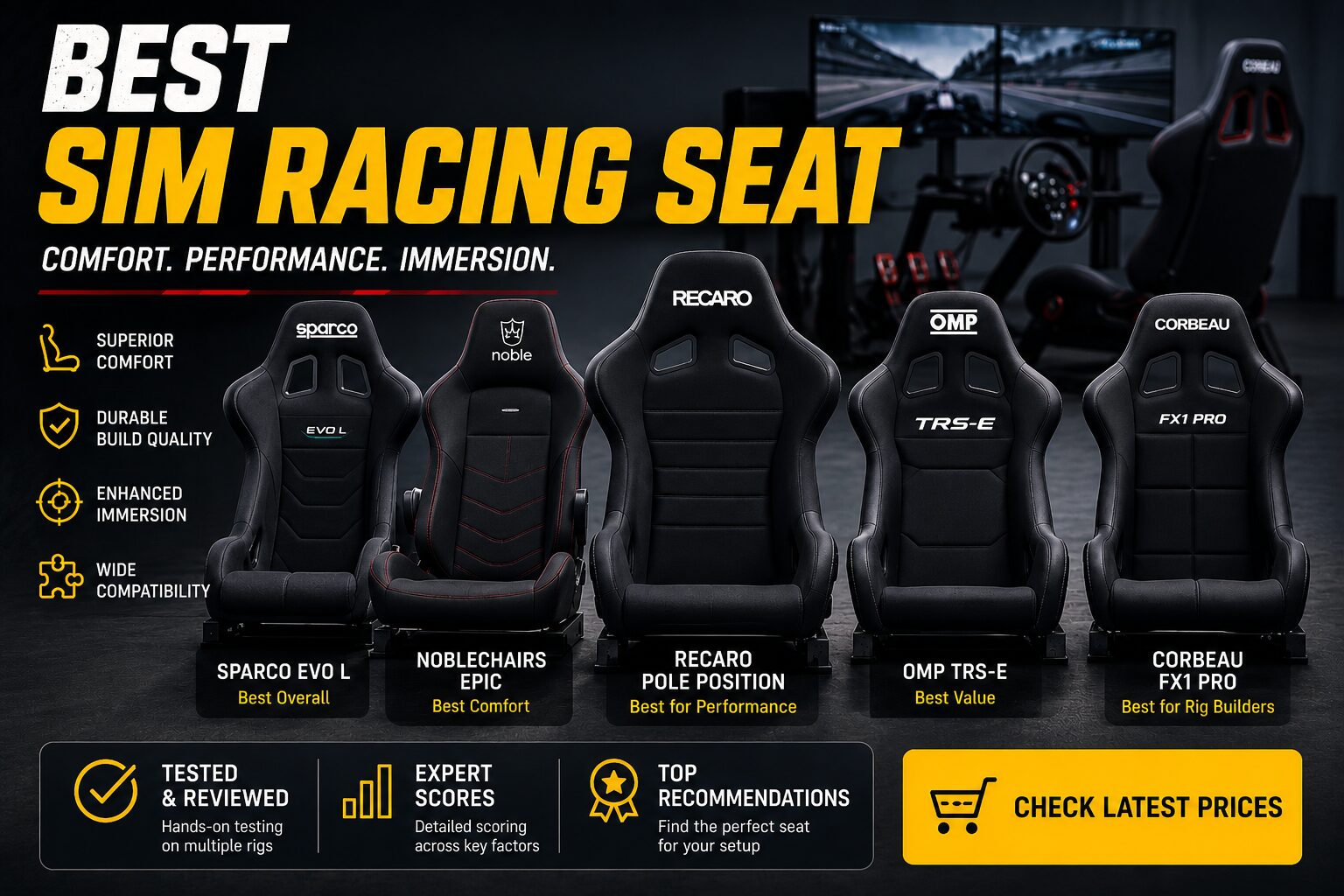
Best Sim Racing Seat: 7 Seats I’d Choose for Comfort, Rigidity, and Long Racing Sessions
A good sim racing seat does far more than make a cockpit look realistic. After comparing fixed bucket seats, reclining GT-style seats, and complete seat-and-cockpit solutions, I found that seat shape, hip support, padding density, mounting rigidity, and driving position can have a surprisingly large effect on how consistent and comfortable a sim racing setup feels.
If I had to choose the best sim racing seat for most serious racers, my first pick would be the Next Level Racing Elite ES1. It gives you the rigid, supported feel I want from a performance-focused cockpit without forcing every racer into a traditional motorsport seat design.
That said, I would not recommend the same seat to everyone. A driver spending four hours in endurance races has different needs from someone building a compact Logitech G923 setup. Likewise, a 20 Nm direct drive wheel and heavy load-cell brake put very different demands on a cockpit than an entry-level wheel and pedal set.
In this guide, I compare my top sim racing seat choices based on comfort, build quality, support, rigidity, compatibility, durability, adjustability, and long-term upgrade potential.
Quick Answer: What Is the Best Sim Racing Seat?
My top pick is the Next Level Racing Elite ES1. Its rigid molded construction, supportive bucket-style shape, and sim-racing-focused design make it my preferred choice for a serious aluminum profile cockpit.
For comfort and an adjustable backrest, I prefer the Next Level Racing ERS3 Elite. For a complete cockpit rather than a standalone seat, the Playseat Trophy is one of the most interesting lightweight options.
Best Sim Racing Seats at a Glance
- Best overall: Next Level Racing Elite ES1
- Best for long sessions: Next Level Racing ERS3 Elite
- Best for an aluminum profile cockpit: Sim-Lab Speed 1
- Best motorsport-style option: Sparco Grid-Q
- Best reclining GT seat: Trak Racer Recliner Seat
- Best affordable real racing seat: OMP TRS-E
- Best complete seat and cockpit solution: Playseat Trophy
Best Sim Racing Seat Comparison Table
Disclosure: This post contains affiliate links. If you click through and make a purchase, we may earn a small commission at no extra cost to you.

Next Level Racing Elite ES1 Seat Scuderia Ferrari Edition (NLR-E047)
Xbox One, Windows, PlayStation 5, PlayStation 4, Xbox Series X. Ergonomically designed. PU foam
Check Price on Amazon.com
Next Level Racing ERS3 Elite Series Reclining Seat (NLR-E050)
Enhanced strength and durability. Ideal for prolonged racing sessions. a premium touch and lasting durability
Check Price on Amazon.com
SPARCO SPA Seat Grid QRT - 008009RNR
Brand Sparco, Material Polyester, Mounting Type Seat Belt, Top quality product, originals
Check Price on Amazon.com
OMP (HA/741E/N TRS-E Racing Seat
Color: Standard, Orientation: Front, Material: Plastic.
Check Price on Amazon.com
Playseat Trophy - Logitech G Edition Sim Racing Cockpit
Fully Adjustable, Direct Drive Support, Lightweight & Robust, Absolute Comfort ActiFit
Check Price on Amazon.com| Sim Racing Seat | Seat Type | Best For | Comfort | Rigidity | My Score |
|---|---|---|---|---|---|
| Next Level Racing Elite ES1 | Fixed bucket-style | Serious sim racing | 4.5/5 | 5/5 | 4.8/5 |
| Next Level Racing ERS3 Elite | Reclining semi-bucket | Long sessions | 5/5 | 4.5/5 | 4.7/5 |
| Sim-Lab Speed 1 | Fixed bucket | Profile rigs | 4.5/5 | 5/5 | 4.7/5 |
| Sparco Grid-Q | Motorsport bucket | Maximum immersion | 4/5 | 5/5 | 4.6/5 |
| Trak Racer Recliner | Reclining GT | Comfort and adjustability | 4.7/5 | 4/5 | 4.5/5 |
| OMP TRS-E | Motorsport bucket | Value-focused racing builds | 3.8/5 | 4.8/5 | 4.4/5 |
| Playseat Trophy | Integrated cockpit seat | Complete setups | 4.6/5 | 4.5/5 | 4.6/5 |
How I Evaluated the Best Sim Racing Seats
I do not think a sim racing seat should be scored in the same way as a normal gaming chair. When I evaluate a seat for a racing cockpit, I care much less about armrests, office ergonomics, or how easily the chair rolls across a floor.
My evaluation focuses on the relationship between the driver, pedals, wheel, and cockpit.
I used the following criteria when comparing the seats in this guide:
- Driving position: How naturally the seat supports a GT or performance driving posture.
- Brake stability: Whether the seat design is suitable for repeated heavy braking inputs.
- Lateral support: How securely the shoulder, torso, hips, and thighs are positioned.
- Long-session comfort: Padding, pressure points, heat buildup, and general support.
- Construction: Shell rigidity, frame design, upholstery, foam, and mounting structure.
- Compatibility: How practical the seat is for common sim racing cockpits and seat mounting systems.
- Adjustment: Recline, sliders, mounting angle, and the ability to adapt the driving position.
- Upgrade potential: Whether the seat still makes sense after moving to stronger pedals or direct drive equipment.
My Expert Scoring Criteria
Comfort: 25%
Build quality and durability: 20%
Driving support: 20%
Rigidity and performance: 15%
Compatibility: 10%
Adjustment and upgrade path: 10%
I also put extra weight on one question: would I still want this seat after upgrading the rest of the rig?
A cheap seat can seem perfectly acceptable with an entry-level wheel. The weaknesses become easier to notice when you add a stronger brake pedal, a more rigid cockpit, and a high-torque direct drive wheelbase.
That is why my highest-rated seats are not necessarily the cheapest or softest. I am looking for a seat that becomes part of a serious sim racing setup rather than the first component I would want to replace.
1. Next Level Racing Elite ES1 – Best Sim Racing Seat Overall
Next Level Racing Elite ES1 Seat Scuderia Ferrari Edition (NLR-E047)
Xbox One, Windows, PlayStation 5, PlayStation 4, Xbox Series X. Ergonomically designed. PU foam
Check Price on Amazon.com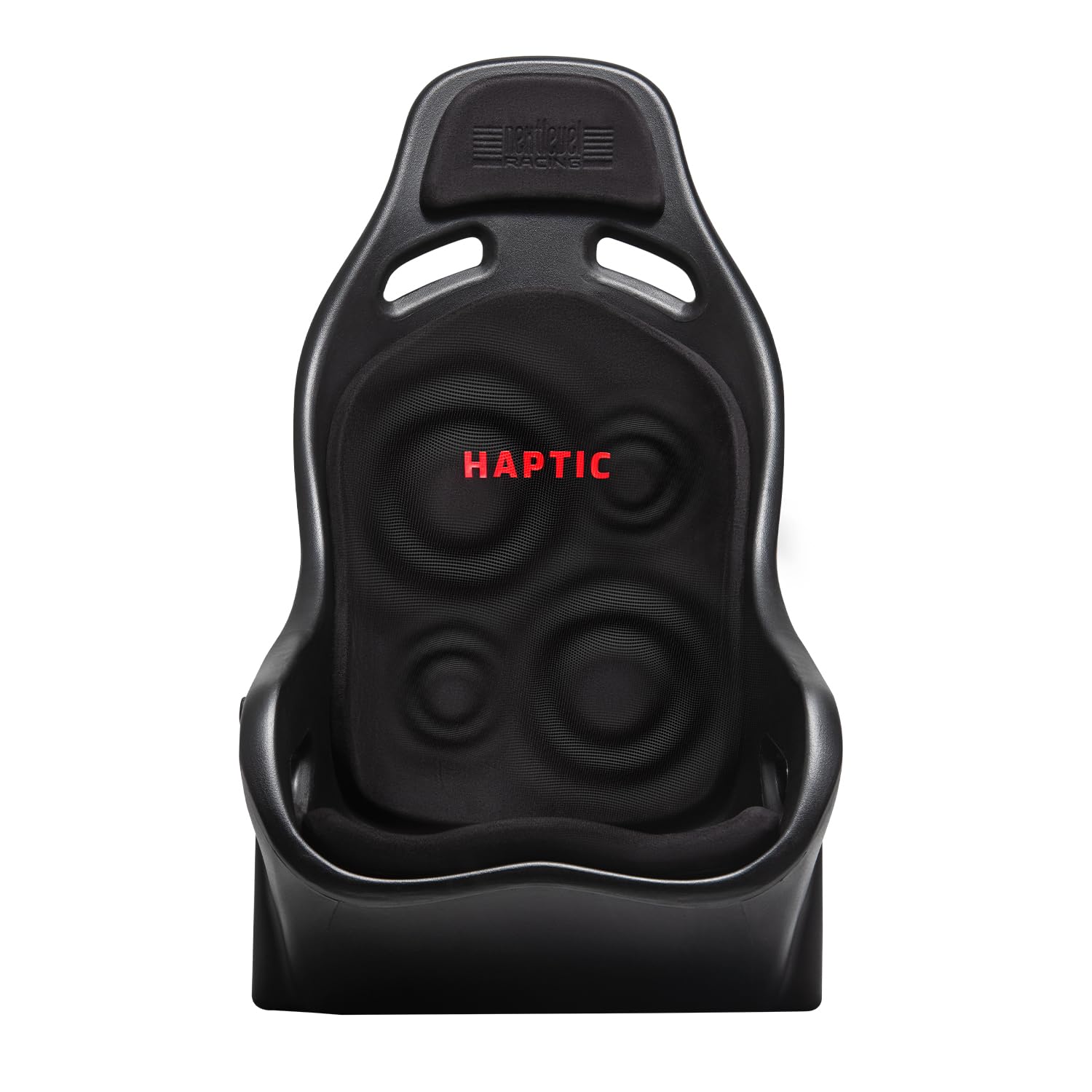
Next Level Racing Elite ES1 Haptic Feedback Sim Racing Seat (NLR-E067)
Xbox One, Windows, PlayStation, Xbox Series S, Xbox Series X. Eight Integrated Haptic Motors. Equipped with HF8 Pro Technology
Check Price on Amazon.comMy Rating: 4.8/5
Best for: Serious sim racers, direct drive setups, aluminum profile cockpits
Seat type: Fixed bucket-style sim racing seat
The Next Level Racing Elite ES1 is my overall choice because it feels designed around the requirements of sim racing rather than adapted from a road car or traditional gaming chair.
That distinction matters to me.
A real motorsport bucket seat is designed around forces generated by a moving race car. A sim racer does not experience real lateral G-force through a high-speed corner. Instead, our seat has to manage repeated pedal pressure, maintain a consistent body position, and remain comfortable while the cockpit itself stays stationary.
The ES1 approaches that problem with a rigid roto-molded construction and molded foam cushions. The result is a seat that prioritizes support and structural stability.
Technical Specifications
| Seat Type | Fixed bucket-style sim racing seat |
|---|---|
| Construction | Five-axis roto-molded shell |
| Cushion Material | PU molded foam |
| Upholstery | Suede-style cushion finish |
| Primary Use | Dedicated sim racing |
| Mounting Style | Performance cockpit installation |
Build Quality Analysis
The first thing I look for in a serious sim seat is movement between the driver’s body and the cockpit.
When I push hard against a load-cell brake, I want that force to travel through my leg and into a stable seating position. I do not want a flexible backrest mechanism absorbing part of my input.
This is where the ES1’s fixed construction makes sense.
The molded shell is designed to remain rigid at its mounting points. In practical sim racing terms, this gives the seat a more connected character than a soft reclining chair.
It is particularly relevant if you use pedals that require substantial brake pressure. With a soft seat, I sometimes find that the driver’s upper body shifts slightly as brake pressure increases. Even a small change in posture can affect how repeatable the braking motion feels.
The ES1’s rigid structure is one reason I rate it highly for competitive driving.
Comfort Analysis
Fixed does not automatically mean uncomfortable.
The ES1 uses molded foam cushions rather than relying on an extremely thin layer of race-seat padding. For sim racing, I think this is the correct approach.
I want support around the hips and torso, but I do not need to tolerate the compromises of a seat built primarily to reduce weight in a real racing car.
The separate cushion design also gives the seat a more technical appearance. More importantly, the padding supports the main pressure areas where I would expect discomfort to develop during a long session.
Body shape is still extremely important. No fixed seat is universally comfortable. A seat that fits one driver’s hips perfectly may feel restrictive to another driver.
For that reason, I always recommend checking seat dimensions before ordering a fixed bucket-style seat.
Performance Analysis
From a performance perspective, I score the ES1 highly because it helps create a repeatable driving position.
Consistency is one of the most underrated benefits of a good sim racing seat.
If my hip position changes, the angle of my leg to the brake pedal changes. If my shoulders move, my relationship with the steering wheel changes. Those differences can be small, but sim racing is often about repeating the same physical input hundreds of times.
A supported seating position reduces unnecessary movement.
I would pair the ES1 with a rigid aluminum profile cockpit, a load-cell or hydraulic-style pedal setup, and a direct drive wheelbase.
Pros
- Excellent structural rigidity
- Designed specifically for demanding sim racing
- Supportive fixed seating position
- Good match for load-cell pedals
- Premium molded foam cushions
- Strong long-term upgrade potential
Cons
- No reclining backrest
- Fit is more body-dependent than a wide recliner
- Overkill for a basic desk-mounted wheel setup
- Requires a suitable cockpit and mounting solution
Who Should Buy the Next Level Racing Elite ES1?
I recommend the ES1 if you are building a dedicated sim racing cockpit and expect to upgrade your wheel and pedals over time.
It makes the most sense for racers using—or planning to use—strong load-cell pedals and direct drive equipment.
Who Should Avoid It?
I would avoid the ES1 if your main priority is a soft, relaxed seating position or if several people with very different body sizes regularly share your simulator.
A reclining seat is generally easier to adapt for a shared family rig.
My Top Pick for Serious Sim Racers
The Elite ES1 is the seat I would choose for a rigid, performance-focused sim racing cockpit.
Check Latest Price
2. Next Level Racing ERS3 Elite – Best for Long Sim Racing Sessions
Next Level Racing ERS3 Elite Series Reclining Seat (NLR-E050)
Enhanced strength and durability. Ideal for prolonged racing sessions. a premium touch and lasting durability
Check Price on Amazon.com
Next Level Racing ERS3 Elite Series Reclining Seat
Xbox One, Windows, PlayStation 5, Xbox Series S, Xbox Series X. High-quality SIMAERO Mesh fabric
Check Price on Amazon.comMy Rating: 4.7/5
Best for: Endurance racing and comfort-focused GT setups
Seat type: Reclining semi-bucket seat
If the ES1 is my performance-first choice, the Next Level Racing ERS3 Elite is the seat I would consider when long-session comfort becomes the priority.
I like the semi-bucket concept for sim racing because it sits between two extremes.
On one side, you have rigid motorsport seats. They offer excellent support but can be unforgiving if the fit is not right.
On the other side, you have soft reclining seats that feel comfortable initially but may provide less support under heavy braking.
The ERS3 attempts to combine a racing-inspired shape with a reclining mechanism.
Technical Analysis
The open seat design is important because it makes the ERS3 more adaptable to different body shapes. Cold-molded foam is used to provide structured cushioning rather than the loose, sofa-like feel I try to avoid in a cockpit.
The reclining mechanism also changes how I would set up the rig.
With a fixed bucket seat, I usually adjust the seat brackets and cockpit geometry to create the desired torso angle. With the ERS3, backrest adjustment makes it easier to fine-tune the position.
That is especially useful in a shared simulator.
Comfort Analysis
For endurance-style sessions, I generally prefer a little more freedom around my shoulders and upper torso.
A deeply bolstered seat looks aggressive, but those bolsters are not always helping in a stationary simulator. The ERS3’s more adaptable design makes sense for racers who spend several hours driving.
I would also choose this style of seat if I regularly switch between serious racing and more casual driving games.
Durability and Upgrade Path
The main concern I have with any reclining seat is the backrest mechanism.
A fixed shell has very few structural variables. A recliner introduces moving components and connection points.
For moderate pedal forces, this is rarely a major concern. When moving toward very heavy brake settings, however, I still prefer a fixed seat.
That does not make the ERS3 a poor upgrade choice. For the majority of enthusiast-level setups, I think its comfort advantage can be more valuable than the final percentage of rigidity.
Pros
- Excellent long-session comfort
- Adjustable reclining position
- More adaptable to different drivers
- Supportive semi-bucket design
- Strong choice for GT racing
Cons
- Not as structurally simple as a fixed shell
- Performance-focused racers may prefer the ES1
- Reclining mechanism is unnecessary for some dedicated rigs
Best for Endurance Racing
If comfort is my priority for multi-hour sessions, the ERS3 Elite is one of the first seats I would consider.
View Current Price
3. Sim-Lab Speed 1 – Best Seat for an Aluminum Profile Rig
The Sim-Lab Speed 1 is the type of seat I naturally associate with a clean aluminum profile cockpit.
Its fiberglass-reinforced shell, fixed bucket design, and memory foam padding give it the combination I want for a dedicated simulator: rigidity without making comfort an afterthought.
Why I Like the Speed 1
My favorite part of a fixed bucket seat is the direct relationship it creates between the pedals and the driver’s body.
When the cockpit is properly adjusted, my hips stay in one position and my braking leg follows a consistent path.
The Speed 1’s deep seating position also contributes to the visual and physical feeling of sitting inside the simulator rather than on top of it.
Build Quality
The fiberglass-reinforced shell is the main structural element I care about. Compared with a reclining seat, there is less potential movement in the backrest area.
High-quality fabric upholstery is also my preference for long sim racing sessions. Synthetic leather can look premium, but fabric often feels more practical when heat becomes a concern.
Compatibility
I would primarily consider the Speed 1 for an aluminum extrusion cockpit.
Before buying, I would check the required side mounts, seat slider compatibility, seat width, and cockpit mounting dimensions.
This is a step I never skip with a bucket seat.
Pros
- Rigid fiberglass-reinforced construction
- Memory foam padding
- Excellent match for profile cockpits
- Supportive deep seating position
- Strong upgrade path
Cons
- Fixed backrest
- Correct sizing is critical
- Mounting hardware may need to be considered separately
4. Sparco Grid-Q – Best Motorsport-Style Sim Racing Seat
SPARCO SPA Seat Grid QRT - 008009RNR
Brand Sparco, Material Polyester, Mounting Type Seat Belt, Top quality product, originals
Check Price on Amazon.comThere is a particular appeal to using a real motorsport-oriented seat in a simulator.
The Sparco Grid-Q is the type of seat I would choose when immersion and a genuine racing-seat character are major parts of the build.
However, I want to make an important distinction: a real racing seat is not automatically a better sim racing seat.
Real motorsport seats solve different problems. They need to support a driver in a moving vehicle, work with racing harness systems, and meet requirements that have little relevance to a stationary simulator.
For sim racing, the question is whether the seat fits your body and driving position.
Support and Driving Position
The Grid-Q’s bucket shape creates a much more enclosed seating position than a typical recliner.
I like this for GT3, rally, and touring car-style simulator builds.
Visually, it immediately changes the character of the cockpit. More importantly, the defined hip and torso position can help create a repeatable posture.
Comfort
This is where I would be careful.
A bucket seat should fit the driver. I would not buy one simply because another sim racer says it is comfortable.
Shoulder width, hip width, leg position, and even the angle at which the seat is mounted can completely change the experience.
If possible, I recommend sitting in a similar Sparco seat before buying.
Who Is It For?
I would choose the Grid-Q for an enthusiast who understands the compromises of a motorsport-style bucket and wants maximum cockpit immersion.
I would not make it my default recommendation for a casual racer.
Pros
- Authentic motorsport character
- Excellent lateral support
- Rigid fixed-seat design
- Ideal for immersive GT and rally cockpits
- Premium racing appearance
Cons
- Fit is highly body-dependent
- Can be restrictive for long casual sessions
- No recline adjustment
- May offer features unnecessary for sim racing
5. Trak Racer Recliner Seat – Best Reclining GT Sim Racing Seat
The Trak Racer Recliner Seat is the option I would look at for a more traditional GT-style cockpit where adjustability and comfort matter more than absolute shell rigidity.
The reclining backrest makes the driving position much easier to change.
This sounds like a small advantage until multiple people use the same rig.
With a fixed seat, changing the driving position can involve sliders, brackets, pedal adjustments, and wheel position changes. A reclining backrest gives you another simple adjustment point.
Comfort Analysis
I prefer this style of seat for relaxed road-car simulations, longer sessions, and mixed-use rigs.
The broader seating position is less restrictive than a deep bucket. That can reduce pressure around the hips and thighs.
For racers who dislike being tightly held by side bolsters, this is a major advantage.
Performance Analysis
The compromise is rigidity.
Under aggressive load-cell braking, a reclining seat may show more movement than a fixed shell. How noticeable this is depends heavily on brake force and the construction of the seat.
For a Logitech G29, G920, G923, Thrustmaster T300, MOZA R5, or similar setup, I would generally prioritize comfort.
For an extreme brake setup, I would move toward a fixed seat.
Pros
- Adjustable backrest
- Comfortable GT-style seating position
- Suitable for a wider range of drivers
- Good for shared rigs
- Less restrictive than a deep bucket seat
Cons
- Less rigid than a fixed shell
- Not my first choice for extremely heavy braking
- Reclining components add potential movement points
6. OMP TRS-E – Best Affordable Real Racing Seat for Sim Racing
OMP (HA/741E/N TRS-E Racing Seat
Color: Standard, Orientation: Front, Material: Plastic.
Check Price on Amazon.com
OMP (HA/781E/N TRS-E XL Racing Seat
Color: Standard, Orientation: Front, Material: Plastic.
Check Price on Amazon.com
OMP (HA/741E/R TRS-E Racing Seat
Color: Standard, Orientation: Front, Material: Plastic.
Check Price on Amazon.com
OMP (HA/741E/B TRS-E Racing Seat
Orientation: Rear, Material: Alloy Steel, Vehicle Service Type: Motor Vehicle
Check Price on Amazon.comThe OMP TRS-E is interesting because it gives sim racers access to a genuine motorsport-oriented seat design without immediately moving into the most expensive seat category.
Its tubular steel frame construction and hard-wearing velour trim give it a distinctly different character from a molded sim racing seat.
Technical Specifications
| Construction | Tubular steel frame |
|---|---|
| Trim | Velour |
| Seat Type | Fixed competition-style seat |
| Harness Openings | Five harness slots |
| Cushions | Removable leg cushions |
| Mounting | Model-dependent side or base mounting considerations |
Build Quality Analysis
The steel frame gives the TRS-E a different structural feel from a fiberglass bucket.
For sim racing, weight is not a major concern. I am not trying to reduce the mass of my simulator to improve lap time.
That means a steel-frame seat can make practical sense.
Comfort Analysis
I consider the TRS-E a performance-oriented choice rather than my first recommendation for maximum comfort.
The removable leg cushions are useful, but I would still pay close attention to seat dimensions.
Again, seat fit matters more than the logo.
Best Use Case
I would use the OMP TRS-E in a rally-inspired, GT, or motorsport-themed cockpit where I wanted a real racing-seat aesthetic and solid body support.
Pros
- Genuine competition-seat design
- Strong tubular steel frame
- Durable velour trim
- Excellent motorsport appearance
- Good value for an authentic racing seat
Cons
- Less comfort-focused than dedicated sim seats
- Sizing requires careful attention
- Competition features may be unnecessary in a simulator
7. Playseat Trophy – Best Complete Sim Racing Seat and Cockpit
Playseat Trophy - Logitech G Edition Sim Racing Cockpit
Fully Adjustable, Direct Drive Support, Lightweight & Robust, Absolute Comfort ActiFit
Check Price on Amazon.comThe Playseat Trophy is different from every other product in this comparison.
I am not looking at it as a standalone seat. It is an integrated cockpit solution that combines the seating structure, wheel mounting area, and pedal support into one design.
For the right buyer, that is a major advantage.
Technical Specifications
| Dimensions | 140 x 58 x 100 cm |
|---|---|
| Weight | 16 kg |
| Frame Material | Lightweight carbon-quality steel |
| Seat Material | ActiFit and racing PU leather |
| Recommended Driver Height | 120–220 cm |
| Recommended Driver Weight | 20–120 kg |
| Foldable | No |
Comfort Analysis
The integrated seat is one of the most interesting parts of the Trophy.
Instead of placing a conventional bucket seat on a cockpit frame, Playseat uses its ActiFit-based seating design to support the driver’s body.
I like the concept for long sessions because the seat is designed to conform around the driver while managing heat more effectively than a heavily padded traditional chair.
Build and Performance
At 16 kg, the complete Trophy is relatively lightweight compared with many large aluminum profile rigs.
That is important if I need to reposition the simulator.
Playseat also states that the Trophy can handle load-cell brake pedal pressure up to 100 kg. That gives the cockpit much more serious pedal potential than its lightweight appearance might suggest.
Compatibility Analysis
I would consider the Trophy for Logitech, Thrustmaster, Fanatec, and other mainstream sim racing ecosystems, but I would always confirm the exact mounting compatibility of my wheelbase and pedals before ordering.
The integrated design is both the Trophy’s strength and its limitation.
With an aluminum profile rig, I can continuously modify the frame. The Trophy is a more defined system.
If I want a clean cockpit that works without turning the simulator into a permanent engineering project, that is an advantage.
Pros
- Complete cockpit and seat solution
- Comfortable integrated seating design
- Relatively lightweight
- Supports serious pedal pressure
- Clean and modern appearance
- Good choice for mainstream direct drive systems
Cons
- Not a standalone seat
- Less modular than aluminum profile
- Not foldable
- Takes dedicated floor space
Want a Complete Cockpit Instead?
The Playseat Trophy is my recommendation for racers who want the seat and cockpit designed as one integrated system.
Check Latest Playseat Trophy Price
Sim Racing Seat Decision Matrix
| Your Priority | My Recommendation | Why |
|---|---|---|
| Best overall performance | Next Level Racing Elite ES1 | Rigid, supportive, sim-focused design |
| Maximum long-session comfort | Next Level Racing ERS3 Elite | Reclining semi-bucket design |
| Aluminum profile cockpit | Sim-Lab Speed 1 | Fixed bucket and strong shell |
| Real motorsport immersion | Sparco Grid-Q | Authentic racing seat character |
| Shared simulator | Trak Racer Recliner | Easier backrest adjustment |
| Affordable motorsport seat | OMP TRS-E | Steel-frame competition design |
| Complete cockpit solution | Playseat Trophy | Integrated frame and seat |
How to Choose the Best Sim Racing Seat
1. Choose Between a Fixed Bucket and Reclining Seat
This is the first decision I would make.
A fixed bucket seat gives me the most consistent body position. I prefer this style for strong load-cell pedals and competitive sim racing.
A reclining sim racing seat offers more adjustment and can be more comfortable for long sessions.
Neither is automatically better.
My rule is simple: the more performance-focused the cockpit becomes, the more I lean toward a fixed seat. The more people use the simulator, the more I value a reclining seat.
2. Measure Your Body Before Buying a Bucket Seat
This is probably the most important advice in this guide.
Do not choose a racing seat based only on height and weight.
I would measure my hip width and compare it with the internal seat dimensions. I would also consider shoulder width and thigh support.
A narrow seat can create painful pressure points. A seat that is too wide may fail to provide the support I wanted from a bucket seat in the first place.
3. Think About Your Brake Pedal
Your pedal setup should influence your seat choice.
With a basic potentiometer brake, seat rigidity is less critical.
With a strong load-cell brake, I want a stable backrest and secure seat mounting.
Heavy braking creates a reaction force against the seat. If the backrest flexes, the driver’s position changes.
This is why I rate fixed seats so highly for performance rigs.
Related guide: Best Sim Racing Pedals.
4. Check Seat Mounting Compatibility
I never assume that a seat will bolt directly onto a cockpit.
Check:
- Side-mount versus bottom-mount installation
- Seat bracket requirements
- Slider compatibility
- Bolt spacing
- Cockpit seat rail width
- Required adapters
If you are using an aluminum profile rig, you usually have more mounting flexibility.
Related guide: Best Sim Racing Cockpit.
5. Do Not Confuse Softness With Comfort
I made this mistake when I first started paying closer attention to seating ergonomics.
A soft seat can feel wonderful for ten minutes.
After two hours, insufficient support may become more noticeable.
For sim racing, I prefer structured foam that distributes pressure while keeping my hips and torso supported.
6. Consider Heat and Breathability
Sim racing can get hot surprisingly quickly.
Direct drive wheelbases, PCs, multiple monitors, and VR headsets can all add heat to the room.
Fabric and breathable seat materials are therefore worth considering.
If you regularly race for several hours, I would prioritize ventilation over a shiny synthetic leather finish.
7. Plan for Future Upgrades
I think the seat is one of the components worth buying for the rig you expect to own in two years—not only the wheel you own today.
If I know I am eventually moving from a Logitech G923 to a stronger direct drive wheel and load-cell pedals, I would avoid buying a seat that becomes the weak point of the cockpit.
Related guides:
- Logitech G923 Review
- MOZA R5 vs R9
- Best Direct Drive Wheel
- Best Sim Racing Cockpit
Fixed Bucket Seat vs Reclining Seat for Sim Racing
| Feature | Fixed Bucket Seat | Reclining Seat |
|---|---|---|
| Rigidity | Excellent | Good to very good |
| Heavy braking | Best choice | Depends on mechanism |
| Adjustment | Bracket-based | Easy backrest adjustment |
| Long-session comfort | Fit dependent | Usually excellent |
| Shared rig | Less convenient | Better |
| Immersion | Excellent | Very good |
My preference: I choose a fixed bucket for a dedicated competitive simulator and a reclining seat for a shared or comfort-focused GT rig.
Common Sim Racing Seat Buying Mistakes
Buying the Narrowest Bucket Seat Because It Looks More Realistic
A tight racing seat is not automatically a better seat.
Remember that you are not experiencing real cornering forces. Excessive lateral restriction may add discomfort without providing a meaningful performance benefit.
Ignoring Seat Brackets
The seat price is not always the final installation cost.
You may need side brackets, a seat slider, profile hardware, or an adapter.
Using a Flexible Office Chair With Load-Cell Pedals
This is one of the fastest ways to make a good pedal set feel inconsistent.
If the chair rolls backward or rotates under braking, your braking reference changes.
Choosing a Seat Before Planning the Driving Position
I prefer to think about the entire ergonomic triangle: seat, steering wheel, and pedals.
The best seat cannot fix a wheel that is too high or pedals positioned at an uncomfortable angle.
Assuming a Real Car Seat Is Always Better
A used road-car seat can be an excellent budget solution. It can also create mounting complications.
Some factory seat rails are asymmetrical. Some seats include complex brackets or electronics.
I would inspect the mounting system before buying.
Frequently Asked Questions About Sim Racing Seats
What is the best sim racing seat?
My top overall choice is the Next Level Racing Elite ES1 because its rigid molded construction, supportive cushions, and sim-racing-specific design make it well suited to serious cockpits and strong pedal setups.
What is the most comfortable sim racing seat?
For long sessions, I prefer a supportive reclining semi-bucket design such as the Next Level Racing ERS3 Elite. The adjustable backrest makes it easier to fine-tune the driving position.
Is a bucket seat good for sim racing?
Yes. A properly fitted bucket seat can provide a stable and repeatable driving position. However, correct sizing is essential, and a bucket seat that is too narrow can become uncomfortable.
Do I need a racing seat for sim racing?
No. Beginners can use a stable chair, particularly with entry-level pedals. A dedicated sim racing seat becomes more valuable when you use a cockpit, load-cell brake, or direct drive wheel.
Is a fixed seat better than a reclining seat?
A fixed seat generally offers better rigidity. A reclining seat provides easier adjustment and may be more practical for long sessions or shared simulators.
Can I use a real car seat on a sim racing rig?
Yes. Many sim racers use automotive seats. You need to check the seat rail design and mounting compatibility because factory car seats do not always use simple, symmetrical mounting points.
Can I use a gaming chair for sim racing?
You can use a gaming chair with entry-level equipment, but wheels and casters may move under braking. I prefer a fixed cockpit seat when using load-cell pedals.
What seat is best for load-cell pedals?
I prefer a rigid fixed seat such as the Next Level Racing Elite ES1 or a well-mounted bucket seat. The stable backrest helps maintain a repeatable braking position.
Are expensive sim racing seats worth it?
They can be worth the cost when the seat improves comfort, mounting rigidity, and driving consistency. I would prioritize the seat more heavily once a rig uses strong pedals and direct drive equipment.
Should I buy a seat slider?
I recommend a slider if multiple drivers use the simulator or if you frequently adjust your position. For a single-driver rig, fixed mounting can provide a simple and rigid installation.
What is the best sim racing seat for endurance racing?
I would choose a supportive semi-bucket or comfortable sim-specific seat with good padding and breathability. The Next Level Racing ERS3 Elite is my preferred option from this comparison for long sessions.
What is the best seat for a direct drive wheel?
The wheelbase itself does not directly determine the seat, but a direct drive setup is usually part of a more rigid cockpit. I would pair it with a fixed bucket-style seat or high-quality sim racing recliner securely mounted to the frame.
Final Verdict: Which Sim Racing Seat Should You Buy?
After comparing the different seat designs, I keep coming back to one conclusion: the best sim racing seat is the one that keeps your body comfortable and repeatable without becoming the weak point of your cockpit.
For my overall recommendation, I choose the Next Level Racing Elite ES1.
I like its rigid molded construction, supportive cushion system, and performance-focused design. It is the seat I would build around if I were putting together a serious aluminum profile cockpit with load-cell pedals and a direct drive wheel.
For endurance racing and longer sessions, I would move to the Next Level Racing ERS3 Elite. Its reclining semi-bucket design provides more adjustment and is easier to adapt to different drivers.
The Sim-Lab Speed 1 is my pick for a clean profile-rig build, while the Sparco Grid-Q makes sense when authentic motorsport character is part of the goal.
If you prefer a comfortable GT-style recliner, look at the Trak Racer Recliner Seat. For a real competition-style seat at a more accessible level, the OMP TRS-E is worth considering.
Finally, if you do not already own a cockpit, the Playseat Trophy changes the buying decision completely. Instead of purchasing a frame and seat separately, you get an integrated racing position in a relatively lightweight package.
My Final Recommendations
Best overall: Next Level Racing Elite ES1
Best for comfort: Next Level Racing ERS3 Elite
Best for profile rigs: Sim-Lab Speed 1
Best complete cockpit: Playseat Trophy
Ready to Upgrade Your Sim Racing Seat?
If I were building a performance-focused rig today, I would start with the Next Level Racing Elite ES1 and build the cockpit geometry around a stable, repeatable driving position.

Hi, I’m Peter Edwards, a lifelong sim racing enthusiast, tech tinkerer, and automotive geek with a passion for making virtual racing feel as real as possible. I’ve spent years testing steering wheels, pedals, and full cockpit rigs—from entry-level gear to pro-grade setups—to help others build immersive, affordable racing experiences at home.
When I’m not tightening bolts on my rig or tuning force feedback curves, you’ll find me comparing telemetry data, exploring new racing titles, or helping fellow racers fine-tune their setups. My goal is to share honest, experience-based insights that help every driver—from casual weekend racers to aspiring eSports pros—get faster, smoother, and more connected to the track.
I write for SimRacingEnthusiast.com, where I share deep-dive reviews, setup guides, and honest opinions on the latest in the sim racing world.