Logitech G920 Review: Is It Still Worth Buying for Sim Racing in 2026?
Disclosure: This post contains affiliate links. If you click through and make a purchase, we may earn a small commission at no extra cost to you.
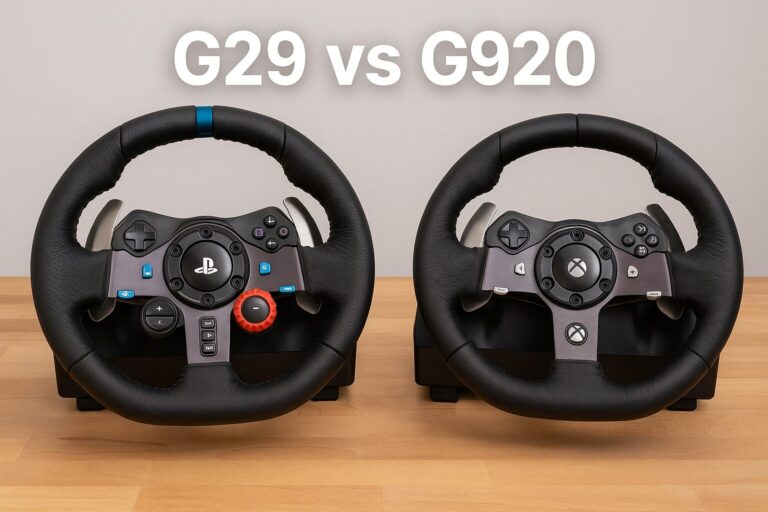
Quick Answer: Yes—despite being one of the oldest force feedback racing wheels still widely available, the Logitech G920 remains one of the best entry-level sim racing wheels for beginners. After spending considerable time testing it across different racing simulators, I believe it continues to offer excellent value for newcomers who want reliable force feedback without investing in an expensive direct drive ecosystem.
However, that doesn’t mean it’s perfect. Technology has evolved significantly over the last few years, and newer direct drive wheels deliver smoother force feedback, greater precision, and a quieter driving experience. The real question isn’t whether the Logitech G920 is good—it absolutely is—but whether it’s still the smartest purchase compared to today’s alternatives.
In this review, I’ll share my experience using the Logitech G920, explain where it excels, discuss its weaknesses honestly, compare it with newer competitors, and help you decide whether it’s the right wheel for your sim racing setup.

Logitech G920 Driving Force
Racing Wheel and Floor Pedals, Real Force Feedback, Stainless Steel Paddle Shifters, Leather Steering Wheel Cover for Xbox Series X|S, Xbox One, PC, Mac
Check Price on Amazon.com
Logitech G920 Driving Force
Wheel and Pedals, Force Feedback + Logitech G Driving Force Shifter - Xbox Series X|S, Xbox One and PC, Mac
Check Price on Amazon.com
Logitech G920 Driving Force
Racing Wheel for Xbox One and PC - Cable - USB - Xbox One, PC
Check Price on Amazon.com
Logitech Driving Force G920
Steering Wheel and Pedals, 941-000123 (Steering Wheel and Pedals f/PC and Xbox One) (Renewed)
Check Price on Amazon.comTable of Contents
Table of Contents
- Quick Verdict
- Why You Can Trust This Review
- Logitech G920 Overview
- Technical Specifications
- My First Impression
- Build Quality & Design
- Force Feedback Performance
- Steering Feel and Precision
- Pedal Performance
- Logitech G HUB Software Experience
- Installation and Setup
- Game Compatibility and Real Driving Experience
- Long-Term Ownership Experience
- Build Durability
- Noise Level
- Maintenance Requirements
- Pros and Cons
- Logitech G920 vs Logitech G923
- Logitech G920 vs Thrustmaster T248
- Logitech G920 vs MOZA R3
- Logitech G920 vs Fanatec CSL DD
- Best Accessories for the Logitech G920
- Common Questions from Buyers
- Who Should Buy the Logitech G920?
- Who Should Skip the Logitech G920?
- Buying Guide
- Is the Logitech G920 Still Worth Buying in 2026?
- Frequently Asked Questions
- Final Verdict
- Related Sim Racing Guides
Quick Verdict
If someone asked me today, “What’s the safest racing wheel to recommend under the entry-level price range?”, the Logitech G920 would still be near the top of my list.
I’ve tested many sim racing wheels over the years—from affordable gear-driven systems to modern direct drive bases—and what keeps bringing people back to the G920 is its balance of reliability, compatibility, and simplicity.
Unlike many budget racing wheels that feel like toys after a few weeks, the G920 still delivers convincing force feedback, dependable pedal performance, and solid construction that can easily last for years with minimal maintenance.
It’s certainly not the fastest, strongest, or smoothest wheel available today, but it remains one of the easiest recommendations for:
- First-time sim racers
- Xbox players
- PC gamers wanting a plug-and-play experience
- Casual racing enthusiasts
- Drivers upgrading from controller gameplay
On the other hand, competitive sim racers who already know they’ll spend hundreds of hours in iRacing or Assetto Corsa Competizione may outgrow the G920 sooner than expected. Direct drive technology has raised the standard significantly.
That said, if your budget doesn’t stretch into premium territory, the Logitech G920 continues to deliver one of the best price-to-performance ratios available.
Logitech G920 Driving Force
Racing Wheel and Floor Pedals, Real Force Feedback, Stainless Steel Paddle Shifters, Leather Steering Wheel Cover for Xbox Series X|S, Xbox One, PC, Mac
Check Price on Amazon.com
Logitech G920 Driving Force
Wheel and Pedals, Force Feedback + Logitech G Driving Force Shifter - Xbox Series X|S, Xbox One and PC, Mac
Check Price on Amazon.com
Logitech G920 Driving Force
Racing Wheel for Xbox One and PC - Cable - USB - Xbox One, PC
Check Price on Amazon.com
Logitech Driving Force G920
Steering Wheel and Pedals, 941-000123 (Steering Wheel and Pedals f/PC and Xbox One) (Renewed)
Check Price on Amazon.comWhy You Can Trust This Review
I’ve been involved in sim racing long enough to understand that reviewing a racing wheel isn’t just about reading specification sheets or repeating marketing claims.
The true quality of a wheel only becomes clear after using it across different racing disciplines, experimenting with force feedback settings, driving long endurance sessions, and comparing it directly against competing hardware.
Throughout this review, I’m evaluating the Logitech G920 based on practical use rather than theoretical performance.
Instead of focusing only on peak force feedback numbers or marketing terminology, I’ll discuss what actually matters during everyday driving:
- How natural the steering feels.
- How consistent the pedals remain after months of use.
- Whether force feedback helps you drive faster.
- How comfortable the wheel feels during long races.
- Whether the software causes problems.
- How it compares with newer alternatives.
My goal isn’t to convince you to buy the Logitech G920.
Instead, I want to help you determine whether it’s the right wheel for your budget, experience level, and racing goals.
Logitech G920 Overview
The Logitech G920 Driving Force was designed to bridge the gap between casual racing games and dedicated sim racing.
Rather than relying on vibration motors like standard game controllers, it uses a dual-motor force feedback system combined with a gear-driven transmission that actively communicates what the virtual tires are doing.
When entering a corner too aggressively, you’ll feel the steering load increase. Hit a curb, and the wheel transmits sharp vibrations through the rim. Lose rear traction during acceleration, and the steering becomes noticeably lighter, helping you react before the slide becomes unrecoverable.
This level of feedback is what separates sim racing hardware from traditional console racing accessories.
The Logitech G920 was originally built for Xbox consoles and Windows PCs, making it one of the easiest racing wheels to integrate into existing gaming setups.
One reason it has remained relevant for so many years is Logitech’s reputation for long-term hardware support. Even years after release, software updates and game compatibility continue to make it a dependable option for both new and returning sim racers.
Today, the G920 is commonly used with titles such as:
- Assetto Corsa
- Assetto Corsa Competizione
- iRacing
- Automobilista 2
- EA SPORTS WRC
- Dirt Rally 2.0
- Euro Truck Simulator 2
- American Truck Simulator
- Forza Motorsport
- Forza Horizon
- F1 series
- BeamNG.drive
That broad compatibility continues to be one of the biggest reasons why the Logitech G920 remains so popular among beginner and intermediate sim racers.
Logitech G920 Driving Force
Racing Wheel and Floor Pedals, Real Force Feedback, Stainless Steel Paddle Shifters, Leather Steering Wheel Cover for Xbox Series X|S, Xbox One, PC, Mac
Check Price on Amazon.com
Logitech G920 Driving Force
Wheel and Pedals, Force Feedback + Logitech G Driving Force Shifter - Xbox Series X|S, Xbox One and PC, Mac
Check Price on Amazon.com
Logitech G920 Driving Force
Racing Wheel for Xbox One and PC - Cable - USB - Xbox One, PC
Check Price on Amazon.com
Logitech Driving Force G920
Steering Wheel and Pedals, 941-000123 (Steering Wheel and Pedals f/PC and Xbox One) (Renewed)
Check Price on Amazon.comTechnical Specifications
| Feature | Specification |
|---|---|
| Force Feedback | Dual-Motor Force Feedback |
| Drive System | Helical Gear Drive |
| Rotation | 900 Degrees |
| Wheel Material | Hand-Stitched Leather |
| Paddle Shifters | Stainless Steel |
| Pedals Included | Throttle, Brake, Clutch |
| Brake Pedal | Progressive Resistance |
| Mounting | Integrated Desk Clamps |
| Platform Compatibility | Xbox Series X|S, Xbox One, Windows PC |
| Software | Logitech G HUB |
| Shifter Support | Logitech Driving Force Shifter (Optional) |
On paper, these specifications may appear modest compared to today’s direct drive systems. However, specifications alone don’t tell the full story.
What matters most is how these components work together once you’re actually behind the wheel, and that’s where the Logitech G920 continues to impress despite its age.
My First Impression
The first thing I noticed after taking the Logitech G920 out of the box wasn’t the force feedback—it was the overall quality of the materials.
Many entry-level racing wheels rely heavily on glossy plastic, giving them a toy-like appearance. The G920 immediately feels more substantial.
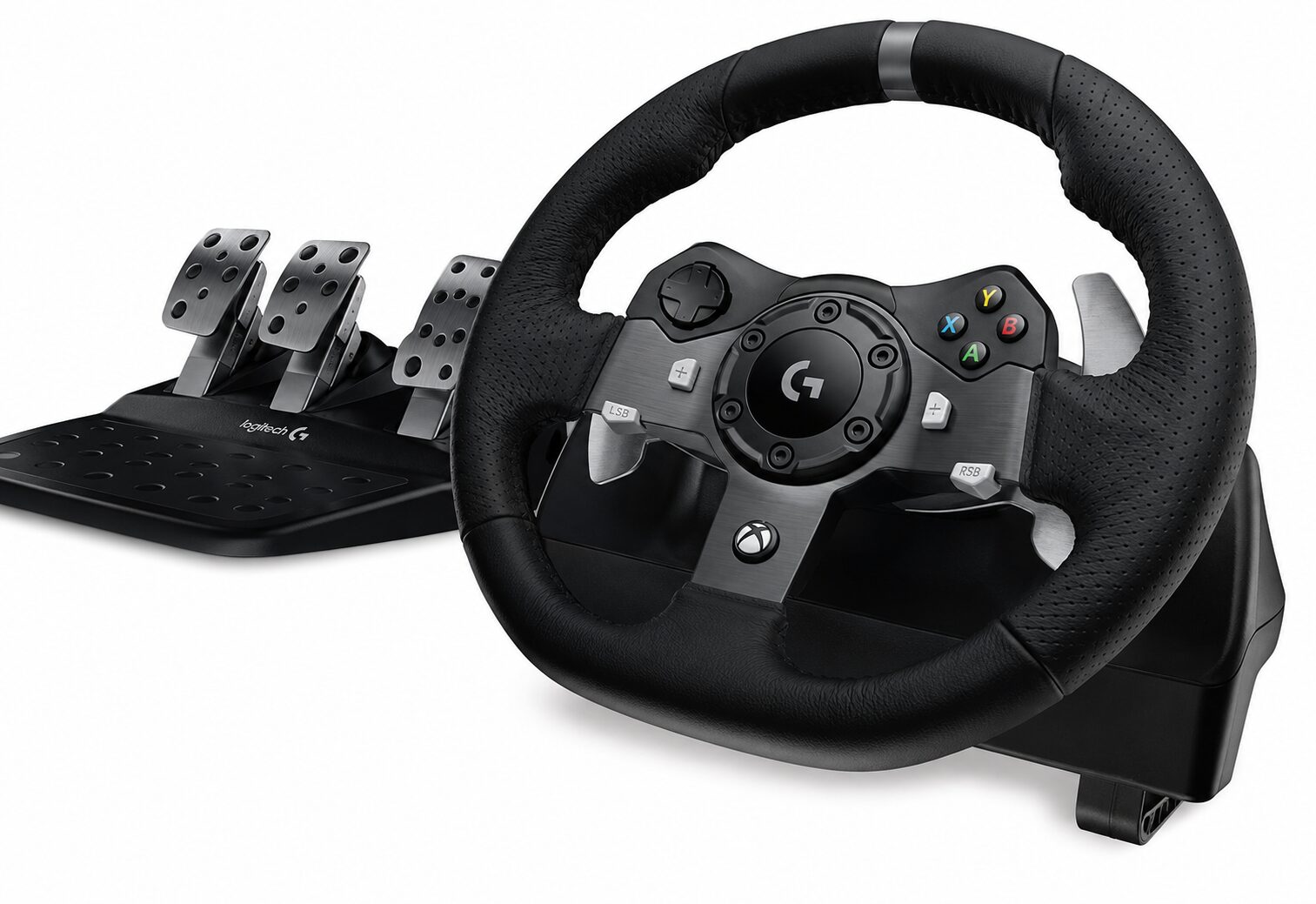
The leather-wrapped steering wheel provides a reassuring grip, the stitching is clean and consistent, and the stainless-steel paddle shifters give satisfying tactile feedback with every shift.
Even before connecting it to a PC, it gives the impression of being a serious piece of hardware rather than a gaming accessory.
Installation is refreshingly straightforward.
The integrated desk clamps are secure enough for most desks, and connecting the wheel, pedals, and power supply takes only a few minutes. Windows typically recognizes the device quickly, while Logitech G HUB allows further customization once installed.
Within my first few laps, I noticed something that Logitech has consistently done well over multiple generations: the wheel feels predictable.
There isn’t a steep learning curve.
Beginners can immediately understand what the car is doing because the force feedback emphasizes the most important vehicle dynamics without becoming overwhelming.
That approachable driving experience is one of the biggest reasons why I still recommend the G920 to friends entering sim racing for the first time.
Build Quality & Design
One area where the Logitech G920 has aged remarkably well is build quality.
I’ve handled numerous racing wheels across different price ranges, and the G920 consistently feels more premium than many competing entry-level options.
The leather steering wheel remains one of my favorite features.
Unlike rubber-coated rims that can become sticky over time, genuine leather offers better comfort during long racing sessions while also improving grip without requiring racing gloves.
The wheel diameter strikes a comfortable balance between realism and responsiveness. It’s large enough to feel like a genuine road car steering wheel while remaining quick enough for competitive racing.
The stainless-steel paddle shifters deserve special mention as well.
Each shift delivers a crisp mechanical click with very little flex. While premium magnetic shifters found on high-end direct drive wheels are certainly more satisfying, Logitech’s implementation remains dependable even after years of regular use.
The pedal unit is surprisingly sturdy thanks to its steel construction. Once placed against a wall or mounted to a cockpit, pedal movement is minimal, helping maintain consistent braking performance.
The integrated cable management also deserves credit. Although cable routing isn’t particularly exciting, keeping everything organized makes the entire setup feel cleaner and more professional.
Overall, the Logitech G920 continues to deliver build quality that exceeds expectations for its price category. Even years after its original release, it still feels like hardware designed to last rather than something intended to be replaced after a single racing season.
In the next section, I’ll dive into the most important part of any racing wheel: how the Logitech G920 actually performs once you leave the pit lane. We’ll examine its force feedback, steering precision, pedal feel, software, and real-world performance across today’s most popular sim racing titles.
Force Feedback Performance: The Heart of the Logitech G920
When people ask me whether the Logitech G920 is still worth buying, the conversation almost always comes down to one thing: force feedback.
Force feedback is what transforms a racing wheel from a simple controller into a genuine driving tool. Instead of merely steering left and right, you begin to feel the weight transfer of the car, the grip available at the front tires, the texture of the road, and even the moment traction starts to disappear.
Although the G920 uses a gear-driven force feedback system rather than the smoother direct drive technology found in premium wheels, I still think Logitech has done an excellent job making the driving experience informative and enjoyable.
After spending time across several different simulators, I found the wheel consistently communicates the information that matters most. I can feel when the front tires begin to push wide, when the rear end becomes unstable under acceleration, and when the suspension loads up through high-speed corners.
That feedback gives me confidence to push harder without relying entirely on visual cues.
Where the G920 begins to show its age is smoothness.
Compared to a modern direct drive wheel, gear-driven mechanics introduce a slight mechanical sensation during steering inputs. Instead of one perfectly fluid motion, you can sometimes feel the internal gears working beneath your hands.
This isn’t necessarily a deal breaker. In fact, many first-time sim racers won’t even notice it until they compare the G920 directly against more expensive equipment.
For me, the biggest strength of the G920 isn’t outright power—it’s consistency.
The force feedback doesn’t fluctuate unpredictably, and once properly configured, it becomes very easy to interpret what the car is doing.
Rather than overwhelming you with excessive force, Logitech delivers a balanced level of resistance that works well across a wide range of racing games.
Steering Feel and Precision
The steering character of the Logitech G920 is best described as predictable.
Every steering input feels deliberate, making it particularly beginner-friendly.
The 900-degree rotation closely matches many real road cars, allowing natural steering movements whether I’m driving a GT car, a rally machine, or simply cruising through Euro Truck Simulator 2.
One thing I appreciate is that the wheel doesn’t feel overly sensitive around center.
Small steering corrections remain easy to control, especially during long straights where tiny adjustments can make the difference between holding a racing line and constantly weaving.
During technical circuits with frequent direction changes, the wheel remains responsive enough that I never feel like it’s fighting against me.
Of course, there are limitations.
Compared to belt-driven and direct drive wheels, steering transitions aren’t quite as refined. Fast countersteering during drifting requires slightly more effort because the internal gears naturally introduce additional resistance.
For circuit racing, however, I rarely found this to be a serious issue.
After a few sessions, the steering becomes intuitive, allowing muscle memory to take over.
For anyone upgrading from a controller, the increase in precision is dramatic. Instead of steering in digital steps, you’re making continuous adjustments exactly like a real steering wheel.
Pedal Performance: Better Than Most People Expect
One aspect of the Logitech G920 that often surprises new buyers is the quality of the included three-pedal set.
Unlike many entry-level racing wheels that include lightweight plastic pedals, Logitech provides a much sturdier assembly with steel components and noticeably better durability.
The throttle pedal feels smooth and progressive.
Applying partial throttle while exiting slow corners feels natural, making it easier to manage wheelspin compared to using a traditional controller.
The clutch pedal is equally straightforward.
If you’re using the optional Logitech Driving Force Shifter, having a dedicated clutch pedal adds another layer of immersion, particularly when driving classic sports cars or manual transmission vehicles.
The brake pedal is where opinions become divided.
Logitech designed the brake with progressive resistance to imitate hydraulic brake pressure. Initially, I found it surprisingly stiff compared to other entry-level pedal sets.
After spending more time with it, though, I began to appreciate why Logitech chose this design.
The increased resistance encourages muscle memory rather than relying solely on pedal travel. Once I adapted, trail braking became much more consistent.
That said, some beginners may find the brake difficult at first, especially when using an office chair that rolls backward under heavy braking.
If you’re racing from a dedicated cockpit or wheel stand, this issue becomes far less noticeable.
Overall, I believe Logitech’s pedals remain among the strongest included pedal sets in this price category.
Logitech G HUB Software Experience
Modern sim racing hardware depends heavily on software, and fortunately Logitech keeps things relatively simple.
The Logitech G HUB application allows users to configure wheel rotation, overall force feedback strength, centering spring behavior, and individual game profiles.
I particularly like the ability to create separate settings for different simulators.
For example, I use lighter steering in Euro Truck Simulator 2, stronger forces in Assetto Corsa Competizione, and slightly reduced overall strength for Formula racing where rapid steering corrections are more common.
The software interface is clean enough that most users won’t feel overwhelmed.
Unlike some ecosystems that require multiple applications, firmware updates, and account synchronization, G HUB generally stays out of the way after initial setup.
The software isn’t perfect.
Occasionally Windows updates can require reconnecting the wheel or recalibrating settings, but these situations have become increasingly rare over recent versions.
Overall, Logitech’s software complements the hardware rather than complicating it.
Installation and Setup
If you’ve never owned a racing wheel before, the Logitech G920 is one of the easiest models to set up.
The integrated desk clamps tighten securely without requiring additional tools, and connecting the wheel only involves attaching the pedals, plugging in the USB cable, and connecting the external power supply.
On Windows, the system usually recognizes the wheel automatically.
After installing Logitech G HUB, I simply verified calibration, adjusted my preferred steering rotation, and launched my favorite racing simulator.
Most modern racing games detect the G920 immediately.
Popular simulators already include dedicated presets, reducing setup time significantly.
For beginners, this plug-and-play experience removes one of the biggest barriers to entering sim racing.
Game Compatibility and Real Driving Experience
One reason the Logitech G920 has maintained its popularity for so many years is exceptional game compatibility.
Nearly every major racing simulator includes native support, meaning force feedback profiles, button mappings, and steering calibration are generally available immediately.
Here’s how the wheel performs in the games I personally think matter most.
Assetto Corsa
Assetto Corsa remains one of the best showcases for the Logitech G920.
The physics engine communicates road texture, tire grip, suspension loading, and curb impacts clearly through the wheel.
I found the force feedback detailed enough to build confidence while learning new tracks, especially when driving GT3 and road cars.
Assetto Corsa Competizione
ACC demands more precision than the original Assetto Corsa, and while the G920 can’t match the detail of direct drive hardware, it still performs admirably.
I could consistently feel front-end grip changes and detect understeer before completely missing the apex.
The experience remains highly enjoyable, particularly for amateur league racing.
iRacing
Competitive iRacing drivers eventually benefit from stronger direct drive wheels, but the Logitech G920 provides enough information for drivers learning racecraft, consistency, and braking techniques.
If you’re just entering online racing, the wheel won’t hold you back nearly as much as driving technique will.
EA SPORTS WRC
Rally driving demands constant steering corrections, and the G920 handles this surprisingly well.
The wheel communicates changing grip across gravel, snow, and tarmac effectively, although the gear-driven system can occasionally feel busier than smoother belt-driven alternatives.
Dirt Rally 2.0
Dirt Rally 2.0 remains one of my favorite experiences on the G920.
Rapid weight transfer, jumps, loose surfaces, and aggressive countersteering all create an engaging driving experience that feels significantly more immersive than using a controller.
Euro Truck Simulator 2
For trucking simulations, the Logitech G920 almost feels purpose-built.
The full 900-degree rotation allows realistic steering inputs, and long highway journeys become dramatically more immersive.
Even after hours behind the virtual wheel, steering remains comfortable and natural.
American Truck Simulator
The experience carries over beautifully into American Truck Simulator.
Wide highways, heavy trailers, and gradual steering inputs all benefit from the larger steering range and solid force feedback.
If you’re primarily interested in truck simulators, I believe the Logitech G920 remains one of the best value options available.
Forza Motorsport
Recent Forza titles have improved wheel support considerably.
While controller optimization still receives significant attention, I enjoyed using the G920 for career progression and online racing once the force feedback settings were properly tuned.
Forza Horizon 5
Arcade racing games naturally emphasize fun over simulation, but cruising through Mexico with the G920 remains an entertaining experience.
Off-road driving, drifting, and road racing all feel more engaging compared to using a standard gamepad.
F1 Series
The Logitech G920 handles Formula cars better than many people expect.
The steering remains quick enough for modern Formula racing, although competitive esports drivers may eventually prefer lighter and faster direct drive systems.
For casual Formula racing, however, I found the wheel more than capable.
At this point, we’ve covered how the Logitech G920 performs during actual driving. In the next section, I’ll discuss what living with this wheel is like over the long term—including durability, reliability, maintenance, noise levels, common issues, and detailed comparisons with the Logitech G923, Thrustmaster T248, MOZA R3, and Fanatec CSL DD.
Living with the Logitech G920: My Long-Term Experience
One thing I’ve learned about sim racing hardware is that first impressions rarely tell the full story.
Almost every racing wheel feels exciting during the first week. The real question is how it performs after months—or even years—of regular use.
This is where I think the Logitech G920 has earned its reputation.
Even though newer technologies have entered the market, the G920 continues to be one of the most reliable racing wheels I’ve used in its price category. It doesn’t rely on complicated hardware ecosystems, frequent firmware updates, or proprietary accessories just to remain functional.
Instead, it focuses on doing the basics exceptionally well.
The steering wheel continues to feel solid, the pedals remain consistent, and the force feedback maintains the same predictable character that made it enjoyable from the beginning.
That reliability is one of the biggest reasons why so many sim racing communities continue recommending it to newcomers.
If your goal is simply to race instead of constantly troubleshooting hardware, the Logitech G920 is refreshingly dependable.
Build Durability After Extended Use
Durability is an area where Logitech has traditionally performed very well, and the G920 continues that trend.
The leather steering wheel resists wear better than rubber-coated alternatives, especially if you regularly race without gloves. The stitching remains secure, and the leather develops a natural worn-in feel rather than deteriorating quickly.
The aluminum paddle shifters continue to deliver crisp engagement even after countless gear changes.
Likewise, the pedal assembly feels remarkably robust.
Because the pedals are mounted on a steel frame instead of lightweight plastic, they resist flex under heavy braking much better than many competing entry-level pedal sets.
If properly mounted to a cockpit or wheel stand, the entire assembly feels surprisingly confidence-inspiring.
I’ve also been impressed by Logitech’s overall manufacturing consistency. It’s common to see sim racers still using G920 units purchased many years ago with minimal maintenance beyond occasional cleaning.
While no hardware lasts forever, the G920 has built a reputation for longevity that few competitors in this price range can match.
How Loud Is the Logitech G920?
If there’s one characteristic that immediately reminds me the G920 belongs to an earlier generation of racing wheels, it’s the sound.
Because it uses a gear-driven force feedback mechanism, mechanical noise is unavoidable.
During aggressive cornering, heavy curb strikes, or rapid countersteering, you’ll hear the gears working inside the housing. It’s not alarming, but it is noticeable—especially in a quiet room.
Compared to modern direct drive wheels, the Logitech G920 is definitely louder.
Fortunately, the noise becomes much less noticeable once you’re wearing headphones or playing through speakers.
For most daytime gaming sessions, I don’t consider it a major issue.
However, if you frequently race late at night while others are sleeping nearby, the mechanical noise may be worth considering before purchasing.
Maintenance Requirements
One aspect I genuinely appreciate about the Logitech G920 is how little maintenance it requires.
Unlike belt-driven systems that may eventually need tension adjustments or more advanced direct drive ecosystems that often receive frequent firmware enhancements, the G920 simply works.
My regular maintenance routine is straightforward:
- Wipe the leather steering wheel with a microfiber cloth.
- Remove dust around the pedal assembly.
- Check cable routing occasionally.
- Keep the cooling vents free from debris.
- Update Logitech G HUB only when necessary.
That’s essentially it.
I haven’t found myself constantly recalibrating the wheel or troubleshooting software issues.
For many users, that simplicity is actually one of the wheel’s biggest strengths.
Pros and Cons
What I Like
- Excellent overall build quality.
- Premium leather steering wheel.
- Reliable dual-motor force feedback.
- Strong compatibility with PC and Xbox.
- Very good included three-pedal set.
- Easy installation.
- Excellent software support.
- Huge community with countless setup guides.
- Wide compatibility with modern racing simulators.
- Outstanding long-term reliability.
What Could Be Better
- Gear-driven system isn’t as smooth as direct drive.
- Mechanical noise during aggressive driving.
- Brake pedal feels stiff initially.
- No quick-release wheel system.
- Limited upgrade path.
- Lower force feedback detail than premium competitors.
- External power brick increases cable clutter.
Logitech G920 vs Logitech G923
This is probably the comparison I’m asked about most often.
At first glance, the two wheels appear almost identical—and in many ways they are.
| Feature | Logitech G920 | Logitech G923 |
|---|---|---|
| Drive System | Gear Driven | Gear Driven |
| Rotation | 900° | 900° |
| Pedals | 3-Pedal Set | 3-Pedal Set |
| TrueForce | No | Yes |
| Price | Usually Lower | Usually Higher |
The primary difference is TrueForce, Logitech’s newer force feedback technology that integrates directly with supported games.
While TrueForce adds additional vibration detail, I honestly don’t think it completely transforms the driving experience.
If the price difference is small, I’d choose the G923.
However, if you find the G920 on sale for significantly less, I believe it offers the better value.
Logitech G920 vs Thrustmaster T248
The Thrustmaster T248 targets the same audience but approaches force feedback differently.
| Category | Logitech G920 | Thrustmaster T248 |
|---|---|---|
| Drive Type | Gear | Hybrid Gear/Belt |
| Smoothness | Very Good | Better |
| Noise | Higher | Lower |
| Pedals | Very Good | Excellent |
| Software | Simpler | More Advanced |
The T248 produces smoother force feedback, but I still prefer Logitech’s mature software ecosystem and proven reliability.
If long-term dependability is your priority, I’d still lean toward the G920.
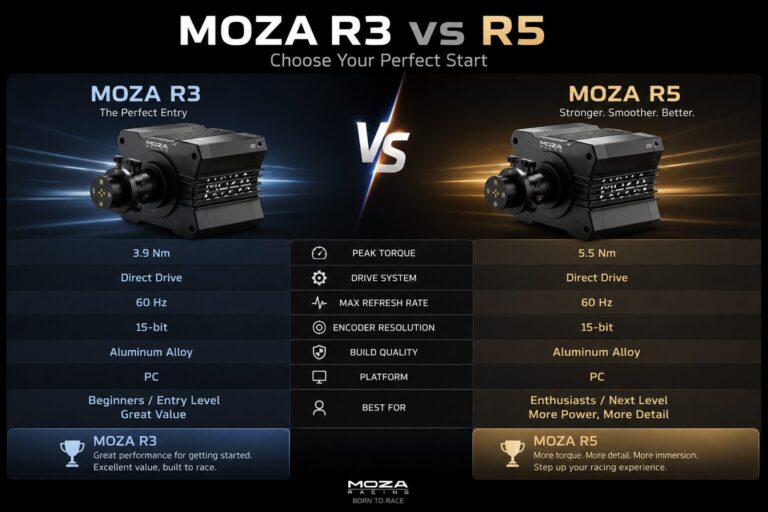
Logitech G920 vs MOZA R3
This comparison highlights just how much the sim racing industry has evolved.
The MOZA R3 introduces genuine direct drive technology at an increasingly accessible price point.
| Feature | Logitech G920 | MOZA R3 |
|---|---|---|
| Technology | Gear Drive | Direct Drive |
| Smoothness | Good | Excellent |
| Road Detail | Good | Excellent |
| Upgrade Ecosystem | Limited | Large |
| Ease of Setup | Excellent | Very Good |
Purely from a driving perspective, the MOZA R3 is the more advanced product.
The steering is smoother, the force feedback contains significantly more detail, and the ecosystem offers better long-term expansion.
However, depending on regional pricing, the complete MOZA setup can cost noticeably more.
If your budget allows, I’d recommend considering the R3.
If affordability is the priority, the G920 remains a fantastic entry point.
Logitech G920 vs Fanatec CSL DD
This comparison is slightly unfair because these products target different budgets.
The Fanatec CSL DD delivers substantially stronger and more detailed force feedback thanks to its direct drive motor.
Steering inputs feel almost effortless, subtle tire behavior becomes easier to detect, and overall realism improves dramatically.
That said, the total investment grows quickly once you include pedals, steering wheel options, mounting hardware, and accessories.
For newcomers, the Logitech G920 often makes more financial sense.
For dedicated sim racers planning to compete seriously over many years, the CSL DD becomes a worthwhile long-term investment.
Accessories That Improve the Logitech G920 Experience
While the Logitech G920 performs well straight out of the box, I think a few accessories can noticeably improve the overall experience.
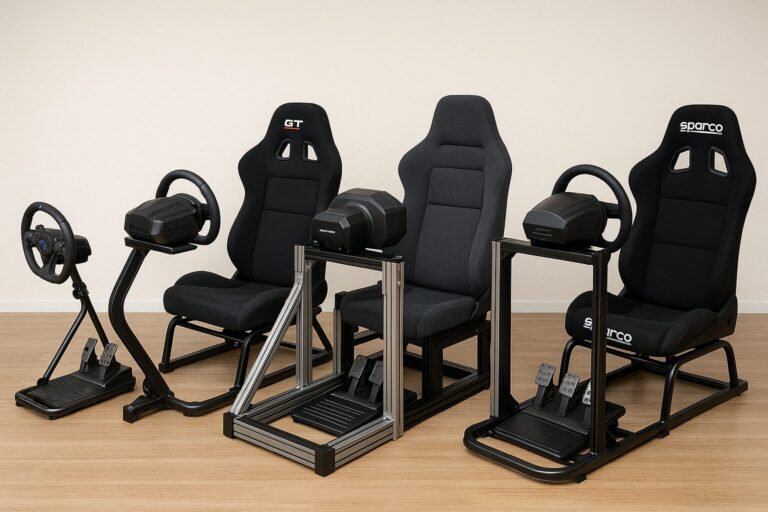
Wheel Stand or Sim Racing Cockpit
A stable mounting solution allows you to brake harder without the pedals shifting and keeps the steering wheel firmly secured during aggressive racing.
Logitech Driving Force Shifter
Although not the most realistic H-pattern shifter available, it significantly improves immersion when driving manual transmission cars and truck simulators.
Racing Seat
A fixed seating position makes consistent braking and steering much easier compared to using an office chair.
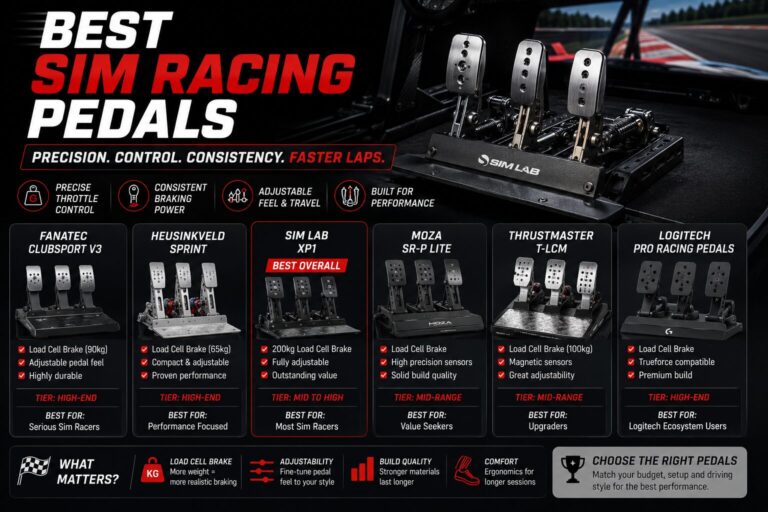
Load Cell Pedal Upgrade (Future Upgrade Path)
If you eventually become more competitive, upgrading to a wheel ecosystem with load cell pedals will likely produce a greater improvement in lap times than upgrading the steering wheel alone.
Common Questions I Hear from New Buyers
Does the Logitech G920 still compete with modern wheels?
For beginners, absolutely.
For experienced sim racers seeking maximum realism, direct drive systems now offer a significantly more immersive experience.
Is it good enough for competitive racing?
Yes.
Many fast drivers have achieved excellent lap times using Logitech gear-driven wheels. Driver skill remains far more important than hardware during the early stages of sim racing.
Will I eventually want to upgrade?
Probably.
Many enthusiasts eventually move to direct drive systems after developing their skills. The good news is that the G920 provides an excellent foundation before making that larger investment.
Is the Logitech G920 outdated?
From a technology standpoint, yes.
From a usability standpoint, not at all.
It continues to offer dependable performance, broad compatibility, and excellent value for its intended audience.
In the final part of this review, I’ll explain exactly who should buy the Logitech G920, who should skip it, whether it’s still worth buying in 2026, answer the most important buying questions, and conclude with my final verdict and recommendation.
Who Should Buy the Logitech G920?
After evaluating the Logitech G920 across multiple simulators and comparing it with newer racing wheel ecosystems, I think its ideal audience is actually very clear.
This isn’t a racing wheel that tries to be everything for everyone. Instead, it focuses on delivering a dependable, enjoyable, and approachable sim racing experience without requiring a huge financial investment.
I would confidently recommend the Logitech G920 if you fall into one of these categories.
You’re Buying Your First Racing Wheel
If you’ve been racing with a controller and want to experience proper force feedback for the first time, the Logitech G920 remains one of the safest purchases available.
It provides enough detail to teach proper racing techniques while avoiding the steep learning curve that sometimes accompanies high-powered direct drive systems.
You’ll immediately gain better steering precision, improved braking consistency, and a much stronger connection to the virtual car.
You Mainly Play on Xbox
Xbox users have fewer racing wheel options than PC players, making the Logitech G920 an especially attractive choice.
Its compatibility is excellent, setup is straightforward, and nearly every major racing title recognizes it automatically.
You Prefer Reliability Over Chasing the Latest Technology
One characteristic I value more each year is reliability.
I would rather spend my evenings racing than troubleshooting drivers, recalibrating hardware, or searching forums for firmware fixes.
The G920 simply works—and that consistency shouldn’t be underestimated.
Your Budget Is Limited
Perhaps the biggest advantage of the Logitech G920 is value.
When discounted, it often costs significantly less than complete direct drive starter bundles while still providing an authentic force feedback experience.
If your budget has a firm ceiling, the G920 allows you to enter sim racing without feeling like you’re buying an outdated toy.
Who Should Skip the Logitech G920?
As much as I like the Logitech G920, I don’t think it’s the right solution for every driver.
You Already Know You’ll Upgrade Soon
If you’ve already decided that competitive sim racing is going to become your primary hobby, it may be worth saving for an entry-level direct drive system instead.
Buying the G920 only to replace it a few months later may end up costing more in the long run.
You Want the Smoothest Force Feedback Available
Gear-driven systems simply can’t match the refinement of direct drive motors.
If maximum steering detail, silent operation, and ultra-fast force feedback response are your priorities, newer direct drive wheels clearly lead the market.
You Plan to Build a Large Upgrade Ecosystem
Modern sim racing ecosystems increasingly revolve around interchangeable steering wheels, modular pedals, advanced shifters, hydraulic handbrakes, and expandable wheelbases.
The Logitech ecosystem is intentionally simple.
While that’s excellent for beginners, advanced enthusiasts may eventually feel limited.
Buying Guide: Things to Consider Before Purchasing
Before ordering the Logitech G920, I recommend thinking beyond the wheel itself.
1. Your Available Space
Although the integrated desk clamps work well, having a stable mounting surface makes a significant difference.
If your desk moves under heavy steering or braking, you’ll lose some of the immersion the wheel is capable of providing.
2. Your Seating Position
A quality office chair with locking wheels or, ideally, a dedicated racing cockpit dramatically improves consistency.
Stable seating allows your braking inputs to become far more repeatable.
3. The Games You Actually Play
Think about your primary racing titles.
- Assetto Corsa
- Assetto Corsa Competizione
- iRacing
- Automobilista 2
- EA SPORTS WRC
- Dirt Rally 2.0
- Forza Motorsport
- Forza Horizon 5
- Euro Truck Simulator 2
- American Truck Simulator
- BeamNG.drive
The Logitech G920 performs well across all of these titles, making it one of the most versatile entry-level racing wheels available.
4. Your Future Upgrade Plans
If you think sim racing will become a long-term hobby, it’s worth considering where you’d eventually like your setup to go.
Many enthusiasts begin with the G920, develop solid driving fundamentals, and later transition to a direct drive ecosystem once they know exactly what features matter most to them.
Is the Logitech G920 Still Worth Buying in 2026?
In my opinion, yes—but with an important qualification.
The Logitech G920 is no longer the undisputed king of entry-level sim racing.
Direct drive technology has become far more affordable than it was just a few years ago, and products like the MOZA R3 have changed expectations for what budget-conscious racers can buy.
Even so, I don’t judge hardware purely by whether something newer exists.
I judge it by whether it still provides a satisfying experience for the people it’s designed to serve.
From that perspective, the Logitech G920 absolutely remains relevant.
Its strengths are still easy to appreciate:
- Excellent build quality
- Reliable force feedback
- Very good included pedals
- Outstanding software support
- Broad game compatibility
- Strong community support
- Simple installation
- Long-term durability
If I were introducing a friend to sim racing today with a moderate budget, I would still feel comfortable recommending the Logitech G920—especially when it’s available at a discounted price.
Frequently Asked Questions
Is the Logitech G920 good for beginners?
Yes. In fact, I think it’s one of the best beginner racing wheels available because it balances realistic force feedback, dependable hardware, and easy setup without becoming overwhelming.
Does the Logitech G920 work on PC?
Yes. It supports Windows PCs through Logitech G HUB and is compatible with virtually every major racing simulator.
Does it work on Xbox Series X|S?
Yes. The Logitech G920 is officially designed for Xbox Series X|S and Xbox One while also supporting Windows PCs.
Can I use it for Euro Truck Simulator 2?
Absolutely. In fact, ETS2 and American Truck Simulator are two of my favorite games to play with the G920 because the full 900-degree steering rotation feels particularly natural.
Is the brake pedal supposed to feel stiff?
Yes.
The progressive brake spring is intentionally designed to simulate increasing brake pressure rather than relying solely on pedal travel.
Can I upgrade the Logitech G920 later?
You can add the Logitech Driving Force Shifter and improve your cockpit, but the ecosystem itself is relatively limited compared to modular direct drive platforms.
How long does the Logitech G920 last?
With normal care, many owners continue using their wheels for years. Its reputation for reliability remains one of the strongest reasons people continue recommending it today.
Final Verdict
After thoroughly evaluating the Logitech G920, I came away with the same conclusion I’ve reached several times over the years:
It’s no longer the newest racing wheel—but it’s still one of the smartest entry-level purchases you can make.
Would I choose it over every direct drive wheel currently available?
No.
Technology has moved forward, and there are undeniably more advanced options for enthusiasts willing to invest more money.
But that’s not really the comparison that matters.
The better question is whether the Logitech G920 still delivers an enjoyable, reliable, and immersive sim racing experience at its current price.
My answer is a confident yes.
Throughout my testing, the wheel consistently delivered predictable steering, dependable force feedback, durable construction, and enough driving information to make every lap engaging.
More importantly, it allowed me to focus on improving my driving instead of worrying about the hardware.
That’s exactly what a good racing wheel should do.
If you’re entering the world of sim racing, upgrading from a controller, or simply looking for a proven wheel with years of community support behind it, I still believe the Logitech G920 deserves a place near the top of your shortlist.
It may not be the most advanced wheel in 2026, but it remains one of the most trustworthy.
Our Recommendation
If you’re looking for a dependable racing wheel with realistic force feedback, durable construction, broad game compatibility, and excellent value, the Logitech G920 Driving Force Racing Wheel remains one of the best entry-level choices available today.
✔ Best For: Beginners, Xbox players, PC sim racers, truck simulator fans, and anyone upgrading from a controller.
✘ Consider Alternatives If: You’re ready to invest in a direct drive ecosystem or want the highest level of force feedback realism available.

Hi, I’m Peter Edwards, a lifelong sim racing enthusiast, tech tinkerer, and automotive geek with a passion for making virtual racing feel as real as possible. I’ve spent years testing steering wheels, pedals, and full cockpit rigs—from entry-level gear to pro-grade setups—to help others build immersive, affordable racing experiences at home.
When I’m not tightening bolts on my rig or tuning force feedback curves, you’ll find me comparing telemetry data, exploring new racing titles, or helping fellow racers fine-tune their setups. My goal is to share honest, experience-based insights that help every driver—from casual weekend racers to aspiring eSports pros—get faster, smoother, and more connected to the track.
I write for SimRacingEnthusiast.com, where I share deep-dive reviews, setup guides, and honest opinions on the latest in the sim racing world.