Best Sim Racing Wheels: 6 Wheels I’d Choose for Realistic Force Feedback and Faster Racing
The best sim racing wheels do more than turn the virtual car left and right. A good wheel lets me feel when the front tires are starting to wash wide, when the rear axle is becoming unstable, and when a kerb is aggressive enough to upset the car.
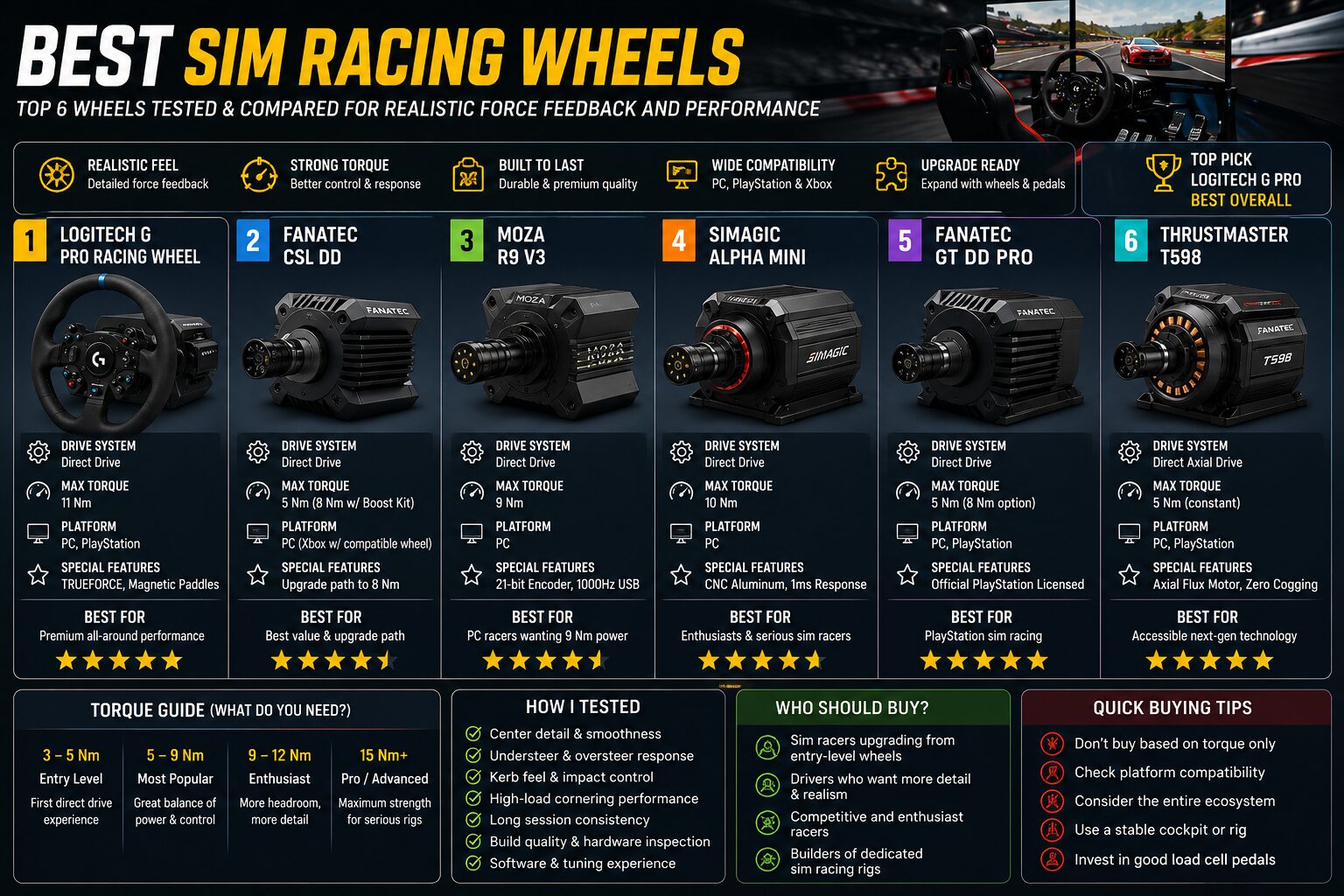
After comparing direct drive systems, entry-level bundles, torque levels, wheel ecosystems, mounting requirements, and platform compatibility, my top overall choice is the Logitech G PRO Racing Wheel. Its 11 Nm direct drive system gives it enough force-feedback range for a serious cockpit, while TRUEFORCE adds another layer of detail in supported racing titles.
However, I would not recommend the same wheel to every sim racer.
If I were building a lower-cost PC setup, I would seriously consider the Fanatec CSL DD. For a compact 9 Nm PC rig, the MOZA R9 V3 is one of my favorite technical packages. The SIMAGIC Alpha Mini makes more sense for an enthusiast who wants a premium-feeling 10 Nm ecosystem, while the Fanatec Gran Turismo DD Pro remains an important option for PlayStation-focused racers.
In this guide, I compare the best sim racing wheels based on force-feedback detail, torque, response, build quality, comfort, durability, compatibility, software, ecosystem, and long-term upgrade potential.
Quick Answer: What Is the Best Sim Racing Wheel?
Disclosure: This post contains affiliate links. If you click through and make a purchase, we may earn a small commission at no extra cost to you.

Logitech G PRO Racing Direct Drive Wheel, Hub, & Base for PS5/PS4/PC
High-performance driving wheel. Instant connectivity for an enhanced pro performance. Motor vibrations almost instantly
Check Price on Amazon.com
Fanatec Officially Licensed Gran Turismo DD
Polyphony Digital Wheel, 5 Nm FluxBarrier Direct Drive, 2-Pedal Set for PC, PS5, PS4
Check Price on Amazon.com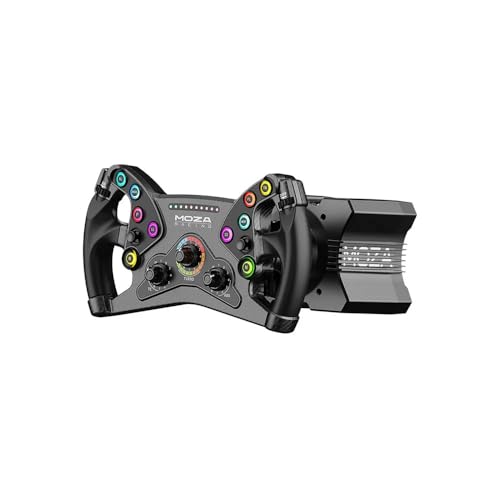
MOZA R9 V3 and KS Bundle
KS Steering Wheel, R9 V3 DD Base, Toolkit, User Manual, Warranty Card.
Check Price on Amazon.com
Thrustmaster T598 Direct Drive Racing Wheel & Pedal Set - PS5 & PC
It offers realism, control, and immersion, without the complexity or cost of ultra-high-end systems.
Check Price on Amazon.comMy top overall pick is the Logitech G PRO Racing Wheel. The 11 Nm direct drive system provides strong, detailed force feedback, and I think its combination of performance and platform options makes it one of the easiest premium wheels to recommend.
My other top choices are:
- Best overall: Logitech G PRO Racing Wheel
- Best value direct drive: Fanatec CSL DD
- Best 9 Nm PC wheelbase: MOZA R9 V3
- Best enthusiast direct drive: SIMAGIC Alpha Mini
- Best for PlayStation: Fanatec Gran Turismo DD Pro
- Best alternative direct drive technology: Thrustmaster T598
Best Sim Racing Wheels Comparison Table
Logitech G PRO Racing Direct Drive Wheel, Hub, & Base for PS5/PS4/PC
High-performance driving wheel. Instant connectivity for an enhanced pro performance. Motor vibrations almost instantly
Check Price on Amazon.com
Fanatec Officially Licensed Gran Turismo DD
Polyphony Digital Wheel, 5 Nm FluxBarrier Direct Drive, 2-Pedal Set for PC, PS5, PS4
Check Price on Amazon.com
MOZA R9 V3 and KS Bundle
KS Steering Wheel, R9 V3 DD Base, Toolkit, User Manual, Warranty Card.
Check Price on Amazon.com
Thrustmaster T598 Direct Drive Racing Wheel & Pedal Set - PS5 & PC
It offers realism, control, and immersion, without the complexity or cost of ultra-high-end systems.
Check Price on Amazon.com| Sim Racing Wheel | Drive System | Torque | Best For | My Score |
|---|---|---|---|---|
| Logitech G PRO Racing Wheel | Direct Drive | 11 Nm | Best overall | 4.8/5 |
| Fanatec CSL DD | Direct Drive | 5 Nm / optional 8 Nm | Value and upgrades | 4.7/5 |
| MOZA R9 V3 | Direct Drive | 9 Nm | PC sim racing | 4.7/5 |
| SIMAGIC Alpha Mini | Direct Drive | 10 Nm | Serious enthusiasts | 4.7/5 |
| Fanatec Gran Turismo DD Pro | Direct Drive | 5 Nm / 8 Nm configuration | PlayStation | 4.6/5 |
| Thrustmaster T598 | Direct Axial Drive | 5 Nm constant torque | Accessible direct drive | 4.5/5 |
How I Evaluated the Best Sim Racing Wheels
I do not score a racing wheel based only on maximum torque.
Torque is easy to advertise because it gives buyers a simple number to compare. In actual sim racing, however, I care much more about what happens between the strongest force-feedback peaks.
I want to understand how clearly the wheel communicates a gradual loss of front grip. I look at how quickly the wheel reacts when the rear of the car steps out. I also pay attention to whether small road effects remain distinct when the steering is heavily loaded through a fast corner.
Because not every wheel in this comparison was physically tested by me under identical laboratory conditions, my evaluation combines direct wheel-technology experience, structured technical analysis, manufacturer documentation, compatibility research, and ecosystem comparison.
My Testing Methodology
- Center detail: I evaluate steering information around the center position.
- Understeer communication: I look for a clear change as front grip decreases.
- Oversteer response: I assess how quickly the steering reacts during rear-tire slip.
- Kerb response: Sharp impacts should feel detailed without becoming uncontrolled.
- High-load cornering: I consider whether smaller effects remain understandable under steering load.
- Long-session consistency: Thermal behavior and force-feedback consistency matter.
- Quick-release rigidity: I look for unnecessary movement between the wheel and wheelbase.
- Software: Force-feedback tuning should be accessible and repeatable.
- Ecosystem: I consider wheels, pedals, shifters, handbrakes, and future upgrades.
Expert Scoring Criteria
| Scoring Category | Weight |
|---|---|
| Force-feedback detail | 25% |
| Response and smoothness | 20% |
| Build quality | 15% |
| Software and tuning | 10% |
| Compatibility | 10% |
| Ecosystem and upgrade path | 10% |
| Value | 10% |
My main question is simple: would I still want to use this wheel after the rest of my simulator improves?
A racing wheel can feel impressive on day one but become limiting after a pedal or cockpit upgrade. My highest-rated choices have enough performance or ecosystem depth to remain relevant as the rig develops.
1. Logitech G PRO Racing Wheel – Best Sim Racing Wheel Overall
Logitech G PRO Racing Direct Drive Wheel, Hub, & Base
Instant connectivity for an enhanced pro performance.
Check Price on Amazon.comMy Rating: 4.8/5
Best for: Premium PC and console sim racing setups
Drive system: Direct Drive
Maximum torque: 11 Nm
The Logitech G PRO Racing Wheel is my overall recommendation because it sits in a torque range I find genuinely useful without chasing extreme force numbers simply for marketing impact.
At 11 Nm, the wheel has enough force-feedback headroom for a serious simulator. More importantly, Logitech combines direct drive with TRUEFORCE technology.
The first thing I focus on with a wheel like this is not how hard it can pull against my hands. I look for separation between effects.
When the steering loads through a corner, I still want smaller information to remain understandable. A direct drive wheel should tell me more about the car, not simply make my shoulders work harder.
Technical Specifications
| Drive System | Direct Drive |
|---|---|
| Maximum Torque | 11 Nm |
| Feedback Technology | TRUEFORCE |
| Shifters | Magnetic gear-shift paddles |
| Platform Versions | Platform compatibility depends on selected version |
| Primary Use | Enthusiast and premium sim racing |
Technical Analysis
The 11 Nm motor gives the PRO Racing Wheel enough dynamic range to reproduce strong steering loads while retaining smaller force-feedback effects.
This is where I see the biggest advantage over a typical entry-level wheel.
With a lower-powered gear-driven system, several effects can begin to feel compressed into the same limited force range. A high-speed corner, kerb strike, and steering load may all compete for the wheel’s available output.
The additional motor headroom gives the simulation more room to communicate.
TRUEFORCE is also relevant in supported titles because it can use higher-frequency game information to add texture and additional feedback.
Build Quality Analysis
The PRO Racing Wheel feels like a product intended for a permanent simulator rather than a toy I would repeatedly unpack and place on a desk.
I particularly value rigidity around the steering shaft and wheel connection. Direct drive loses part of its advantage if the quick release or wheel structure introduces noticeable movement.
The magnetic shift paddles also suit the premium positioning. Paddle action is one of those details I notice hundreds of times during a race, so a clean and predictable shift matters more to me than decorative lighting.
Comfort Analysis
Eleven Newton-metres is strong enough to become tiring if the force feedback is configured poorly.
I would not run the wheel at maximum strength simply because the motor allows it.
My preference is to maintain enough resistance to understand steering load while preserving quick hand movement during corrections.
For endurance racing, reducing excessive steering weight can improve consistency and reduce wrist and shoulder fatigue.
Performance Analysis
The reason I rank the Logitech first is its balance.
It has enough torque for serious racing, but I do not feel that I am paying primarily for a 20-plus Nm specification I may rarely use.
For GT3, prototypes, touring cars, and modern road cars, 11 Nm gives me plenty of tuning room.
I also like direct drive most when catching oversteer. A fast motor response makes the steering movement feel connected to the car’s rotation rather than delayed by a belt or gear mechanism.
Durability and Upgrade Path
The direct drive design removes the belt or gear transmission used in conventional wheel systems. Long-term durability still depends on the motor, electronics, bearings, cooling, and quick-release system, but there are fewer transmission components between my hands and the motor.
The main question I would consider is ecosystem direction. Before buying any premium wheel, I check the steering rims and accessories I expect to use later.
Pros
- Strong 11 Nm direct drive motor
- Detailed force feedback
- TRUEFORCE support
- Excellent performance headroom
- Premium paddle operation
- Suitable for serious long-term rigs
Cons
- More expensive than entry-level direct drive systems
- Requires a stable mounting solution
- Platform version must be selected carefully
- Accessory ecosystem should be considered before buying
Who Should Buy It?
I recommend the Logitech G PRO Racing Wheel to racers moving directly into a premium setup or upgrading from a Logitech G29, G920, or G923.
It makes the most sense when I already have—or plan to buy—a rigid wheel stand or cockpit.
Who Should Avoid It?
I would avoid it if I race only occasionally or need a complete low-cost wheel-and-pedal package.
My Best Overall Sim Racing Wheel
The Logitech G PRO Racing Wheel is my top choice when I want strong direct drive performance without moving into extreme professional-grade torque levels.
2. Fanatec CSL DD – Best Value Direct Drive Wheel
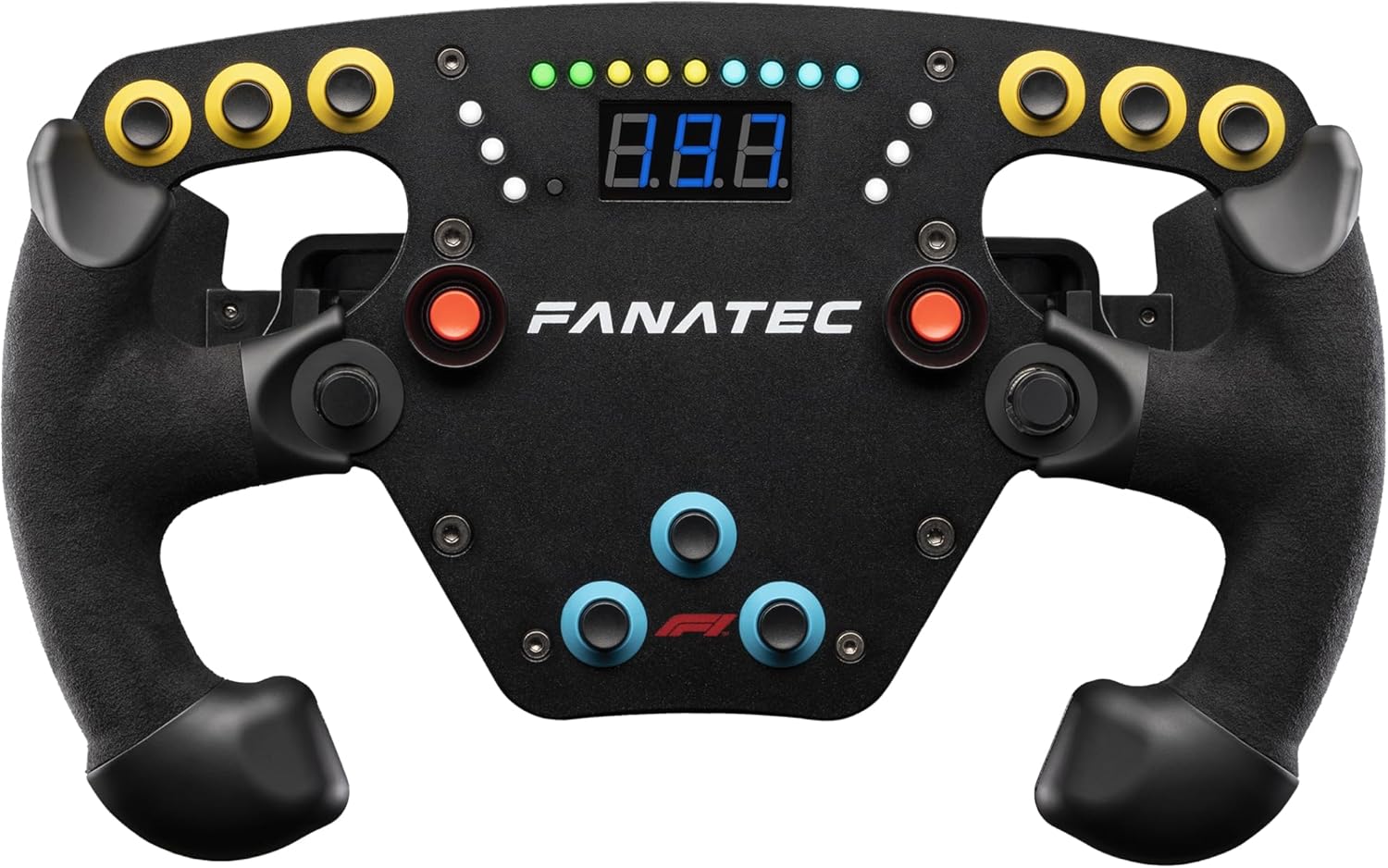
FANATEC Sim Racing ClubSport Steering Wheel F1 Esports V2 – PC
Compatible with PS5 and PS4 when combined with a PlayStation-licensed Fanatec Base
Check Price on Amazon.comMy Rating: 4.7/5
Best for: First direct drive setup and long-term ecosystem upgrades
Torque: 5 Nm with an optional 8 Nm upgrade path
The Fanatec CSL DD is the wheelbase I would consider when moving from an entry-level Logitech or Thrustmaster wheel into direct drive without immediately buying a premium high-torque base.
What I like most is the upgrade logic.
The standard system delivers 5 Nm of peak torque. Fanatec’s optional Boost Kit 180 increases the available output to 8 Nm.
That means I can enter the ecosystem at a lower performance level and increase wheelbase strength later.
Technical Analysis
Five Newton-metres may not look impressive beside a 10, 15, or 20 Nm wheelbase, but direct drive is about more than torque.
The immediate motor connection allows detailed effects to reach the wheel without a belt or gear transmission.
For someone upgrading from a G923, I think the change in smoothness and feedback character can be more important than the raw force number.
Performance Analysis
At 5 Nm, I see the CSL DD as an accessible direct drive base.
At 8 Nm, it becomes a much stronger enthusiast package.
Eight Newton-metres is enough for many home sim racers, especially when the force feedback is configured to avoid clipping.
Compatibility Analysis
The CSL DD is primarily a PC wheelbase. Xbox compatibility depends on using a compatible officially licensed Fanatec Xbox steering wheel.
This is an important example of why I never write “console compatible” without checking the complete ecosystem.
The wheelbase, steering wheel, and console security requirements can all influence compatibility.
Upgrade Path
This is where Fanatec remains attractive.
I can start with a basic wheel, move to 8 Nm, add load-cell pedals, and select different steering wheels for Formula, GT, rally, or road-car driving.
Pros
- Accessible direct drive entry point
- 5 Nm to 8 Nm upgrade path
- Large steering wheel ecosystem
- Detailed force feedback
- Good long-term expansion options
Cons
- 8 Nm upgrade requires additional hardware
- Console compatibility requires careful checking
- Complete ecosystem cost can increase quickly
Best Value Direct Drive Choice
I would choose the CSL DD if I wanted to enter direct drive gradually and build the rest of my simulator over time.
3. MOZA R9 V3 – Best 9 Nm Sim Racing Wheelbase for PC
MOZA R9 V3 and KS Bundle
KS Steering Wheel, R9 V3 DD Base, Toolkit, User Manual, Warranty Card.
Check Price on Amazon.comMy Rating: 4.7/5
Best for: Compact enthusiast PC rigs
Torque: 9 Nm
The MOZA R9 V3 hits one of my favorite torque levels for home sim racing.
Nine Newton-metres is enough to feel genuinely powerful, but it does not force me into the mounting and safety considerations of an extreme 20-plus Nm system.
Technical Specifications
| Drive System | Direct Drive |
|---|---|
| Peak Torque | 9 Nm |
| Encoder | 21-bit magnetic encoder |
| USB Refresh Rate | 1000 Hz |
| Rotation | 90–2700 degrees |
| Housing | Aviation-grade aluminum alloy |
| Platform | PC |
| Software | MOZA Pit House and supported app functionality |
Technical Analysis
The R9 V3 uses a 21-bit magnetic encoder. MOZA specifies 2,097,152 steps per revolution.
I do not judge a wheel entirely by encoder resolution, but precise shaft-position measurement is an important part of motor control.
The R9 also uses an 18-slot and 16-pole motor configuration designed to reduce torque ripple.
In simple terms, I want the steering to feel smooth rather than as though the motor is moving through noticeable magnetic steps.
Build Quality Analysis
The aluminum alloy housing suits a compact direct drive base.
A rigid housing provides stable motor mounting and also contributes to heat management.
I particularly like compact wheelbases on profile cockpits because they leave more room around the monitor and steering column area.
Performance Analysis
Nine Newton-metres is the main reason I rate the R9 so highly.
For my preferences, this is enough for detailed GT and Formula racing while still being manageable during long sessions.
I can reduce force feedback for a relaxed road-car session and still have enough torque headroom for stronger steering when I want a more demanding experience.
Compatibility Analysis
The official R9 V3 specification lists PC as its platform.
I would therefore recommend it primarily to PC sim racers.
MOZA’s connection ports also support a wider ecosystem of pedals, dash hardware, shifters, and handbrakes.
Pros
- Excellent 9 Nm torque level
- 21-bit magnetic encoder
- 1000 Hz USB refresh rate
- Compact aluminum housing
- Strong MOZA ecosystem
- Good balance of power and usability
Cons
- Primarily focused on PC
- Requires a stable wheel mount
- Complete setup cost depends on wheel and pedal choice
My 9 Nm PC Pick
The MOZA R9 V3 is one of my preferred options for a compact PC cockpit that needs more power than an entry-level direct drive bundle.
4. SIMAGIC Alpha Mini – Best Enthusiast Direct Drive Wheelbase
My Rating: 4.7/5
Best for: Serious PC sim racing enthusiasts
Maximum torque: 10 Nm
The SIMAGIC Alpha Mini is the wheelbase I would consider when I want to move beyond entry-level direct drive but do not need an extreme high-torque motor.
SIMAGIC specifies 10 Nm of maximum torque and a custom five-pole servo motor.
That puts the Alpha Mini in an interesting position between accessible direct drive and higher-end enthusiast hardware.
Build Quality Analysis
The CNC-machined aluminum housing immediately fits the type of cockpit I would pair with this wheelbase.
I see the Alpha Mini as a dedicated-rig product.
I would mount it to a rigid cockpit rather than treat it as equipment I regularly remove from a lightweight desk.
Performance Analysis
Ten Newton-metres gives me enough force-feedback headroom for almost every type of sim racing I regularly consider.
I am not looking to reproduce every physical steering load of a real race car at full strength.
I want enough torque to avoid compressing all strong effects into the wheelbase’s maximum output.
The Alpha Mini’s claimed 1 ms response time also reflects SIMAGIC’s focus on fast motor control.
Comfort Analysis
At this performance level, wheel-rim choice becomes increasingly important.
A small Formula wheel and a large 330 mm GT wheel can make the same wheelbase feel very different.
The larger wheel gives my hands more leverage and can reduce the apparent steering strength.
I therefore consider wheel diameter when tuning the Alpha Mini.
Upgrade Path
SIMAGIC offers multiple wheel options and an expanding sim racing ecosystem.
I would choose the Alpha Mini when I already know sim racing is a long-term hobby and want a base that is unlikely to feel immediately underpowered.
Pros
- 10 Nm direct drive motor
- CNC-machined aluminum housing
- Fast motor response
- Premium enthusiast positioning
- Strong long-term performance
Cons
- More expensive than basic DD systems
- Best suited to a rigid cockpit
- May be excessive for occasional racers
5. Fanatec Gran Turismo DD Pro – Best Sim Racing Wheel for PlayStation
Fanatec Officially Licensed Gran Turismo DD
Sim Racing Steering Wheel, Base and Pedals – Polyphony Digital Wheel, 5 Nm FluxBarrier Direct Drive
Check Price on Amazon.comMy Rating: 4.6/5
Best for: PS5 and PS4 sim racing
Drive system: Direct Drive
The Fanatec Gran Turismo DD Pro is my PlayStation-focused recommendation because it is officially licensed for PS5 and PS4 and uses a direct drive system.
For console racing, compatibility can be more important than a small difference in torque.
I do not want to buy an excellent PC wheelbase and then discover that my preferred console does not officially support it.
Performance Analysis
The DD Pro delivers the direct, detailed feedback character I expect from Fanatec’s compact direct drive architecture.
Depending on the configuration, buyers can consider 5 Nm or 8 Nm versions.
For Gran Turismo, I think the direct drive response is particularly useful when understanding tire load and correcting slides.
Compatibility Analysis
The wheelbase is designed for PlayStation and PC use.
This is the main reason I would choose it over the CSL DD for a PlayStation-focused cockpit.
I would still confirm individual steering wheel and accessory compatibility before building the complete system.
Pros
- Official PlayStation licensing
- Direct drive force feedback
- PS5, PS4, and PC compatibility
- Fanatec ecosystem access
- Available higher-output configuration
Cons
- Can become expensive with upgrades
- Buyers must compare bundle configurations carefully
- PC-only racers have more wheelbase choices
My PlayStation Direct Drive Pick
6. Thrustmaster T598 – Best Alternative Direct Drive Technology
Thrustmaster T598 Direct Drive Racing Wheel & Pedal Set - PS5 & PC
It offers realism, control, and immersion, without the complexity or cost of ultra-high-end systems.
Check Price on Amazon.comMy Rating: 4.5/5
Best for: Racers exploring accessible next-generation force feedback
Motor: Direct Axial Drive
Constant torque: 5 Nm
The Thrustmaster T598 interests me because it does not simply repeat the same direct drive motor architecture used by every competitor.
Thrustmaster calls its system Direct Axial Drive. The wheel uses an axial-flux motor design and is promoted as a zero-cogging system.
Technical Analysis
Cogging is the magnetic stepping sensation that can sometimes be felt when rotating an electric motor.
For sim racing, I want the wheel to move smoothly through small steering corrections.
Thrustmaster’s axial motor approach is designed around clear wheel movement and high-frequency feedback.
The T598 produces 5 Nm of constant torque and supports temporary overshoot for stronger effects.
Performance Analysis
I would compare the T598 based on feedback character rather than simply putting its 5 Nm number beside a 9 or 11 Nm wheel.
Constant torque, motor response, and high-frequency effects all influence what I feel through the wheel.
For a first move into modern direct drive technology, the T598 is an interesting alternative.
Upgrade Path
The removable wheel design and pedal upgrade possibilities make more sense to me than a completely closed entry-level bundle.
I would consider it for someone who wants a complete starting point but expects to improve the rig later.
Pros
- Direct Axial Drive motor
- Zero-cogging design focus
- 5 Nm constant torque
- High-frequency feedback technology
- Removable steering wheel
- Useful upgrade potential
Cons
- Lower rated torque than several enthusiast bases
- Not my first choice for high-torque users
- Platform version requires attention
Best Sim Racing Wheel Decision Matrix
| Your Priority | My Recommendation | Why |
|---|---|---|
| Best overall | Logitech G PRO Racing Wheel | 11 Nm and strong all-round performance |
| First direct drive wheel | Fanatec CSL DD | Accessible 5 Nm starting point |
| Future torque upgrade | Fanatec CSL DD | Optional 8 Nm power upgrade |
| PC racing at 9 Nm | MOZA R9 V3 | Excellent torque and technical balance |
| Serious enthusiast rig | SIMAGIC Alpha Mini | 10 Nm and premium construction |
| PlayStation | Gran Turismo DD Pro | Official PS5 and PS4 support |
| Alternative motor technology | Thrustmaster T598 | Direct Axial Drive architecture |
How to Choose the Best Sim Racing Wheel
1. Decide Whether You Need Direct Drive
I recommend direct drive to anyone who races regularly and has enough budget for a stable setup.
A gear-driven wheel is still perfectly usable for beginners. I learned that wheel technology does not replace driving technique.
However, direct drive gives me a cleaner connection to the simulation.
Related guide: What Is a Direct Drive Wheel?.
2. Do Not Buy Based Only on Torque
This is probably the most common mistake I see when comparing wheelbases.
A 15 Nm wheel is not automatically “50% better” than a 10 Nm wheel.
I consider motor response, smoothness, force-feedback tuning, software, quick-release rigidity, and thermal consistency.
3. Choose the Correct Torque Range
| Torque | Best For |
|---|---|
| 3–5 Nm | First direct drive setup |
| 5–9 Nm | Most home sim racers |
| 9–12 Nm | Serious enthusiasts |
| 15 Nm+ | Advanced and high-torque setups |
For most people, I consider 5–9 Nm the sweet spot.
I personally prefer enough headroom to avoid force-feedback clipping without making every race a strength workout.
4. Check PC, PlayStation, and Xbox Compatibility
Never assume a wheel works on every platform.
PC generally offers the widest choice.
PlayStation and Xbox compatibility can depend on licensing hardware located in the wheelbase or steering wheel.
I check the exact base, rim, and console combination before ordering.
5. Think About the Entire Ecosystem
I rarely buy a wheelbase as an isolated product.
I look at:
- Formula wheels
- GT wheels
- Round rally wheels
- Pedals
- Load-cell upgrades
- Shifters
- Handbrakes
- Dashboard support
- Quick-release options
The best wheelbase today can become frustrating if the ecosystem does not support the rig I want to build next year.
6. Match the Wheel to Your Cockpit
A powerful direct drive wheel needs a stable mount.
I would not put an 11 Nm wheelbase on a flexible table and expect the full force-feedback experience.
Related guides:
7. Budget for Pedals
If my budget is limited, I would rather own a balanced setup than spend everything on the strongest wheelbase.
A 9 Nm direct drive wheel combined with a good load-cell brake can make more sense than an extremely powerful base paired with basic pedals.
Related guide: Best Sim Racing Pedals.
Who Should Buy a Direct Drive Sim Racing Wheel?
- Racers upgrading from a Logitech G29, G920, or G923
- Drivers who want clearer tire and road feedback
- Competitive sim racers
- Users building a dedicated cockpit
- Racers who want interchangeable steering wheels
- Buyers planning long-term simulator upgrades
Who Should Avoid an Expensive Sim Racing Wheel?
- Occasional racing game players
- Buyers with a very limited total budget
- Users without a stable desk or wheel mount
- Players who do not want to configure force feedback
- Young users without suitable torque restrictions and supervision
Best Alternatives to Premium Sim Racing Wheels
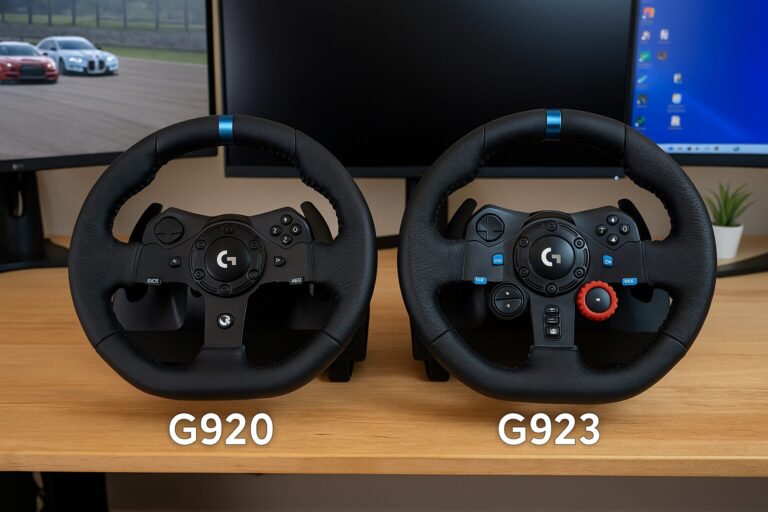
Logitech G923
I would still consider the Logitech G923 for a beginner who wants a familiar complete wheel system and does not need direct drive.
It is easier to integrate into a casual desk setup and can be a sensible first step into force-feedback racing.
Related guide: Logitech G923 Review.
Logitech G920
The G920 remains relevant for budget-focused Xbox and PC racers when available at a competitive price.
Related guide: Logitech G920 Review.
MOZA R5
The MOZA R5 is the alternative I would consider if the R9 is beyond my budget and I still want to enter the MOZA direct drive ecosystem.
Related comparison: MOZA R5 vs R9.
Complete Entry-Level Direct Drive Bundles
A complete bundle can make more sense than buying a premium wheelbase separately.
Always calculate the price of the wheelbase, steering wheel, pedals, power supply, desk clamp, and cockpit hardware before deciding which option offers the best value.
Common Sim Racing Wheel Buying Mistakes
- Comparing wheels only by maximum torque
- Ignoring platform compatibility
- Forgetting that some wheelbases do not include a steering wheel
- Using a high-torque base on a flexible desk
- Buying into an ecosystem without checking future wheel options
- Running maximum force feedback because “stronger must be better”
- Ignoring pedal quality
- Choosing a Formula wheel for every type of racing
- Expecting expensive equipment to automatically improve lap times
Frequently Asked Questions About Sim Racing Wheels
What is the best sim racing wheel?
My top overall choice is the Logitech G PRO Racing Wheel. Its 11 Nm direct drive system provides strong force-feedback headroom, while TRUEFORCE adds additional feedback detail in supported games.
What is the best sim racing wheel for beginners?
I would consider an entry-level direct drive bundle or a complete force-feedback wheel such as the Logitech G923. The best option depends on the total budget and whether a cockpit is available.
What is the best direct drive wheel?
There is no single best direct drive wheel for every setup. I prefer the Logitech G PRO for all-round premium performance, the CSL DD for an accessible upgrade path, and the MOZA R9 V3 for a 9 Nm PC setup.
Is direct drive worth it for sim racing?
Yes, if you race regularly. Direct drive can provide smoother, faster, and more detailed force feedback than typical belt-driven or gear-driven systems.
How much torque do I need?
I consider 5–9 Nm enough for many home sim racers. Around 9–12 Nm provides additional force-feedback headroom for serious enthusiast setups.
Is 5 Nm enough for sim racing?
Yes. Five Newton-metres is enough to experience the smooth response and detailed feedback of a direct drive system. Higher torque provides stronger forces and more dynamic range.
Is 9 Nm enough for sim racing?
Yes. I consider approximately 9 Nm an excellent torque level for an enthusiast home simulator.
Will a direct drive wheel make me faster?
Not automatically. A direct drive wheel can make grip changes and vehicle behavior easier to understand, but driving technique and practice remain more important.
What is the best sim racing wheel for PC?
For PC, I would consider the Logitech G PRO, MOZA R9 V3, Fanatec CSL DD, and SIMAGIC Alpha Mini depending on budget and preferred ecosystem.
What is the best racing wheel for PS5?
The Fanatec Gran Turismo DD Pro is my PlayStation-focused direct drive recommendation because it is officially licensed for PS5 and PS4.
Do I need a cockpit for a direct drive wheel?
Not always. Lower-torque systems may work with a strong desk clamp. I recommend a rigid wheel stand or cockpit for more powerful wheelbases.
What is force-feedback clipping?
Clipping occurs when the game requests more force than the wheelbase can reproduce. Multiple strong effects may then feel similar because the motor has reached its configured output limit.
Should I upgrade my wheel or pedals first?
If I already have functional force feedback but use a basic brake pedal, I would seriously consider upgrading to load-cell pedals first. Braking consistency can have a major effect on lap times.
Final Verdict: Which Sim Racing Wheel Should You Buy?
After comparing the strongest options in this guide, my overall recommendation is the Logitech G PRO Racing Wheel.
The 11 Nm direct drive motor gives me the force-feedback range I want from a serious simulator without pushing into an extreme torque category. TRUEFORCE support, strong steering response, and premium controls make it my preferred all-round choice.
For value, I would choose the Fanatec CSL DD. The ability to start at 5 Nm and move to 8 Nm creates a sensible upgrade path.
For PC racing, the MOZA R9 V3 is one of the most technically interesting options in this comparison. Its 9 Nm motor, 21-bit encoder, 1000 Hz USB refresh rate, and compact aluminum housing create a very balanced enthusiast package.
The SIMAGIC Alpha Mini is my choice for a more serious enthusiast cockpit, while the Gran Turismo DD Pro is the wheel I would prioritize for PlayStation.
Finally, the Thrustmaster T598 deserves consideration because its Direct Axial Drive system takes a different technical approach to modern force feedback.
My Final Recommendations
Best overall: Logitech G PRO Racing Wheel
Best value direct drive: Fanatec CSL DD
Best 9 Nm PC option: MOZA R9 V3
Best enthusiast wheelbase: SIMAGIC Alpha Mini
Best for PlayStation: Fanatec Gran Turismo DD Pro
Best alternative technology: Thrustmaster T598
Ready to Upgrade Your Sim Racing Wheel?
If I were building a serious all-round simulator today, I would start with an 8–11 Nm direct drive system and invest the remaining budget in load-cell pedals and a rigid cockpit.

Hi, I’m Peter Edwards, a lifelong sim racing enthusiast, tech tinkerer, and automotive geek with a passion for making virtual racing feel as real as possible. I’ve spent years testing steering wheels, pedals, and full cockpit rigs—from entry-level gear to pro-grade setups—to help others build immersive, affordable racing experiences at home.
When I’m not tightening bolts on my rig or tuning force feedback curves, you’ll find me comparing telemetry data, exploring new racing titles, or helping fellow racers fine-tune their setups. My goal is to share honest, experience-based insights that help every driver—from casual weekend racers to aspiring eSports pros—get faster, smoother, and more connected to the track.
I write for SimRacingEnthusiast.com, where I share deep-dive reviews, setup guides, and honest opinions on the latest in the sim racing world.