Best Sim Racing Shoes: 8 Lightweight Options for Better Pedal Control
The best sim racing shoes should help me feel the brake, throttle, and clutch without placing a thick layer of foam between my feet and the pedals. They should be light, narrow, flexible, breathable, and stable around the heel.
Sim racing shoes are not as essential as a wheelbase, pedal set, or stable cockpit. Many drivers race successfully in socks, bare feet, slippers, or ordinary trainers. However, dedicated footwear becomes much more useful when I install stiffer load-cell pedals, drive for several hours, use closely spaced Formula-style pedals, or need consistent heel-and-toe technique.
Running shoes are designed to cushion repeated impacts while walking or running. That thick cushioning can make a brake pedal feel vague. A soft sole compresses before the pedal begins moving, changing the relationship between foot pressure and braking force.
A suitable racing shoe works differently. It normally uses a thin, relatively firm sole that allows the foot to feel the pedal face. The heel is rounded or reinforced so it can pivot smoothly on the heel plate, while the upper supports the foot without limiting ankle movement.
After comparing sole thickness, pedal feedback, heel stability, forefoot width, flexibility, ventilation, ankle freedom, fastening, sizing, durability, and overall value, my best overall recommendation is the Sparco Hyperdrive.
The Hyperdrive was developed specifically as a gaming and sim racing shoe rather than a certified real-world competition boot. It uses a knitted sock-style upper, an ultra-lightweight structure, a shaped ankle opening, and a thin racing-style sole. These features make it better suited to indoor simulator use than a heavy road-running shoe or thick fire-resistant racing boot.
My premium performance choice is the Alpinestars Tech-1 K V2. It is a real karting shoe with an ultra-lightweight structure, high airflow, a contoured shape, and an ergonomic footbed intended to support natural foot movement. It provides more structure and protection than the Hyperdrive, although it is also more expensive and warmer.
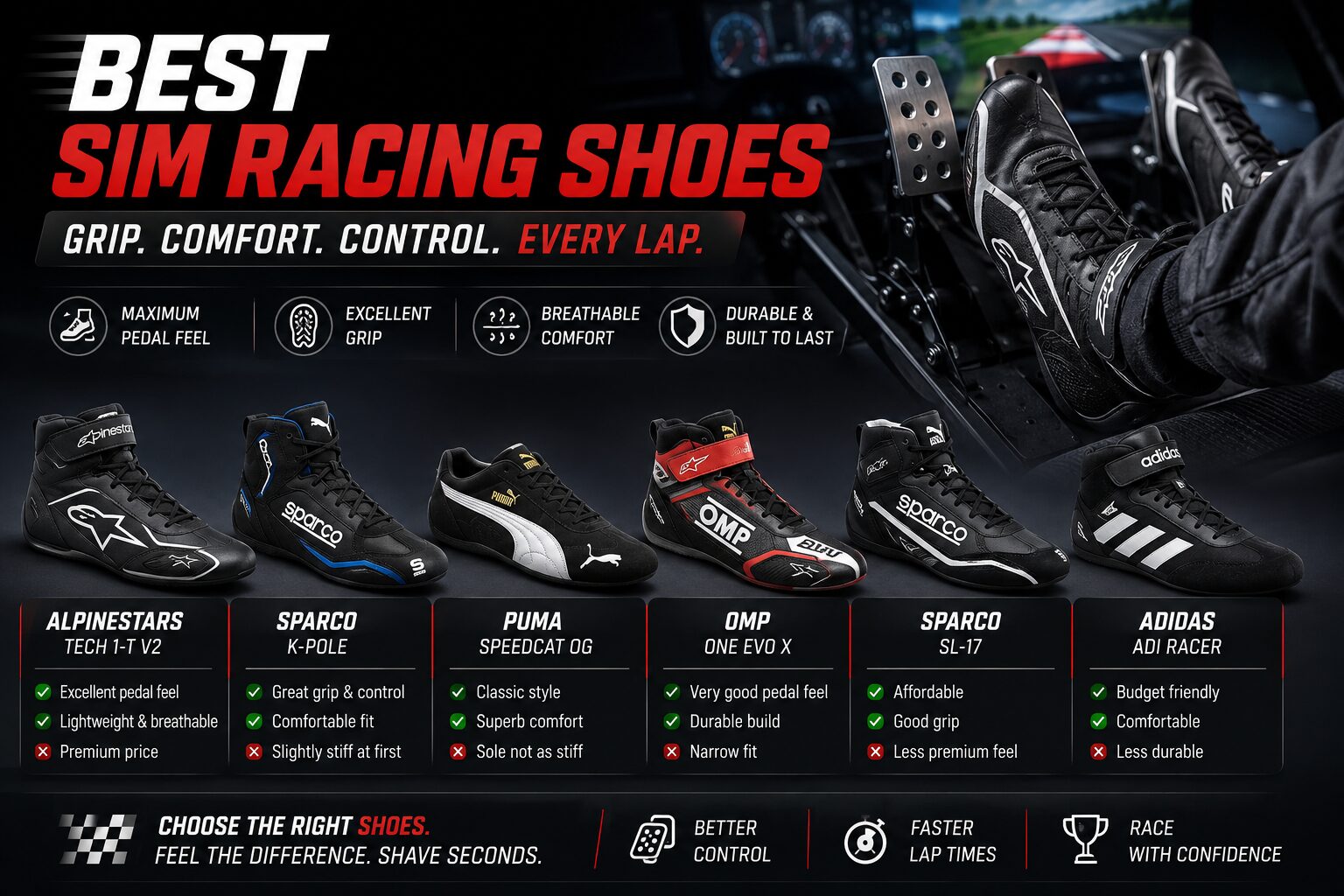
The Sparco K-Run is my best versatile karting and simulator option, while the Sparco S-Pole is the best casual shoe for racers who want something that can be worn away from the cockpit. The PUMA Speedcat is another strong lifestyle alternative because of its low-profile motorsport-inspired shape.
Sim Hound and Abruzzi also produce footwear aimed directly at simulator and karting users. Their products are especially interesting for drivers who prefer specialist sim-racing brands, distinctive designs, or customized boots.
In this guide, I explain which sim racing shoes work best with load-cell brakes, hydraulic pedals, hanging pedals, floor-mounted pedals, Formula cockpits, GT cockpits, and entry-level pedal sets. I also compare racing shoes with socks, bare feet, water shoes, wrestling shoes, karting boots, and ordinary trainers.
Quick Answer: What Are the Best Sim Racing Shoes?

Sparco Skid Racing Shoes 001275
Sole material is Rubber, Shaft height is Ankle, Outer material is Leather, & Closure type is Lace-Up
Check Price on Amazon.com
Alpinestars TECH-1 K START V2 SHOES
Ultra-lightweight performance, comfort and abrasion resistance.
Check Price on Amazon.com
Sparco Unisex Sparco Kart Shoes K
Made of durable and durable materials. Multicolor design.
Check Price on Amazon.com
SPARCO SPA Shoe S-Pole
Outer material is Rubber, and Inner material is Microfibre.
Check Price on Amazon.com
Puma Men's Speedcat Sneakers
Sole material is Rubber, Outer material is Suede, Inner material is Rubber
Check Price on Amazon.com
STRASSE Sim Racing Shoes
Lightweight & Thin Sole for Maximum Pedal Control. Comfortable for All Racing Games & Sim Platforms
Check Price on Amazon.comThe Sparco Hyperdrive is my best overall sim racing shoe. Its lightweight sock-style upper, shaped ankle, breathable construction, and racing-oriented sole provide an excellent balance of pedal feedback and indoor comfort.
- Best overall: Sparco Hyperdrive
- Best premium performance shoe: Alpinestars Tech-1 K V2
- Best karting and sim racing crossover: Sparco K-Run
- Best casual racing-style shoe: Sparco S-Pole
- Best lifestyle alternative: PUMA Speedcat
- Best specialist sim racing option: Sim Hound Racing Shoes
- Best customizable option: Abruzzi Racing Boots
- Best budget alternative: Thin wrestling, boxing, or water shoes
- Best free option: Socks, when the pedals are smooth and braking force is moderate
Best Sim Racing Shoes Comparison Table
Disclosure: This post contains affiliate links. If you click through and make a purchase, we may earn a small commission at no extra cost to you.
Sparco Skid Racing Shoes 001275
Sole material is Rubber, Shaft height is Ankle, Outer material is Leather, & Closure type is Lace-Up
Check Price on Amazon.com
Alpinestars TECH-1 K START V2 SHOES
Ultra-lightweight performance, comfort and abrasion resistance.
Check Price on Amazon.com
Sparco Unisex Sparco Kart Shoes K
Made of durable and durable materials. Multicolor design.
Check Price on Amazon.com
SPARCO SPA Shoe S-Pole
Outer material is Rubber, and Inner material is Microfibre.
Check Price on Amazon.com
Puma Men's Speedcat Sneakers
Sole material is Rubber, Outer material is Suede, Inner material is Rubber
Check Price on Amazon.com
STRASSE Sim Racing Shoes
Lightweight & Thin Sole for Maximum Pedal Control. Comfortable for All Racing Games & Sim Platforms
Check Price on Amazon.com| Shoe | Sole Feel | Breathability | Heel Support | Walking Comfort | Best For | My Score |
|---|---|---|---|---|---|---|
| Sparco Hyperdrive | Excellent | Excellent | Good | Moderate | Best overall sim racing | 4.9/5 |
| Alpinestars Tech-1 K V2 | Excellent | Excellent | Excellent | Moderate | Premium pedal performance | 4.8/5 |
| Sparco K-Run | Very good | Excellent | Very good | Good | Karting and sim racing crossover | 4.7/5 |
| Sparco S-Pole | Very good | Very good | Good | Very good | Casual use and sim racing | 4.5/5 |
| PUMA Speedcat | Very good | Moderate | Good | Very good | Lifestyle driving shoe | 4.4/5 |
| Sim Hound Racing Shoes | Very good | Very good | Good | Moderate | Sim-specific specialist option | 4.5/5 |
| Abruzzi Racing Boots | Very good | Good | Very good | Moderate | Custom designs and karting crossover | 4.5/5 |
| Thin wrestling or water shoes | Good | Very good | Moderate | Moderate | Budget setups | 4.1/5 |
Why Wear Shoes for Sim Racing?
Featured snippet answer: Sim racing shoes provide a thin, consistent surface between the foot and pedal. They improve pedal feedback, protect the feet, stabilize the heel, distribute load-cell brake pressure, and make heel-and-toe movement easier than thick running shoes.
Better Pedal Feedback
A thick running-shoe sole contains foam designed to compress under impact. That cushioning is useful when running but less useful when controlling a simulator pedal.
When I begin pressing the brake, part of my foot movement first compresses the shoe. Only after the foam compresses does the force transfer fully to the pedal.
A thinner and firmer racing-style sole reduces this delay. I can feel the pedal face, resistance curve, elastomer compression, hydraulic movement, and mechanical stop more clearly.
More Consistent Braking
Load-cell pedals measure applied force rather than pedal travel alone.
Consistency depends on repeating the same pressure. A stable sole distributes that pressure across the forefoot and reduces the amount of unpredictable cushioning between the foot and pedal.
This does not automatically make the driver faster. It makes the physical input easier to repeat, which can support better braking consistency with practice.
Protection From Firm Pedal Faces
High-end pedals often use metal faces with slots, holes, raised edges, or aggressive grip tape.
Those surfaces may become uncomfortable through socks, especially when the brake is configured firmly.
A proper shoe spreads the force across a larger area and protects the skin from sharp edges or repeated rubbing.
Heel Stability
The heel acts as a pivot during throttle and brake operation.
A rounded racing heel allows the foot to rotate smoothly instead of catching on the pedal plate or cockpit floor. The shoe also protects the heel from friction during long sessions.
Improved Heel-and-Toe Movement
Heel-and-toe downshifting requires the driver to brake while rotating or rolling the right foot toward the throttle.
A narrow forefoot reduces the risk of contacting the wrong pedal. A flexible ankle and rounded heel make the movement smoother.
Cleaner Pedals
Dedicated indoor shoes prevent outdoor dirt, small stones, water, and oil from reaching the pedal tray.
This is important around exposed pedal mechanisms, sensors, elastomers, and polished metal surfaces.
Consistent Routine
Using the same shoes for every serious session removes one variable from the setup.
A driver may brake differently in thick trainers, thin socks, or bare feet because each option changes leverage, sensation, and effective foot position.
How I Evaluated the Best Sim Racing Shoes
A sim racing shoe does not need fire resistance, weather protection, or impact protection. Those features are necessary in real motorsport but add cost, weight, and heat indoors.
I focused on characteristics that affect pedal use directly.
Evaluation Criteria
- Sole thickness: How clearly the pedal can be felt through the shoe.
- Sole stiffness: Whether the shoe distributes brake pressure without becoming inflexible.
- Heel shape: How smoothly the foot pivots on the cockpit heel plate.
- Forefoot width: Whether the shoe fits between closely spaced pedals.
- Ankle freedom: Ability to dorsiflex, rotate, and roll the foot naturally.
- Upper support: Whether the foot moves inside the shoe during hard braking.
- Breathability: Comfort during long indoor sessions.
- Fastening: Laces, straps, elastic cuffs, or sock-style construction.
- Durability: Wear at the heel, toe, sole edge, and pedal contact area.
- Walking comfort: Whether the shoe can be worn around the room or at an event.
- Value: Performance compared with the total purchase price.
Scoring Method
| Category | Weight |
|---|---|
| Pedal feel and sole control | 25% |
| Comfort and fit | 20% |
| Heel and ankle movement | 15% |
| Brake-force distribution | 15% |
| Breathability | 10% |
| Durability | 10% |
| Value | 5% |
Fit remains personal. A highly rated shoe will not perform properly when it is too wide, too narrow, too long, or incorrectly shaped for the driver’s foot.
1. Sparco Hyperdrive – Best Sim Racing Shoes Overall
Sparco Skid Racing Shoes 001275
Sole material is Rubber, Shaft height is Ankle, Outer material is Leather, & Closure type is Lace-Up
Check Price on Amazon.comMy Rating: 4.9/5
Best for: General sim racing, load-cell pedals, and warm rooms
Upper: Knitted sock-style construction
Ankle: Shaped for movement
Sizes: Commonly offered in EU sizes 38–46
The Sparco Hyperdrive is my best overall choice because it is designed specifically around gaming and simulator use.
Sparco uses a knitted sock upper with differentiated structures intended to support the foot while remaining ultra-breathable, enveloping, and lightweight. The ankle is shaped to allow movement, and the lower section uses a racing-oriented sole.
Pedal Feedback
The thin sole provides substantially more feedback than a normal running shoe.
I can feel where the foot sits on the pedal and detect the transition from free pedal movement to the firmer section of the brake.
This is especially helpful with elastomer-based load-cell pedals. The driver can feel the initial movement, elastomer compression, and final resistance rather than experiencing the pedal only as a general pressure under a thick trainer.
Sock-Style Upper
The knitted upper wraps around the foot instead of relying on a heavily structured outer shell.
This reduces weight and heat. It also allows the shoe to flex naturally while moving between throttle and brake.
The disadvantage is reduced protection and support compared with a karting boot. Drivers who press very heavy brakes may prefer a more structured upper.
Breathability
Breathability is one of the Hyperdrive’s biggest advantages.
A simulator room has limited airflow around the feet, particularly in a closed Formula cockpit. Thick synthetic boots can become uncomfortable quickly.
The knitted upper allows more ventilation and makes the shoe practical for long endurance sessions.
Heel Movement
The shaped ankle reduces interference while the foot pivots.
This is useful for both conventional pedal operation and heel-and-toe technique. A stiff high-top collar can press against the ankle when the foot rotates toward the throttle.
Fit and Width
The Hyperdrive has a close, racing-oriented fit.
This benefits drivers with closely spaced pedals because the outer edge of the shoe is less likely to contact the clutch or throttle accidentally.
Drivers with wide feet should study the size chart and retailer return policy carefully. A narrow shoe that compresses the toes will become painful during long sessions.
Walking
The Hyperdrive is designed primarily for simulator use rather than all-day walking.
The thin sole provides limited cushioning on hard floors. I would wear it around the racing room or at a simulator event, but I would not choose it for long walks.
Durability
The lightweight design naturally sacrifices some abrasion resistance.
I would reserve the shoe for indoor use. Wearing it outdoors exposes the thin sole and knitted upper to rough pavement, water, and dirt.
Pros
- Designed specifically for sim racing
- Excellent pedal feedback
- Very light construction
- Highly breathable knitted upper
- Close fit around the forefoot
- Good ankle freedom
- Comfortable for long indoor sessions
- Works well with load-cell pedals
- Distinctive motorsport styling
Cons
- Less structured than a karting boot
- Limited cushioning for walking
- Close fit may not suit wide feet
- Light upper offers limited protection
- Best reserved for indoor use
- Availability may vary by size and color
Who Should Buy Them?
I recommend the Hyperdrive to most sim racers who want a dedicated indoor shoe with strong pedal feedback and excellent ventilation.
Who Should Avoid Them?
I would choose a structured karting shoe if maximum heel support, a firmer upper, or real kart use is required.
My Best Overall Sim Racing Shoes
The Hyperdrive provides the most useful balance of pedal feel, breathability, low weight, and ankle movement.
Check Sparco Hyperdrive Price
2. Alpinestars Tech-1 K V2 – Best Premium Performance Shoe
Alpinestars TECH-1 K START V2 SHOES - BLACK/WHITE - 9.5
ultra-lightweight performance, comfort and abrasion resistance.
Check Price on Amazon.com
Alpinestars TECH-1 K V2 SHOES - BLACK/WHITE - 8
light weight, excellent breathability and superior feel
Check Price on Amazon.com
Alpinestars TECH-1 K START V2 SHOES - ASPH BLK ONG FL - 8.5
soft inner lining for high levels of comfort and breathability
Check Price on Amazon.comMy Rating: 4.8/5
Best for: Firm load-cell pedals, karting crossover, and premium cockpit use
Construction: Ultra-lightweight karting shoe
Footbed: Ergonomic
Ventilation: Optimized for airflow
The Alpinestars Tech-1 K V2 is a real karting shoe that also works extremely well in a simulator.
Alpinestars describes it as ultra-lightweight and optimized for airflow and breathability. Its contoured shape is designed to follow the foot more closely, while the ergonomic footbed supports a natural posture, flexibility, and free movement.
Structured Support
The Tech-1 K V2 provides more structure than the Sparco Hyperdrive.
This helps stabilize the foot when pressing a firm brake. The shoe distributes pressure across the sole and reduces local discomfort under the ball of the foot.
The additional structure is useful for drivers who use high braking forces or long pedals that require the foot to remain aligned carefully.
Pedal Feel
The karting sole remains thin enough to communicate pedal movement clearly.
It feels firmer than a sock-style simulator shoe, creating a more defined platform under the forefoot.
I prefer this type of sole when using a stiff load-cell or hydraulic brake. The shoe supports the foot rather than folding around the pedal edge.
Heel and Ankle Control
The contoured design helps keep the heel positioned while allowing enough ankle movement for throttle modulation.
This balance is important. A loose heel causes the foot to move inside the shoe, while a rigid ankle reduces precise pedal control.
Breathability
Alpinestars specifically emphasizes airflow and breathability.
It remains warmer than the knitted Hyperdrive because the karting shoe has a more protective and structured construction.
Real Karting Use
The Tech-1 K V2 offers more crossover value because it is designed as karting footwear.
A driver who participates in both karting and sim racing may justify the higher cost more easily than someone who never leaves the home cockpit.
Any required competition approval should be checked for the specific championship. Product suitability for simulator use does not automatically confirm compliance with every karting regulation.
Pros
- Excellent pedal feedback
- Stronger foot support than sock-style shoes
- Ultra-lightweight karting construction
- High airflow and breathability
- Ergonomic footbed
- Contoured performance fit
- Good load-cell brake support
- Suitable for sim racing and karting
- High-quality performance design
Cons
- More expensive than sim-only shoes
- Warmer than knitted footwear
- More shoe than many casual racers need
- Fit can be narrow
- Long walking sessions may wear the thin sole
Who Should Buy Them?
I recommend the Tech-1 K V2 to serious racers using firm pedals or anyone who needs one shoe for both sim racing and karting.
Who Should Avoid Them?
I would choose the Hyperdrive or a budget alternative when the shoes will only be used occasionally with entry-level pedals.
Check Alpinestars Tech-1 K V2 Price
3. Sparco K-Run – Best Karting and Sim Racing Crossover
Sparco Unisex Sparco Kart Shoes K Pole Size 45
Made of durable and durable materials
Check Price on Amazon.com


My Rating: 4.7/5
Best for: Racers wanting breathable karting-style support
Upper: Ultra-breathable three-dimensional mesh
Reinforcement: Internal lateral insert
Size range: Adult and youth sizes available
The Sparco K-Run is another karting-oriented shoe that translates effectively to simulator pedals.
Sparco lists an ultra-breathable 3D mesh upper, internal lateral reinforcement, and a broad size range extending through adult and youth options.
Mesh Upper
The mesh upper improves ventilation compared with traditional synthetic karting boots.
This makes the K-Run more suitable for home simulator use, where heat management often matters more than weather resistance.
Lateral Reinforcement
The internal lateral reinforcement helps control sideways foot movement.
This is useful while rolling the foot toward the throttle or moving rapidly between the brake and accelerator.
The shoe should stabilize the foot without creating a rigid shell. Excessive lateral stiffness can interfere with heel-and-toe rotation.
Youth Sizing
The available youth sizes make the K-Run particularly interesting for younger sim racers.
Adult shoes are often too wide or long, causing the foot to move inside the shoe and reducing pedal control.
Pedal Suitability
The K-Run is appropriate for load-cell brakes, clutch use, and close pedal spacing.
Its racing shape is narrower and less cushioned than a running trainer.
Pros
- Excellent ventilation
- Structured karting-style support
- Internal lateral reinforcement
- Good pedal feedback
- Adult and youth sizing
- Suitable for load-cell pedals
- Useful sim and karting crossover
Cons
- More expensive than casual footwear
- Less flexible than knitted sim shoes
- Not designed for long-distance walking
- Racing fit may feel narrow
Check Sparco K-Run Price
4. Sparco S-Pole – Best Casual Sim Racing Shoe
My Rating: 4.5/5
Best for: Sim racing events, casual use, and moderate pedal forces
Sole: Karting-style sole
Upper: Breathable fabric and microfiber
Fastening: Double lacing system
The Sparco S-Pole sits between a dedicated racing shoe and a casual sneaker.
Sparco specifies a karting sole, breathable fabric and microfiber upper, double lacing, and an ergonomic insole.
Everyday Versatility
The S-Pole makes more sense than a dedicated boot when I want one pair of shoes for simulator events, travel, and ordinary indoor walking.
It has a low-profile racing shape but looks less specialized than a high-top karting boot.
Karting-Style Sole
The sole remains thinner and more pedal-focused than a conventional running shoe.
It provides adequate feedback for entry-level and moderate load-cell brakes while offering better walking comfort than an ultra-thin simulator sock shoe.
Upper and Lacing
The breathable fabric reduces heat, while microfiber adds support around higher-wear areas.
The double-lacing design allows the shoe to be secured around the foot, although laces must be tied carefully so loose ends cannot reach the pedals.
Compromise Design
The S-Pole is not the absolute best at either walking or pedal feedback.
Its strength is balance. It is more suitable for walking than the Hyperdrive and more pedal-friendly than a normal casual trainer.
Pros
- Good balance of driving and walking comfort
- Karting-style sole
- Breathable upper
- Microfiber reinforcement
- Ergonomic insole
- Less specialized appearance
- Suitable for simulator events
Cons
- Less pedal feel than thinner shoes
- Less support than a karting boot
- Laces must be secured carefully
- Not the best choice for extremely stiff brakes
Check Sparco S-Pole Price
5. PUMA Speedcat – Best Lifestyle Driving Shoe

PUMA Womens Speedcat Og Lace Up Sneakers Shoes Casual
Fabric type is 100% Suede
Check Price on Amazon.com
My Rating: 4.4/5
Best for: Casual racers wanting a low-profile shoe that works outside the cockpit
Shape: Slim, low-profile motorsport-inspired design
Upper: Commonly suede or leather depending on version
The PUMA Speedcat is a motorsport-inspired lifestyle shoe rather than a dedicated simulator product.
PUMA describes the Speedcat as originating from a slim driving shoe and developing into a streetwear model. Current versions retain the low-profile shape and motorsport identity, with materials varying between suede and leather editions.
Low-Profile Shape
The narrow forefoot and rounded heel make the Speedcat better for pedals than a thick running shoe.
It is easier to position accurately on narrow throttle and brake faces, and the heel can pivot without catching as easily.
Sole Feedback
The sole is relatively thin for a casual sneaker.
It does not provide the same direct sensation as the Hyperdrive or Tech-1 K V2, but it is adequate for moderate load-cell settings and entry-level pedals.
Walking Comfort
The Speedcat is the best option in this guide for someone who wants to leave the cockpit and continue wearing the same shoes.
It remains a low-profile shoe, so it provides less cushioning than a running trainer. However, it is more practical for general use than a dedicated karting boot.
Suede Care
Many Speedcat versions use suede.
I would reserve a clean pair for indoor use or protect the pedals from dirt. Suede also requires appropriate cleaning and should not be saturated unnecessarily.
Availability
The Speedcat remains an active PUMA collection with multiple current variations and regional releases.
Pros
- Slim motorsport-inspired shape
- Rounded heel
- Better pedal feel than running shoes
- Comfortable for casual use
- Widely recognizable styling
- Many versions and colors
- Can be worn outside the simulator
Cons
- Not purpose-built for sim racing
- Less pedal feedback than dedicated shoes
- Suede versions need careful cleaning
- May be too narrow for wide feet
- Provides less support than karting boots
Check PUMA Speedcat Price
6. Sim Hound Racing Shoes – Best Specialist Sim Racing Alternative
My Rating: 4.5/5
Best for: Racers wanting footwear from a sim-focused specialist
Sim Hound maintains a dedicated sim racing footwear range that includes racing shoes, boots, and pedal-oriented socks.
The brand’s main appeal is specialization. Instead of adapting an outdoor running or motorsport product, the footwear category is built around home simulator use.
Simulator-Focused Design
Sim-specific footwear generally prioritizes:
- Thin soles
- Low weight
- Indoor breathability
- Heel movement
- Pedal feedback
- Minimal unnecessary protection
This makes specialist sim footwear a sensible alternative to karting shoes for drivers who never need real-world track protection.
Product Selection
Because model names, stock, and generations can change, I would confirm the exact current design, size chart, upper material, sole construction, and return policy before ordering.
This is particularly important for international buyers because footwear exchanges can be expensive.
Pros
- Focused specifically on sim racing
- Thin and pedal-oriented designs
- Generally lighter than karting boots
- Specialist sim-racing brand
- Footwear and pedal-sock options
Cons
- Availability can vary
- International returns may be inconvenient
- Less useful outside the cockpit
- Exact features depend on the selected model
Check Sim Hound Racing Shoes
7. Abruzzi Racing Boots – Best Customizable Sim and Karting Option
My Rating: 4.5/5
Best for: Custom designs, teams, content creators, and karting crossover
Abruzzi specializes in sim racing and karting apparel and currently offers a build-your-own boot service alongside its broader racing range.
Customization
Customization is the main reason to consider Abruzzi.
A driver, esports team, streamer, or racing community may want footwear that matches gloves, cockpit branding, team colors, or sponsor graphics.
Sim and Kart Use
A boot designed for both sim racing and karting usually provides more structure than a thin sock-style shoe.
That added support works well with high brake forces but may feel warmer during long indoor races.
Ordering Considerations
Custom products require careful measurement.
I would confirm:
- Exact foot length
- Width and volume
- Size conversion
- Production time
- Return restrictions
- Design approval process
- Whether the selected boot carries any real-world competition certification
A customized appearance does not automatically make a boot approved for real motorsport. Required certification should be confirmed separately for the exact product and event.
Pros
- Custom design potential
- Strong team and creator appeal
- Built around sim and kart users
- Structured pedal support
- Distinctive appearance
Cons
- Custom orders may take longer
- Potentially more expensive
- Returns may be restricted
- Warmer than minimal sim shoes
- Certification must be checked separately
Build Abruzzi Racing Boots
8. Best Budget Alternatives to Sim Racing Shoes
A dedicated shoe is not necessary for every driver.
Several inexpensive types of footwear can work well when selected carefully.
Wrestling Shoes
Wrestling shoes use a thin sole, flexible ankle, and close fit.
They can provide excellent pedal feel, although the tread may be more aggressive than necessary and high ankle coverage can retain heat.
Boxing Shoes
Boxing shoes are light and flexible, but many extend high above the ankle.
This provides support while standing but may restrict ankle movement in a seated cockpit.
Water Shoes
Thin water shoes are inexpensive, light, and breathable.
They offer strong pedal sensation but limited support. The flexible sole can fold around narrow pedal edges under heavy braking.
Indoor Football Shoes
Some indoor football shoes have relatively flat soles and narrow uppers.
They provide more structure than water shoes but may use a tread pattern that catches on carpet or pedal plates.
Minimalist Shoes
Minimalist shoes offer thin, flexible soles and wide toe boxes.
The wide forefoot can become a disadvantage with closely spaced pedals, so pedal clearance should be checked.
Flat Casual Sneakers
Canvas sneakers with thin rubber soles can work adequately.
They are heavier and wider than racing shoes but usually provide better pedal feel than cushioned running footwear.
Pros
- Lower cost
- Easy local availability
- Many sizing options
- Can be used for other activities
- Useful for testing footwear preferences
Cons
- Not shaped specifically for pedals
- Heel design may catch
- Width may interfere with nearby pedals
- Breathability and support vary
- Some soles are too soft or flexible
Sim Racing Shoes vs Socks vs Bare Feet
Racing in Socks
Socks provide excellent pedal feedback and cost nothing.
They work well with smooth, low-force pedals. However, metal pedal faces, grip tape, and stiff load-cell brakes can create pain or wear holes in the fabric.
Racing Barefoot
Bare feet provide direct sensation but expose the skin to sharp edges, dirt, sweat, and repeated friction.
They are not ideal for heavy brake pressure or aggressive pedal surfaces.
Racing in Shoes
Shoes distribute pressure, protect the feet, and make the contact surface consistent.
The trade-off is slightly reduced sensitivity compared with socks.
| Option | Pedal Feel | Protection | Heavy Brake Suitability | Best Use |
|---|---|---|---|---|
| Bare feet | Excellent | Very low | Poor | Light, smooth pedals |
| Socks | Excellent | Low | Limited | Entry-level pedals |
| Thin sim shoes | Excellent | Good | Very good | Most simulator setups |
| Karting boots | Very good | Excellent | Excellent | Heavy brakes and crossover use |
| Running shoes | Limited | Very good | Moderate | Not recommended for precise pedal feel |
Best Sim Racing Shoes for Load-Cell Pedals
Load-cell pedals measure pressure, making sole stability especially important.
Soft Shoes vs Firm Shoes
A soft shoe compresses under braking. The compression can feel comfortable, but it adds another spring-like layer to the pedal system.
A firm, thin racing sole distributes force more consistently.
Recommended Shoe Type by Brake Force
| Brake Configuration | Recommended Footwear |
|---|---|
| Light entry-level brake | Socks or thin casual shoes |
| Moderate load-cell brake | Sparco Hyperdrive or similar sim shoe |
| Firm load-cell brake | Structured sim or karting shoe |
| Very heavy load-cell brake | Alpinestars Tech-1 K V2 or structured kart boot |
| Hydraulic brake with high force | Firm sole and reinforced upper |
Do Not Over-Calibrate the Brake
A stronger shoe may make heavy braking more comfortable, but it does not mean the brake should always be configured at maximum force.
The appropriate force is one the driver can reach repeatedly without lifting from the seat, locking the knee, or creating pain.
Best Sim Racing Shoes for Heel-and-Toe Driving
Heel-and-toe downshifting requires the right foot to operate the brake and throttle during the same movement.
Important Shoe Characteristics
- Narrow forefoot
- Rounded heel
- Flexible ankle
- Firm sole edge
- Secure heel cup
- Minimal bulky cushioning
Side-of-Foot Technique
Many drivers do not literally use the heel.
They brake with the left side of the forefoot and roll the right side toward the throttle. A narrow racing shoe makes this movement more predictable.
Pedal Spacing
The shoe cannot compensate for poor pedal placement.
The brake and throttle should be positioned so the driver can reach both without excessive ankle rotation. Pedal faces may need lateral, vertical, or angle adjustment.
Choosing Shoes for Different Sim Racing Pedals
Entry-Level Plastic Pedals
Light shoes or socks are usually sufficient.
A heavy karting boot may reduce too much pedal sensation.
Metal Load-Cell Pedals
Use a thin racing shoe with enough sole firmness to distribute pressure.
Hydraulic Pedals
A more structured karting shoe can support the foot during high pressure.
Hanging Pedals
Hanging pedals resemble road-car geometry. A rounded heel and flexible ankle work well.
Floor-Mounted Formula Pedals
Formula layouts often place the feet higher and more horizontally.
Lightweight shoes reduce ankle fatigue, while a secure heel helps maintain position.
Pedals With Grip Tape
A durable sole is essential. Grip tape can damage socks and soft water shoes quickly.
How Should Sim Racing Shoes Fit?
Sim racing shoes should fit closely without compressing the toes.
Correct Fit
- Heel remains secure
- Toes can move slightly
- Forefoot does not slide sideways
- No pressure on the little toe
- Ankle can move freely
- Laces or straps hold the midfoot
- No numbness during long sessions
Too Large
A large shoe moves around the foot, reducing precision and making the effective pedal contact point inconsistent.
Too Small
A small shoe compresses the toes and can create numbness, cramping, or pain under braking.
Wide Feet
Many racing shoes have a narrow performance fit.
Drivers with wide feet should check width feedback, measure both feet, and buy from a retailer with a practical exchange policy.
Wear the Correct Socks
Measure and test shoes using the same type of socks planned for racing.
A thick sock can change the fit significantly in a close racing shoe.
How to Choose the Best Sim Racing Shoes
1. Choose a Thin Sole
The sole should be thin enough to feel the pedal but firm enough to spread brake pressure.
2. Avoid Thick Running Foam
Running-shoe cushioning reduces pedal feedback and changes as it compresses.
3. Check the Heel Shape
A rounded heel supports smooth pivoting and reduces catching on the heel plate.
4. Check Pedal Spacing
A wide shoe may contact two pedals at once.
5. Match the Shoe to Brake Force
Soft, minimal shoes work with light pedals. Firm load-cell brakes benefit from more structure.
6. Prioritize Breathability
Indoor simulators can become hot. Mesh and knitted uppers improve long-session comfort.
7. Secure the Laces
Loose laces can catch on pedal hardware. Tie them securely and tuck away excess length.
8. Consider Indoor-Only Use
Keeping the shoes inside protects the pedals from dirt and extends sole life.
9. Check Return Policies
Racing footwear can fit differently from normal shoes. Easy exchanges are valuable.
10. Do Not Pay for Unneeded Certification
A fire-resistant certified race boot may be unnecessary for home simulation.
Certification becomes relevant only when the exact shoe will also be used in regulated real-world competition.
Sim Racing Shoe Decision Matrix
| Your Priority | Best Choice | Reason |
|---|---|---|
| Best overall | Sparco Hyperdrive | Lightweight, breathable, and purpose-built for simulation |
| Strong load-cell brake | Alpinestars Tech-1 K V2 | Firm support and ergonomic footbed |
| Sim racing and karting | Sparco K-Run | Breathable karting construction and structured support |
| Casual and simulator use | Sparco S-Pole | Karting sole with more everyday comfort |
| Lifestyle design | PUMA Speedcat | Low-profile driving shape that works away from the rig |
| Sim specialist | Sim Hound Racing Shoes | Footwear category focused on simulator users |
| Custom team design | Abruzzi Racing Boots | Customizable appearance and karting crossover |
| Budget | Thin wrestling or water shoes | Low cost and good pedal sensation |
| Entry-level pedals | Socks or thin casual shoes | No need for heavy footwear |
| Heel-and-toe driving | Hyperdrive, Tech-1 K V2, or Speedcat | Narrow shape, thin sole, and rounded heel |
Common Sim Racing Shoe Buying Mistakes
Using Thick Running Shoes
Soft foam reduces pedal feedback and can interfere with closely spaced pedals.
Buying an Extremely Tight Size
Racing fit should be close, not painful.
Ignoring Foot Width
Many motorsport shoes are narrow. Length alone does not determine fit.
Choosing the Thinnest Possible Sole for Heavy Brakes
An extremely soft sole may fold around the pedal edge and create foot pain.
Wearing Outdoor Shoes in the Cockpit
Dirt and stones can damage pedal finishes and mechanisms.
Leaving Laces Loose
Loose laces can become trapped around pedal arms or adjustment hardware.
Assuming Racing Shoes Are Automatically Certified
Gaming, karting, and lifestyle shoes may not meet real motorsport safety requirements.
Buying Only for Appearance
A stylish shoe that fits poorly will reduce control and comfort.
Ignoring Heel-Plate Friction
A sole that grips the floor too strongly can restrict ankle movement.
Using Maximum Brake Force Because Shoes Feel Stronger
Heavy braking should remain repeatable and comfortable rather than becoming a strength exercise.
Frequently Asked Questions About Sim Racing Shoes
What are the best sim racing shoes?
The Sparco Hyperdrive is my best overall choice because it combines a thin racing sole, knitted breathable upper, low weight, and shaped ankle construction designed for simulator use.
Are sim racing shoes worth it?
They are worthwhile for load-cell pedals, long races, metal pedal faces, heel-and-toe driving, and drivers seeking a consistent footwear setup.
Do I need shoes for sim racing?
No. Socks can work well with light, smooth pedals. Shoes become more useful as pedal force and surface aggressiveness increase.
Can I sim race in socks?
Yes. Socks provide excellent feedback but limited protection from metal edges, grip tape, and heavy brake pressure.
Can I sim race barefoot?
Yes with light, smooth pedals, but bare feet are more vulnerable to friction, sharp edges, and discomfort.
Why are racing-shoe soles thin?
A thin sole improves pedal feedback and allows more precise foot placement.
Are running shoes good for sim racing?
They are usable but not ideal. Thick foam and wide soles reduce feedback and may contact neighboring pedals.
Are karting shoes good for sim racing?
Yes. They provide thin soles, rounded heels, close fit, and strong support, although they may be warmer and more expensive than sim-specific shoes.
Are wrestling shoes good for sim racing?
Yes as a budget alternative. They are thin and flexible but may have aggressive tread or excessive ankle coverage.
Are water shoes good for sim racing?
They work with light and moderate pedals but may lack enough sole structure for heavy load-cell brakes.
Are PUMA Speedcats good for sim racing?
Yes. Their slim, low-profile driving shape and relatively thin sole make them better suited to pedals than most running shoes.
What shoes are best for load-cell pedals?
Use thin racing shoes with a firm sole. The Sparco Hyperdrive suits moderate load-cell settings, while the Alpinestars Tech-1 K V2 provides more support for heavier braking.
What shoes are best for hydraulic pedals?
A structured karting shoe with a firm sole and secure heel is generally the best option.
What shoes are best for Formula-style pedals?
Choose lightweight, narrow shoes with ankle flexibility and secure heels.
What shoes are best for heel-and-toe?
A narrow shoe with a thin sole, rounded heel, and flexible ankle works best.
Should sim racing shoes fit tightly?
They should fit closely, but the toes should not be compressed and circulation should remain normal.
Should I size up in racing shoes?
Use the manufacturer’s size chart. Some racing shoes fit narrower than casual trainers, but automatically sizing up can create excess length.
Can wide feet fit racing shoes?
Yes, but model choice matters. Check width information and buy from a retailer that allows exchanges.
Do shoes improve lap times?
Not automatically. They can improve consistency, comfort, and pedal confidence, which may support better performance.
Do thin soles hurt with load-cell brakes?
They can if the sole is too soft or the brake force is too high. A thin but firm sole distributes pressure better.
Can I use real FIA racing boots?
Yes, but they are often more expensive, warmer, and more protective than necessary for home simulation.
Are sim racing shoes fireproof?
Most gaming and simulator shoes are not certified fire-resistant safety equipment.
Can I use karting shoes in a real race car?
Only when the shoe meets the regulations and certification required by the event. Karting approval does not automatically equal automotive racing approval.
Can I walk outside in sim racing shoes?
You can, but thin soles and lightweight uppers may wear quickly. Indoor-only use keeps the pedals clean and extends shoe life.
How do I clean sim racing shoes?
Follow the manufacturer’s care label. Use gentle hand cleaning, mild soap, and air drying where appropriate.
Can I machine wash racing shoes?
Only when explicitly permitted. Machine washing can damage adhesives, structured uppers, and sole bonding.
How do I stop my feet sweating?
Choose knitted or mesh uppers, wear moisture-managing socks, ventilate the room, and allow the shoes to dry completely between sessions.
Should I wear socks with sim racing shoes?
Yes. Thin moisture-managing socks improve hygiene and reduce rubbing.
How long do sim racing shoes last?
Indoor-only shoes can last for years, depending on construction, brake force, heel friction, cleaning, and weekly use.
Why does my heel hurt while sim racing?
Possible causes include a hard heel plate, poor pedal angle, excessive brake force, inadequate shoe cushioning, or an unsupported heel position.
Why does the ball of my foot hurt?
The pedal may be too narrow, the sole too soft, or the brake force too high. Adjust pedal position and consider a firmer sole.
Should my heel stay on the floor?
The heel normally remains supported during throttle use and many braking situations. It may lift slightly under very heavy braking depending on pedal geometry.
Can shoes help prevent pressing two pedals?
A narrow shoe improves clearance, but pedal spacing and alignment should also be adjusted.
What shoes work with Logitech pedals?
Socks, thin casual shoes, water shoes, or any dedicated sim racing shoe are sufficient.
What shoes work with Fanatec CSL pedals?
Thin sim shoes work well. A firmer racing sole becomes more useful when a load-cell brake is installed.
What shoes work with Heusinkveld pedals?
A thin but structured sim or karting shoe is appropriate, especially when using higher brake-force settings.
What shoes work with Simagic P1000 pedals?
Use a thin racing shoe for moderate settings or a structured karting shoe for a firmer load-cell or hydraulic configuration.
Are slippers good for sim racing?
Loose slippers are not recommended because the foot can move inside them and the sole may catch or fold.
Are Crocs good for sim racing?
They are generally too wide, loose, and thick for precise pedal work.
Should I buy high-top or low-top shoes?
Low-top shoes maximize ankle freedom. High-top karting shoes provide more support but may retain heat or restrict movement.
Final Verdict: Which Sim Racing Shoes Should You Buy?
The Sparco Hyperdrive is my best overall sim racing shoe.
It focuses on the characteristics that matter inside a home simulator: low weight, ventilation, close fit, ankle freedom, and direct pedal feedback.
The knitted sock-style upper is more breathable than a conventional racing boot, while the dedicated racing sole is thin enough to feel brake and throttle movement clearly. The shaped ankle also supports natural foot rotation during heel-and-toe downshifts.
I would choose the Alpinestars Tech-1 K V2 when the brake pedal is especially firm or when one shoe must support both sim racing and real karting. Its contoured structure, ergonomic footbed, and airflow-focused design create a more supportive platform under heavy braking.
The Sparco K-Run is another strong crossover option. Its breathable three-dimensional mesh and lateral reinforcement make it suitable for long simulator races while retaining karting-oriented support.
The Sparco S-Pole is the better choice for drivers who want a racing-style shoe that can be worn comfortably at events or around the gaming room.
The PUMA Speedcat is my preferred lifestyle alternative. It does not provide the same pedal precision as a dedicated simulator shoe, but its slim shape, rounded heel, and low-profile sole make it much better than a heavily cushioned running trainer.
Sim Hound Racing Shoes deserve consideration from buyers who want a specialist simulator product, while Abruzzi Racing Boots are particularly appealing for custom team colors, creator branding, and combined sim-and-kart use.
Budget buyers do not need to abandon pedal precision. Thin wrestling shoes, water shoes, minimalist footwear, and flat canvas sneakers can all work, provided the sole is stable, the shoe is not too wide, and the heel moves freely.
Socks remain a completely valid choice for light, smooth pedals. However, once the pedal face becomes sharp or the brake force becomes firm, a suitable shoe improves comfort and distributes pressure more effectively.
My final advice is to choose the shoe based on the pedal system rather than the wheelbase.
A powerful direct-drive wheel does not necessarily require racing shoes. A heavy load-cell or hydraulic brake does.
The best sim racing shoe should create a consistent connection between the foot and pedal. It should allow me to feel the pedal clearly, press firmly without pain, move between controls without interference, and finish a long race without thinking about the footwear.
My Final Recommendations
Best overall: Sparco Hyperdrive
Best premium performance shoe: Alpinestars Tech-1 K V2
Best karting crossover: Sparco K-Run
Best casual racing shoe: Sparco S-Pole
Best lifestyle shoe: PUMA Speedcat
Best specialist sim option: Sim Hound Racing Shoes
Best customizable boot: Abruzzi Racing Boots
Best for firm load-cell pedals: Alpinestars Tech-1 K V2
Best for warm rooms: Sparco Hyperdrive
Best budget alternative: Thin wrestling or water shoes
Best free option: Clean socks with smooth, low-force pedals
Choose the Sparco Hyperdrive
I would choose the Hyperdrive for the strongest overall combination of pedal feel, breathability, low weight, and indoor comfort.
Check Sparco Hyperdrive Price
Choose the Alpinestars Tech-1 K V2
I would choose the Tech-1 K V2 for heavier brake pressure, stronger foot support, and combined simulator and karting use.
Check Alpinestars Tech-1 K V2 Price

Hi, I’m Peter Edwards, a lifelong sim racing enthusiast, tech tinkerer, and automotive geek with a passion for making virtual racing feel as real as possible. I’ve spent years testing steering wheels, pedals, and full cockpit rigs—from entry-level gear to pro-grade setups—to help others build immersive, affordable racing experiences at home.
When I’m not tightening bolts on my rig or tuning force feedback curves, you’ll find me comparing telemetry data, exploring new racing titles, or helping fellow racers fine-tune their setups. My goal is to share honest, experience-based insights that help every driver—from casual weekend racers to aspiring eSports pros—get faster, smoother, and more connected to the track.
I write for SimRacingEnthusiast.com, where I share deep-dive reviews, setup guides, and honest opinions on the latest in the sim racing world.