When I compare sim racing hardware, I don’t start with the biggest torque number. I start with three questions: what platform will it run on, how rigid is the mounting setup, and what will the next upgrade cost? Those decisions affect the ownership experience more than a flashy specification sheet.
Editorial transparency: This is a specification-led buying analysis, not a claim that I personally bench-tested every MOZA and Fanatec product. Hardware facts are checked against manufacturer documentation; handling, comfort, and durability assessments below are reasoned evaluations, not fabricated test results. Prices, firmware features, and compatibility can change. Affiliate links may earn the site a commission at no additional cost to you.
At a glance
Best for a PC-first setup: MOZA R5 or R9 family. Best flexible entry upgrade: Fanatec CSL DD with optional Boost Kit 180. Best for PlayStation: A specifically PlayStation-licensed Fanatec base, such as the Gran Turismo DD Pro or compatible DD+ system. Best overall: Depends on platform, budget, wheel preference, and local support.
MOZA vs Fanatec: Quick Comparison Table
| Category | MOZA Racing | Fanatec |
|---|---|---|
| Core technology | Direct-drive wheel bases | Direct-drive wheel bases |
| Entry example | R5, 5.5 Nm | CSL DD, 5 Nm; 8 Nm with Boost Kit |
| Higher torque choices | R9, R12, R16 and higher families | ClubSport DD/DD+, Podium family |
| PC compatibility | Yes, for supported models and games | Yes, for supported models and games |
| Xbox compatibility | Specific Xbox-licensed wheels/bundles | Specific Xbox-compatible wheels and bases |
| PlayStation compatibility | No official PS4/PS5 support according to MOZA | Selected officially licensed bases |
| Setup software | MOZA Pit House | Fanatec app / driver ecosystem |
| Upgrade consideration | Move to a higher-output base; confirm accessory compatibility | CSL DD 5-to-8 Nm power-supply option; higher base tiers |
| My buying priority | PC value and preferred wheel design | Console requirements and ecosystem fit |
What Is the Main Difference Between MOZA and Fanatec?
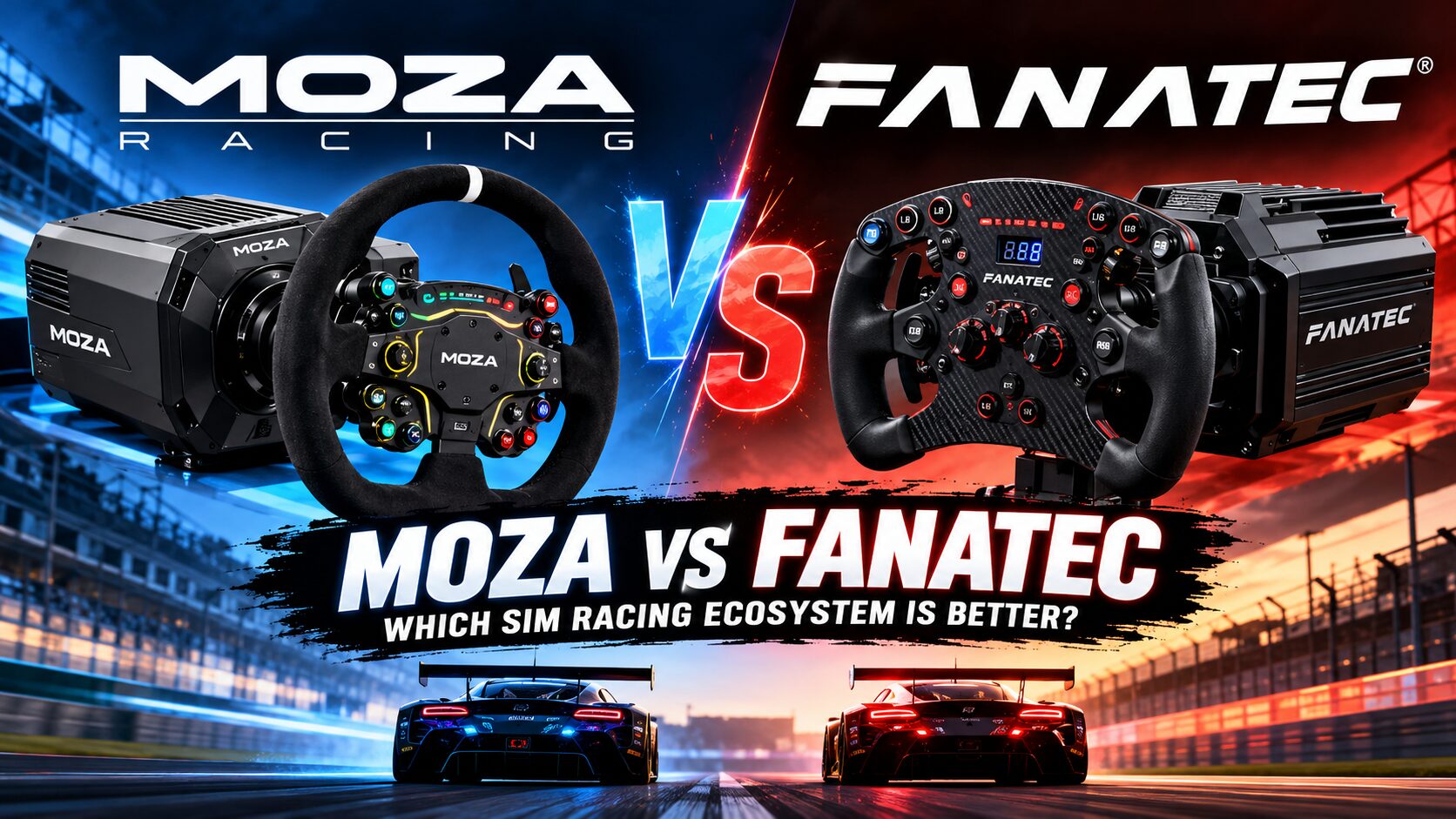
The main difference is ecosystem fit rather than direct-drive technology itself. Both brands sell capable motor-driven steering systems. MOZA is particularly attractive for a PC-centered build. Fanatec has a meaningful advantage when official PlayStation compatibility is non-negotiable. Each brand has proprietary wheel-side connections and model-specific accessory requirements, so switching ecosystems later can be expensive.
For an introduction to what wheelbase torque actually means, read our direct drive vs belt drive guide. If you are assembling your first rig, our sim racing setup guide is a useful next step.
Technical Specifications: Popular Wheelbase Families
| Wheelbase | Advertised torque | Platform notes | Typical buyer |
|---|---|---|---|
| MOZA R5 | 5.5 Nm | PC; not officially PlayStation compatible | Entry direct-drive PC racer |
| MOZA R9 | 9 Nm | PC; check wheel-dependent Xbox support | PC enthusiast seeking more headroom |
| MOZA R12 | 12 Nm | PC; verify exact generation and accessories | Dedicated cockpit owner |
| Fanatec CSL DD | 5 Nm / 8 Nm with Boost Kit 180 | PC; Xbox with compatible licensed wheel; not PlayStation | Starter with incremental upgrade plans |
| Fanatec Gran Turismo DD Pro | 5 Nm / 8 Nm with Boost Kit 180 | PC and PlayStation; Xbox depends on wheel | PlayStation and PC racer |
| Fanatec ClubSport DD | Up to 15 Nm with current software* | PC; Xbox depends on wheel; not PlayStation | Advanced sim racer |
| Fanatec ClubSport DD+ | Up to 18 Nm with current software* | PC and PlayStation; Xbox depends on wheel | Premium multi-platform racer |
*Fanatec documents torque increases released in May 2026, requiring the current Fanatec software. The torque figures above are manufacturer ratings, not directly comparable independent measurements. Confirm the exact SKU, software version, and compatible steering wheel.
Force Feedback Performance: Which Feels Better?
Torque is only one part of force feedback. I evaluate a wheelbase conceptually through steering detail, response to rapid direction changes, clipping resistance, filtering, oscillation control, and consistency during a long session. A 12 Nm motor does not automatically feel twice as realistic as a 6 Nm motor.
Low-speed detail and road texture
In titles such as Assetto Corsa Competizione and iRacing, a useful wheelbase should communicate tire loading and steering transitions without drowning out subtler information. Both brands offer tuning controls. I would spend time matching in-game force feedback and wheelbase output before concluding that one motor is inherently more detailed.
Peak torque, holding torque, and clipping
More torque headroom lets you run stronger sustained steering forces while preserving room for peaks. But motor ratings can use different measurement conventions. If a game repeatedly requests more force than a base can deliver, the signal clips and distinct peaks feel flattened. Correct gain settings matter more than chasing the largest number.
Oscillation, filters, and latency
Excessive damping can hide detail; too little filtering can make the wheel nervous on straights. Wheel mass, steering diameter, game physics, firmware, and force-feedback settings all affect perceived response. Without a controlled side-by-side test, I would not declare a universal winner for latency or smoothness.
Build Quality and Mechanical Design
Both manufacturers offer metal-bodied wheelbases and detachable wheels, but build quality varies by model and price tier. I look for a rigid base mount, minimal unwanted flex in the steering wheel, secure electrical contacts, accessible connectors, and a quick release that locks consistently. A high-quality wheel rim attached to a flexing desk can feel worse than a modest rim on a solid cockpit.
The MOZA R5 bundle combines an aluminum-alloy steering wheel structure with a steel pedal assembly. Fanatec’s wheel and pedal construction depends heavily on whether you choose CSL, ClubSport, or Podium hardware. Avoid treating the cheapest bundle as representative of every product from either brand.
Comfort and Ergonomics
Comfort is about fit, not just padding. A larger round rim suits rallying, drifting, and road-car driving; a compact formula or GT-style rim suits racing where hand placement stays consistent. Consider rim diameter, grip shape, button reach, paddle action, and how easily you can read or reach controls in VR.
At stronger torque levels, a rigid seat and pedal deck become especially important. Start with conservative force-feedback strength, secure the wheelbase properly, and increase force gradually. For cockpit planning, see our sim racing cockpit guide and wheel stand guide.
Pedals: The Upgrade That May Matter More
For consistent braking, I would often prioritize a well-mounted load-cell brake over a jump from a mid-torque base to a much stronger one. Load-cell systems measure force rather than simply pedal travel, making it easier to build repeatable braking pressure once the pedal is properly calibrated.
MOZA’s entry R5 bundle uses SR-P Lite pedals with Hall-effect sensing; these should not be confused with higher-tier load-cell pedal sets. Fanatec offers separate load-cell upgrade routes, but the exact options depend on the pedal model. Check whether a clutch, brake upgrade, mounting hardware, or USB connection is included before comparing bundle prices.
Compatibility: PC, Xbox, PlayStation, and Games
PC
PC is the most flexible platform for mixing devices. You can often connect pedals from one brand and a wheelbase from another using separate USB connections, provided each device supports independent USB operation and the game accepts multiple controllers. Wheel rims and base electronics are a different matter: do not assume cross-brand direct attachment.
Xbox
Both brands have Xbox-capable combinations. MOZA documents its Xbox-licensed R3 bundle and ESX wheel options; Fanatec supports Xbox mode when an appropriately licensed wheel is paired with a compatible base. The wheel and base must be checked as a combination.
PlayStation
Fanatec wins this specific comparison because selected Fanatec bases have official PlayStation compatibility. MOZA states that its current racing hardware does not offer official PS4/PS5 support. Third-party adapters are not equivalent to native manufacturer support.
Game compatibility
Before ordering, check the manufacturer’s current game-support list for iRacing, Assetto Corsa, Assetto Corsa Competizione, Automobilista 2, F1 titles, and whichever rally or trucking simulators you actually play. Support may differ between PC and console editions and can change with updates.
Software and Setup Experience
MOZA Pit House and Fanatec’s software tools provide ways to configure wheelbase behavior, update firmware, and manage supported hardware. My preference is a repeatable setup: install the current stable driver, update firmware as instructed, calibrate the steering and pedals, then save a baseline profile before experimenting.
Do not copy another racer’s force-feedback values blindly. The right settings depend on your wheelbase, rim diameter, cockpit stiffness, game, and physical comfort. A practical starting point is to lower game gain until major steering loads stop clipping, then tune damping and detail filters one at a time.
Durability and Long-Term Ownership
Neither brand should be assigned a universal failure rate without credible warranty-claim data. I would judge long-term ownership by replacement-part availability, regional warranty coverage, firmware maintenance, quick-release wear, and the ease of getting support when a device fails. Direct-drive motors eliminate belt wear, but the wheelbase still contains electronics, bearings, connectors, and other parts that can fail.
Before buying, read the warranty for your country, identify the actual seller responsible for returns, and confirm the support procedure. Keep firmware records and avoid repeatedly plugging connectors while devices are powered unless the manufacturer explicitly permits it.
Upgrade Paths: Buying Once Versus Buying Twice
MOZA upgrade path
Start with an R5 if you want a compact PC-oriented entry system, then consider an R9 or R12 when you have a sturdy cockpit and a clear reason for extra torque. Some steering wheels and accessories carry forward, but compatibility differs by product generation. Check MOZA’s live compatibility matrix before treating any purchase as future-proof.
Fanatec upgrade path
The CSL DD offers a particularly understandable early upgrade: move from 5 Nm to 8 Nm with the official Boost Kit 180, where supported. Beyond that, a higher-tier base is required. The QR2 ecosystem is important when choosing wheels and hubs; verify your existing hardware before planning a conversion.
For a broader buying framework, compare our best direct drive wheel guide and best sim racing pedals guide.
Pros and Cons
MOZA Racing Pros
- Attractive range of PC-focused direct-drive hardware.
- Multiple wheelbase torque tiers and wheel styles.
- Convenient ecosystem software and broad accessory catalog.
- Good fit for racers building a PC-only cockpit.
MOZA Racing Cons
- No official PlayStation support according to the manufacturer.
- Console support depends on specific licensed products.
- Not every wheel and accessory supports every older base generation.
- Moving from R5 to higher torque means replacing the base.
Fanatec Pros
- Official PlayStation options on selected wheelbases.
- CSL DD 5-to-8 Nm upgrade with official power supply.
- Extensive wheel, pedal, and accessory choices.
- Multiple performance tiers for different budgets.
Fanatec Cons
- PlayStation and Xbox support are not universal across all models.
- Compatibility requires careful checking of wheels, hubs, and QR generations.
- Complete bundle pricing can rise with pedals and accessories.
- Higher torque bases demand a stronger mounting setup.
Decision Matrix: Which Brand Fits Your Situation?
| Your situation | My shortlist | Why |
|---|---|---|
| PC beginner on a compact setup | MOZA R5 bundle / Fanatec CSL DD bundle | Compare full kit prices and mounting options |
| Want to add torque without replacing the base | Fanatec CSL DD | Official 5-to-8 Nm upgrade path |
| Dedicated PC cockpit, midrange torque | MOZA R9 / R12 or Fanatec equivalent | Choose wheel preference and full ecosystem cost |
| PlayStation 5 racing | Compatible Fanatec PlayStation base | Official console support |
| Xbox racing | Either, with licensed compatible combination | Compatibility is configuration-specific |
| Already own wheels and pedals | Usually stay with compatible ecosystem | Lower switching costs |
| Strong brake consistency is the priority | Budget for load-cell pedals first | Brake control may offer greater practical benefit |
Expert Scoring Criteria: How to Evaluate a Wheelbase
Rather than publish unsupported numerical ratings, I use the following 100-point evaluation rubric. These are weights, not claimed laboratory scores for either manufacturer.
| Criterion | Weight | What to check |
|---|---|---|
| Force-feedback quality | 25 | Detail, clipping, response, sustained output |
| Compatibility | 20 | Platform, games, accessories |
| Total ownership value | 15 | Bundle, upgrades, shipping, warranty |
| Build and mounting | 15 | Rigidity, quick release, connectors |
| Comfort and controls | 10 | Rim fit, buttons, ergonomics |
| Software and setup | 10 | Calibration, firmware, profiles |
| Support and longevity | 5 | Service availability and parts |
How I Evaluated This Comparison
This article uses a documented comparison method rather than pretending a controlled hands-on test took place. I cross-checked advertised torque and compatibility against manufacturer support pages, separated base compatibility from wheel licensing, and assessed upgrade paths by the parts a buyer would need to replace. I also considered the effects of pedal choice and cockpit rigidity on the overall driving experience.
Recommended hands-on testing methodology
- Mount both bases to the same rigid cockpit with equivalent steering wheel diameters where possible.
- Update firmware and record all driver, game, and force-feedback settings.
- Use the same game version, car, track, conditions, and lap sequence.
- Normalize steering effort to comparable sustained output instead of comparing unmatched percentage sliders.
- Run repeated laps and record clipping, center feel, kerb feedback, oscillation, heat behavior, and any connection failures.
- Test button reach, quick-release play, pedal braking repeatability, and setup time.
- Document observations and separate subjective impressions from instrumented measurements.
Testing status: No controlled A/B driving data, measured latency, thermal logs, or long-term failure statistics are claimed in this article. Add genuine first-person test notes only after completing and documenting the process above.
Who Should Buy MOZA?
I would put MOZA high on the shortlist for a PC-only racer who likes its wheel designs, wants an R5-to-R12-class range of options, and can purchase through a seller with dependable local support. It is especially worth comparing when you are building a fresh rig without existing brand-specific wheels.
Who Should Avoid MOZA?
A PlayStation player who wants native, officially supported compatibility should look elsewhere. I would also avoid buying a MOZA wheel or accessory without checking the exact base generation and supported connection method.
Who Should Buy Fanatec?
I would lean toward Fanatec for a racer who needs an officially compatible PlayStation base, already owns compatible Fanatec hardware, or specifically wants the CSL DD 5-to-8 Nm upgrade route. Its broader tiers also make sense for buyers willing to invest in a long-term ecosystem.
Who Should Avoid Fanatec?
Do not buy a Fanatec base solely because the brand has PlayStation products: the CSL DD itself is not a PlayStation-compatible base. I would also reconsider a premium bundle if it leaves no budget for a rigid mount and suitable pedals.
Compare MOZA Direct-Drive Options
Check the R5, R9, and R12 models, then compare the total price with your preferred wheel and pedals. Confirm platform support before ordering.
Merchant link; replace with an approved affiliate tracking URL if applicable.
Best Alternatives to MOZA and Fanatec
Simagic: Consider its direct-drive wheelbases if you want to compare another PC-focused ecosystem and compatible wheel options. Thrustmaster: Worth considering if you already own its accessories or want to compare supported console setups. Logitech: An alternative for buyers prioritizing a simpler complete system with model-specific console support. Compare current products, not just brand reputations.
Frequently Asked Questions
Is MOZA better than Fanatec?
Neither is universally better. MOZA is an appealing PC-first option, while Fanatec offers selected officially PlayStation-compatible wheelbases and an incremental CSL DD power upgrade. Compare the exact bundles you can buy.
Is MOZA R5 better than Fanatec CSL DD?
The MOZA R5 advertises 5.5 Nm; the Fanatec CSL DD offers 5 Nm or 8 Nm with its official Boost Kit. Torque alone does not settle the comparison. Consider pedals, wheel design, full bundle cost, and your intended platform.
Can MOZA work on PS5?
MOZA says its racing products do not currently have official PS4 or PS5 support. Choose officially licensed PlayStation hardware if that is your primary platform.
Can Fanatec work on Xbox?
Yes, certain Fanatec base-and-wheel combinations support Xbox. A compatible licensed wheel is required, and not every Fanatec product supports every console.
Can I use Fanatec pedals with a MOZA wheelbase?
On PC, many independently USB-connected pedals can be used alongside a different brand’s wheelbase. On consoles, cross-brand setups are much more restricted. Check the exact pedal connection and game support.
Is 5 Nm enough for sim racing?
For many beginners, yes. A properly configured 5 Nm direct-drive base on a stable mount can deliver meaningful steering feedback. Higher torque offers more headroom but is not essential for every driver.
Do I need a sim racing cockpit for 12 Nm?
A rigid cockpit is strongly recommended for higher-output wheelbases. Check the manufacturer’s mounting requirements and ensure the seat, wheel deck, and pedals can handle the forces safely.
Which brand has better durability?
There is not enough consistent, independently verified failure-rate data to name a universal winner. Compare warranties, regional service, replacement parts, and model-specific owner reports.
Which ecosystem is easier to upgrade?
Fanatec has a straightforward 5-to-8 Nm CSL DD upgrade using its official power supply. MOZA offers higher-torque base replacements and many compatible accessories, but buyers must check generation-specific support.
Should I upgrade pedals or wheelbase first?
If you already have a competent direct-drive base but basic travel-based pedals, a properly mounted load-cell brake may be the more useful upgrade for consistent braking.
Final Verdict: MOZA or Fanatec?
If I were starting a PC-only sim racing setup today, I would price a MOZA R5 or R9 system against an equivalently equipped Fanatec CSL DD package and put the saved money toward better pedals and a stronger mount. If I needed PlayStation compatibility, I would narrow the list immediately to the officially supported Fanatec options. And if I already owned a set of compatible wheels, I would calculate the cost of staying in that ecosystem before switching.
The smartest purchase is not necessarily the strongest motor. It is the complete setup that works with your games, fits your cockpit, feels comfortable, and leaves you a sensible upgrade path.
Compare Fanatec Bundles and Compatibility
Check the CSL DD, Gran Turismo DD Pro, and ClubSport ranges. Verify console support and included accessories on the exact product page.
Merchant link; replace with an approved affiliate tracking URL if applicable.

Hi, I’m Peter Edwards, a lifelong sim racing enthusiast, tech tinkerer, and automotive geek with a passion for making virtual racing feel as real as possible. I’ve spent years testing steering wheels, pedals, and full cockpit rigs—from entry-level gear to pro-grade setups—to help others build immersive, affordable racing experiences at home.
When I’m not tightening bolts on my rig or tuning force feedback curves, you’ll find me comparing telemetry data, exploring new racing titles, or helping fellow racers fine-tune their setups. My goal is to share honest, experience-based insights that help every driver—from casual weekend racers to aspiring eSports pros—get faster, smoother, and more connected to the track.
I write for SimRacingEnthusiast.com, where I share deep-dive reviews, setup guides, and honest opinions on the latest in the sim racing world.